Nexo Mette Andersen, Watt Torquil, Bonnema Steen Joop, Hegedüs Laszlo, Rasmussen Åse Krogh, Feldt-Rasmussen Ulla, Bjorner Jakob Bue
The National Research Centre for the Working Environment, Lersø Parkallé 105, 2100, Copenhagen, Denmark,
Qual Life Res. 2015 Jul;24(7):1615-27. doi: 10.1007/s11136-014-0896-0. Epub 2014 Dec 19.
We aimed to identify the best approach to work ability assessment in patients with thyroid disease by evaluating the factor structure, measurement equivalence, known-groups validity, and predictive validity of a broad set of work ability items.
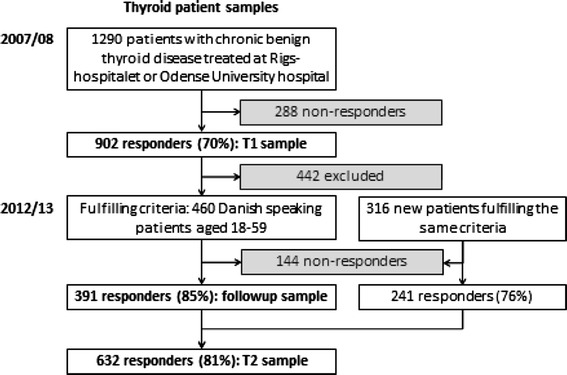
Based on the literature and interviews with thyroid patients, 24 work ability items were selected from previous questionnaires, revised, or developed anew. Items were tested among 632 patients with thyroid disease (non-toxic goiter, toxic nodular goiter, Graves' disease (with or without orbitopathy), autoimmune hypothyroidism, and other thyroid diseases), 391 of which had participated in a study 5 years previously. Responses to select items were compared to general population data. We used confirmatory factor analyses for categorical data, logistic regression analyses and tests of differential item function, and head-to-head comparisons of relative validity in distinguishing known groups.
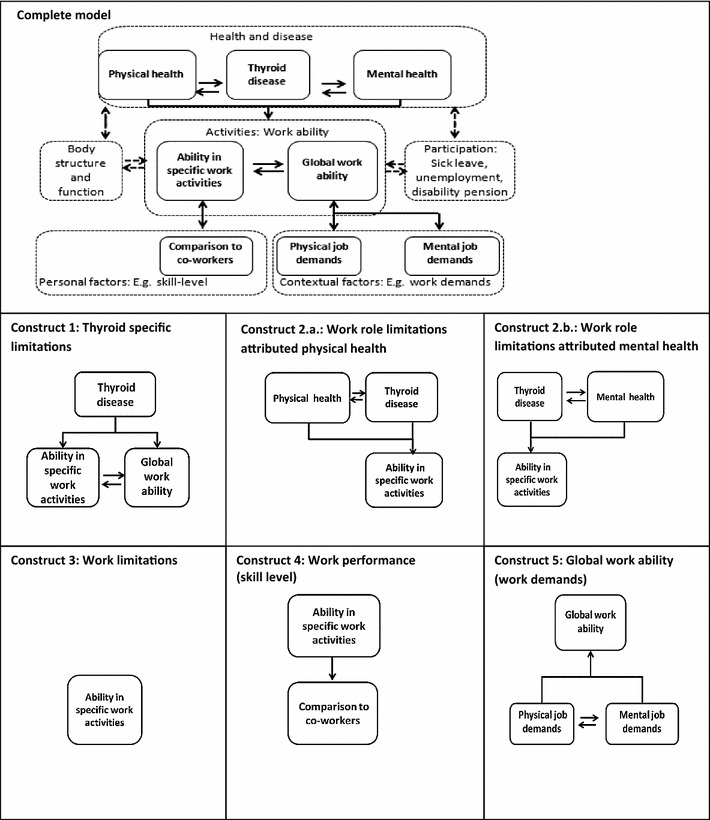
Although all work ability items loaded on a common factor, the optimal factor solution included five factors: role physical, role emotional, thyroid-specific limitations, work limitations (without disease attribution), and work performance. The scale on thyroid-specific limitations showed the most power in distinguishing clinical groups and time since diagnosis. A global single item proved useful for comparisons with the general population, and a thyroid-specific item predicted labor market exclusion within the next 5 years (OR 5.0, 95 % CI 2.7-9.1).
Items on work limitations with attribution to thyroid disease were most effective in detecting impact on work ability and showed good predictive validity. Generic work ability items remain useful for general population comparisons.
我们旨在通过评估一系列广泛的工作能力项目的因子结构、测量等效性、已知群组效度和预测效度,确定甲状腺疾病患者工作能力评估的最佳方法。
基于文献以及对甲状腺疾病患者的访谈,从先前的问卷中选取、修订或重新制定了24个工作能力项目。在632例甲状腺疾病患者(非毒性甲状腺肿、毒性结节性甲状腺肿、格雷夫斯病(伴或不伴眼眶病)、自身免疫性甲状腺功能减退症及其他甲状腺疾病)中对这些项目进行测试,其中391例患者曾在5年前参与过一项研究。将部分项目的回答与一般人群数据进行比较。我们对分类数据进行验证性因子分析、逻辑回归分析和差异项目功能测试,并对区分已知群组的相对效度进行直接比较。
尽管所有工作能力项目均负荷于一个共同因子,但最佳因子解决方案包括五个因子:身体角色、情感角色、甲状腺特异性限制、工作限制(无疾病归因)和工作表现。甲状腺特异性限制量表在区分临床群组和诊断后的时间方面显示出最强的能力。一个总体单项指标被证明有助于与一般人群进行比较,一个甲状腺特异性项目预测未来5年内劳动力市场排斥情况(比值比5.0,95%置信区间2.7 - 9.1)。
归因于甲状腺疾病的工作限制项目在检测对工作能力的影响方面最有效,且显示出良好的预测效度。通用的工作能力项目对于与一般人群进行比较仍然有用。