Araujo Ricardo Vieira, Albertini Marcos Roberto, Costa-da-Silva André Luis, Suesdek Lincoln, Franceschi Nathália Cristina Soares, Bastos Nancy Marçal, Katz Gizelda, Cardoso Vivian Ailt, Castro Bronislawa Ciotek, Capurro Margareth Lara, Allegro Vera Lúcia Anacleto Cardoso
Ministério da Ciência, Tecnologia & Inovação, Secretaria de Políticas e Programas de Pesquisa e Desenvolvimento, Brasília, DF, Brazil.
Gerência de Vigilância de Saúde Ambiental Coordenação de Vigilância em Saúde SMS/PMSP, São Paulo, SP, Brazil.
Braz J Infect Dis. 2015 Mar-Apr;19(2):146-55. doi: 10.1016/j.bjid.2014.10.004. Epub 2014 Dec 15.
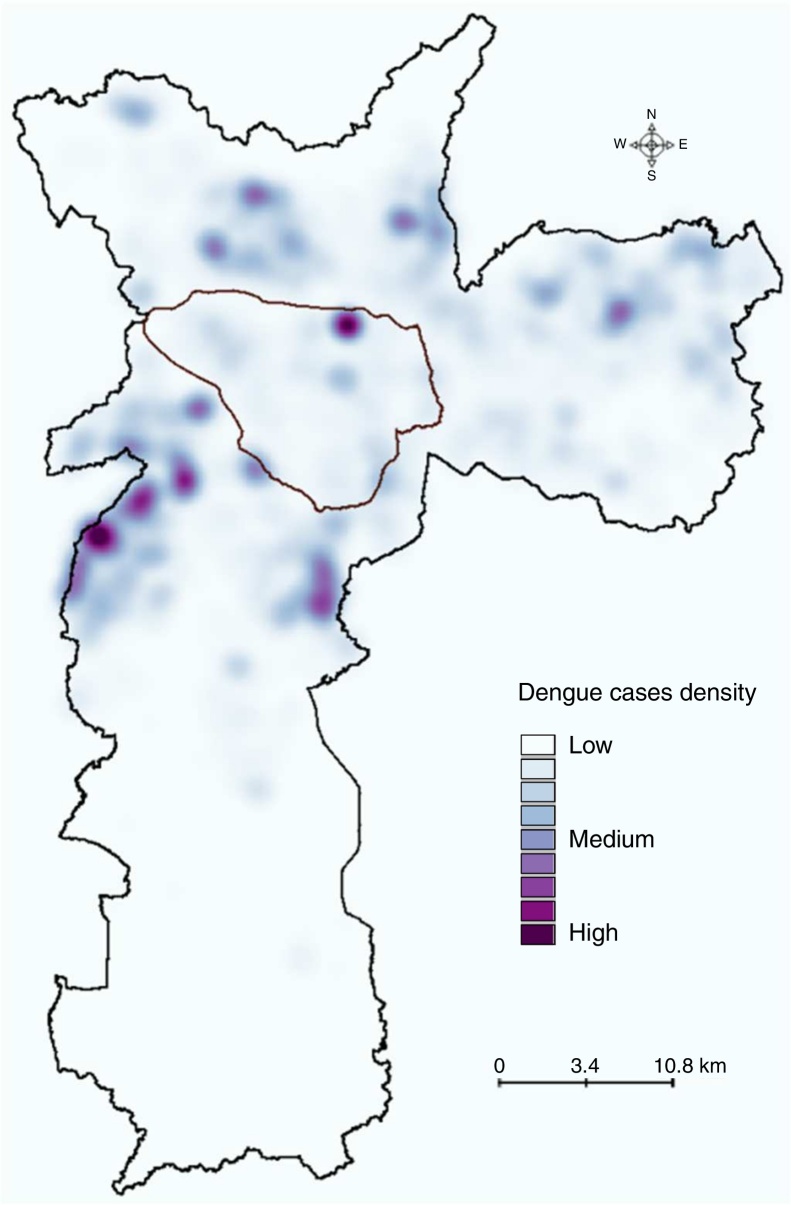
Urban heat islands are characterized by high land surface temperature, low humidity, and poor vegetation, and considered to favor the transmission of the mosquito-borne dengue fever that is transmitted by the Aedes aegypti mosquito. We analyzed the recorded dengue incidence in Sao Paulo city, Brazil, in 2010-2011, in terms of multiple environmental and socioeconomic variables. Geographical information systems, thermal remote sensing images, and census data were used to classify city areas according to land surface temperature, vegetation cover, population density, socioeconomic status, and housing standards. Of the 7415 dengue cases, a majority (93.1%) mapped to areas with land surface temperature >28°C. The dengue incidence rate (cases per 100,000 inhabitants) was low (3.2 cases) in high vegetation cover areas, but high (72.3 cases) in low vegetation cover areas where the land surface temperature was 29±2°C. Interestingly, a multiple cluster analysis phenogram showed more dengue cases clustered in areas of land surface temperature >32°C, than in areas characterized as low socioeconomic zones, high population density areas, or slum-like areas. In laboratory experiments, A. aegypti mosquito larval development, blood feeding, and oviposition associated positively with temperatures of 28-32°C, indicating these temperatures to be favorable for dengue transmission. Thus, among all the variables studied, dengue incidence was most affected by the temperature.
城市热岛的特点是地表温度高、湿度低且植被稀少,被认为有利于由埃及伊蚊传播的蚊媒登革热的传播。我们根据多种环境和社会经济变量,分析了2010 - 2011年巴西圣保罗市记录的登革热发病率。利用地理信息系统、热遥感图像和人口普查数据,根据地表温度、植被覆盖、人口密度、社会经济地位和住房标准对城市区域进行分类。在7415例登革热病例中,大多数(93.1%)分布在地表温度>28°C的区域。高植被覆盖地区的登革热发病率(每10万居民中的病例数)较低(3.2例),但在植被覆盖低且地表温度为29±2°C的地区发病率较高(72.3例)。有趣的是,多重聚类分析树形图显示,与社会经济地位低的区域、高人口密度地区或贫民窟样地区相比,更多登革热病例聚集在地表温度>32°C的区域。在实验室实验中,埃及伊蚊幼虫的发育、吸血和产卵与28 - 32°C的温度呈正相关,表明这些温度有利于登革热传播。因此,在所有研究的变量中,登革热发病率受温度影响最大。