Remote Sensing and GIS Field of Study, School of Engineering and Technology, Asian Institute of Technology, P.O. Box 4, Klong Luang, Pathumthani 12120, Thailand.
Int J Environ Res Public Health. 2011 Jan;8(1):51-74. doi: 10.3390/ijerph8010051. Epub 2010 Dec 29.
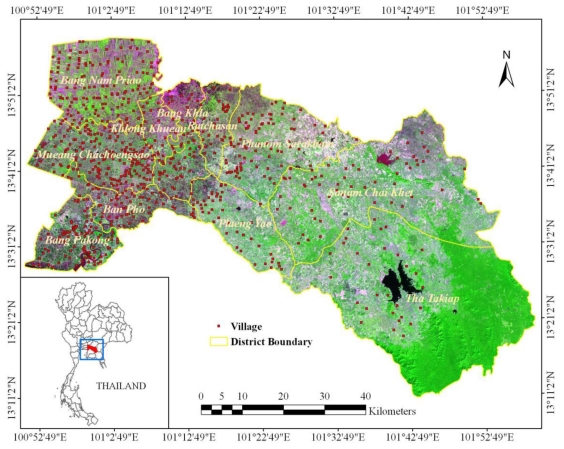
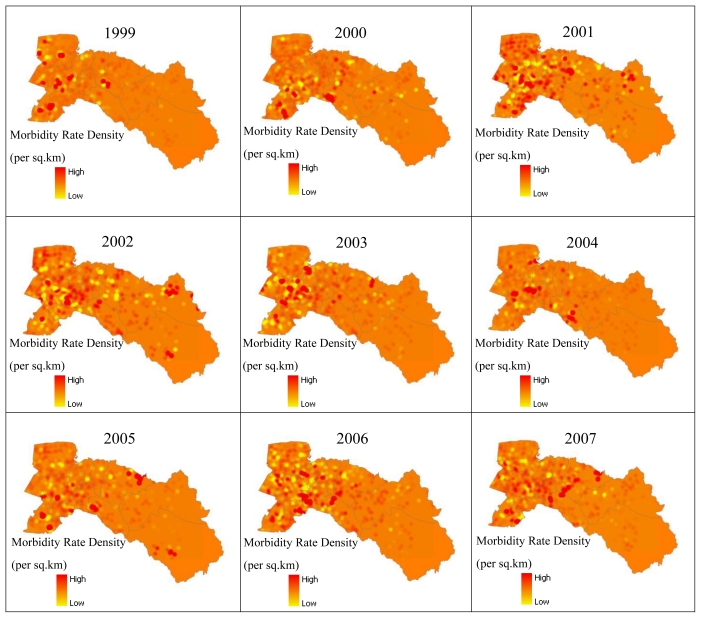
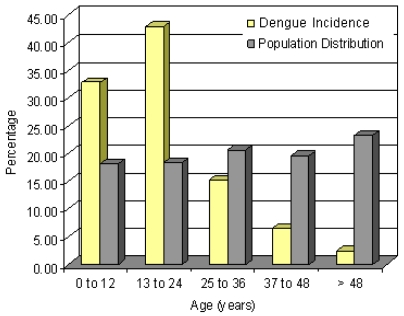
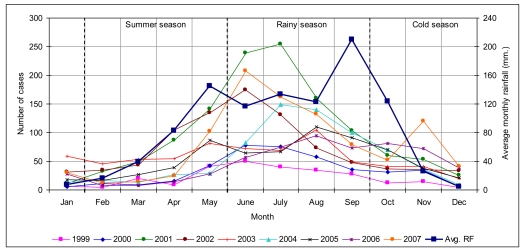
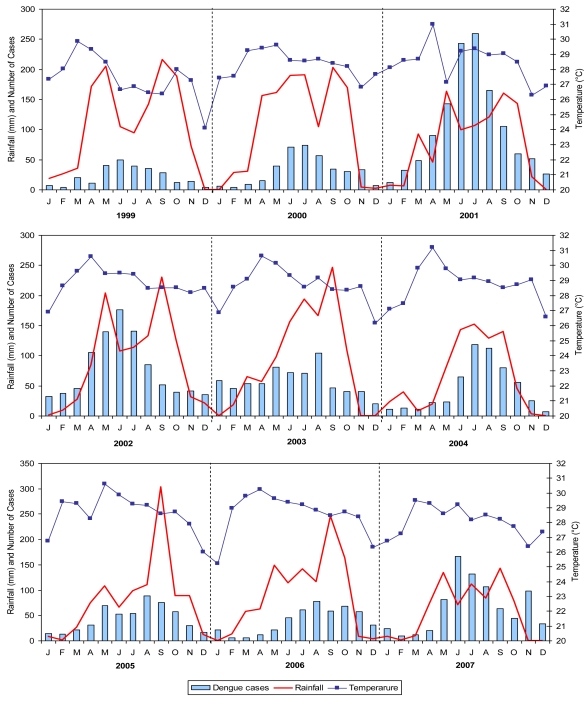
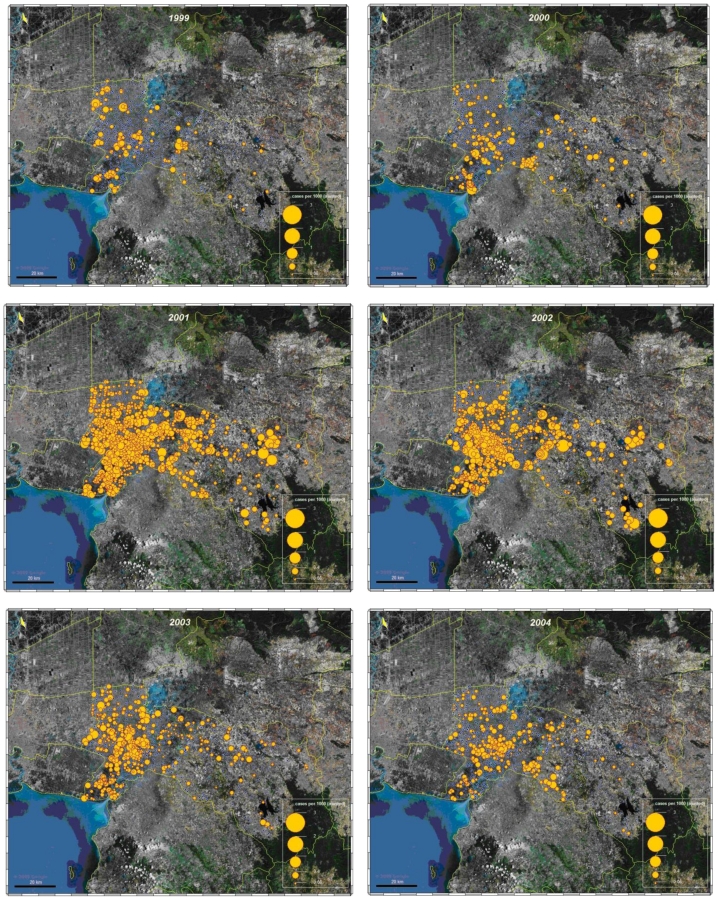
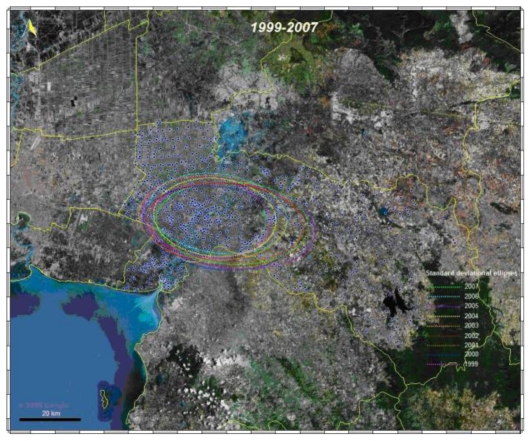
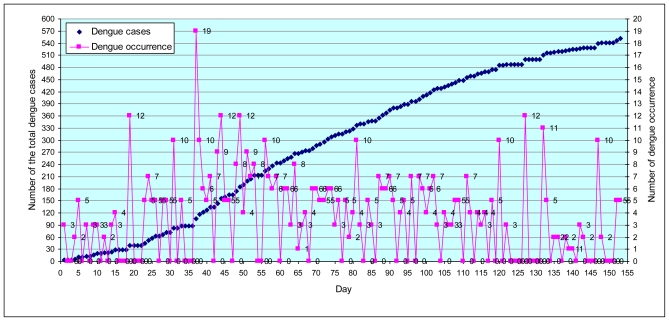
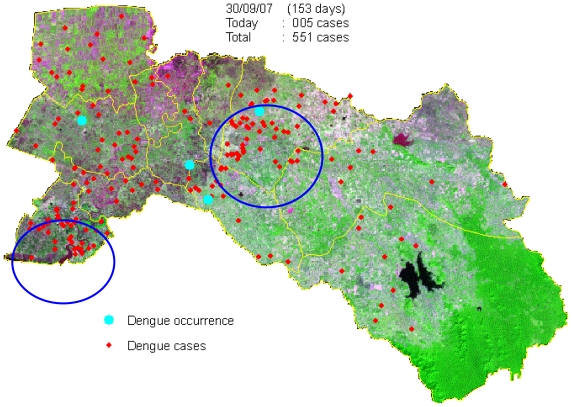
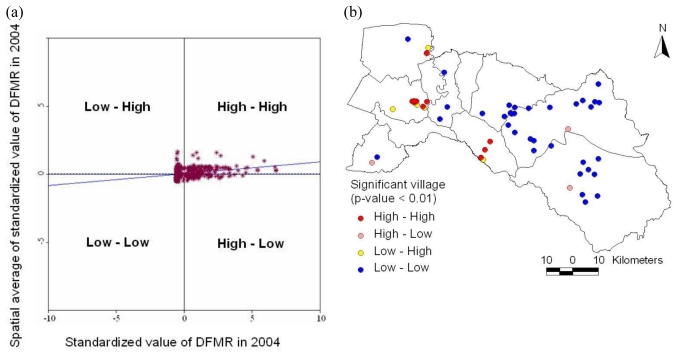
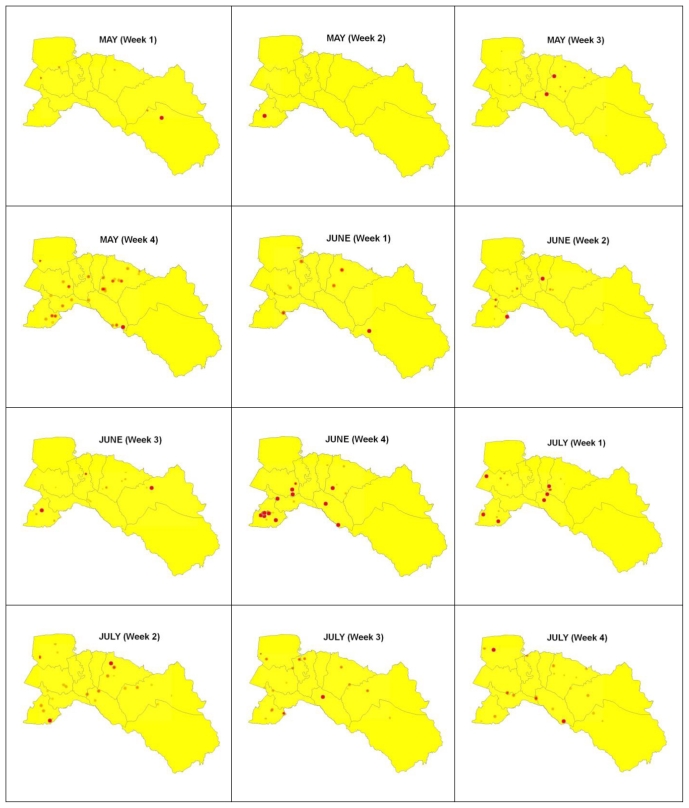
In recent years, dengue has become a major international public health concern. In Thailand it is also an important concern as several dengue outbreaks were reported in last decade. This paper presents a GIS approach to analyze the spatial and temporal dynamics of dengue epidemics. The major objective of this study was to examine spatial diffusion patterns and hotspot identification for reported dengue cases. Geospatial diffusion pattern of the 2007 dengue outbreak was investigated. Map of daily cases was generated for the 153 days of the outbreak. Epidemiological data from Chachoengsao province, Thailand (reported dengue cases for the years 1999-2007) was used for this study. To analyze the dynamic space-time pattern of dengue outbreaks, all cases were positioned in space at a village level. After a general statistical analysis (by gender and age group), data was subsequently analyzed for temporal patterns and correlation with climatic data (especially rainfall), spatial patterns and cluster analysis, and spatio-temporal patterns of hotspots during epidemics. The results revealed spatial diffusion patterns during the years 1999-2007 representing spatially clustered patterns with significant differences by village. Villages on the urban fringe reported higher incidences. The space and time of the cases showed outbreak movement and spread patterns that could be related to entomologic and epidemiologic factors. The hotspots showed the spatial trend of dengue diffusion. This study presents useful information related to the dengue outbreak patterns in space and time and may help public health departments to plan strategies to control the spread of disease. The methodology is general for space-time analysis and can be applied for other infectious diseases as well.
近年来,登革热已成为国际重大公共卫生关注点。在泰国,它也是一个重要关注点,因为在过去十年中报告了几起登革热疫情。本文提出了一种 GIS 方法来分析登革热疫情的时空动态。本研究的主要目的是检查报告登革热病例的空间扩散模式和热点识别。研究调查了 2007 年登革热疫情的地理空间扩散模式。生成了疫情爆发的 153 天的每日病例图。本研究使用了泰国乍都乍府(1999-2007 年报告的登革热病例)的地理空间扩散模式。为了分析登革热疫情的动态时空模式,将所有病例在村庄一级进行空间定位。在进行一般统计分析(按性别和年龄组)之后,随后分析了时间模式以及与气候数据(特别是降雨量)的相关性、空间模式和聚类分析以及疫情期间热点的时空模式。结果显示,1999-2007 年期间的空间扩散模式代表了具有显著差异的空间聚类模式。城市边缘的村庄报告的发病率更高。病例的时空显示出疫情爆发的移动和传播模式,这些模式可能与昆虫学和流行病学因素有关。热点显示了登革热扩散的空间趋势。本研究提供了与时空登革热疫情模式相关的有用信息,并可能有助于公共卫生部门制定控制疾病传播的策略。该方法是一般的时空分析方法,也可应用于其他传染病。