Musser Richard O, Hum-Musser Sue M, Gallucci Matthew, DesRochers Brittany, Brown Judith K
Department of Biological Sciences, Western Illinois University, Macomb, IL 61455
Department of Biological Sciences, Western Illinois University, Macomb, IL 61455.
J Insect Sci. 2014 Jan 1;14. doi: 10.1093/jisesa/ieu092. Print 2014.
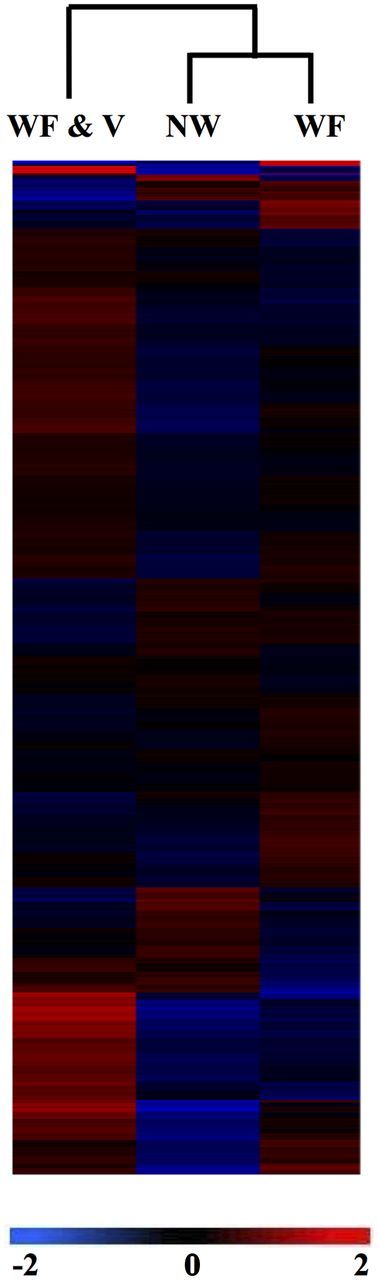
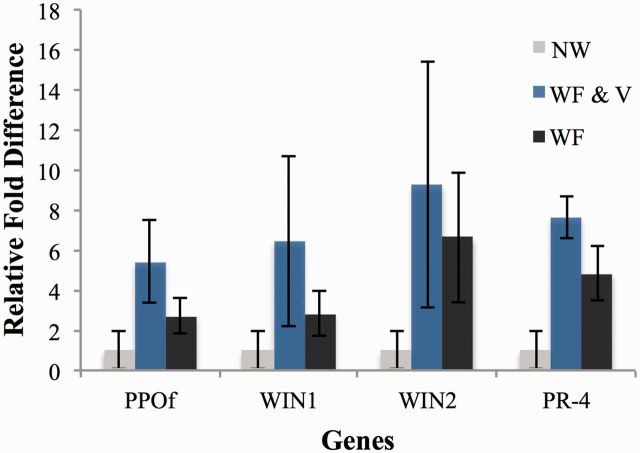
Plants are routinely exposed to biotic and abiotic stresses to which they have evolved by synthesizing constitutive and induced defense compounds. Induced defense compounds are usually made, initially, at low levels; however, following further stimulation by specific kinds of biotic and abiotic stresses, they can be synthesized in relatively large amounts to abate the particular stress. cDNA microarray hybridization was used to identify an array of genes that were differentially expressed in tomato plants 15 d after they were exposed to feeding by nonviruliferous whiteflies or by viruliferous whiteflies carrying Pepper golden mosaic virus (PepGMV) (Begomovirus, Geminiviridae). Tomato plants inoculated by viruliferous whiteflies developed symptoms characteristic of PepGMV, whereas plants exposed to nonviruliferous whitefly feeding or nonwounded (negative) control plants exhibited no disease symptoms. The microarray analysis yielded over 290 spotted probes, with significantly altered expression of 161 putative annotated gene targets, and 129 spotted probes of unknown identities. The majority of the differentially regulated "known" genes were associated with the plants exposed to viruliferous compared with nonviruliferous whitefly feeding. Overall, significant differences in gene expression were represented by major physiological functions including defense-, pathogen-, photosynthesis-, and signaling-related responses and were similar to genes identified for other insect-plant systems. Viruliferous whitefly-stimulated gene expression was validated by real-time quantitative polymerase chain reaction of selected, representative candidate genes (messenger RNA): arginase, dehydrin, pathogenesis-related proteins 1 and -4, polyphenol oxidase, and several protease inhibitors. This is the first comparative profiling of the expression of tomato plants portraying different responses to biotic stress induced by viruliferous whitefly feeding (with resultant virus infection) compared with whitefly feeding only and negative control nonwounded plants exposed to neither. These results may be applicable to many other plant-insect-pathogen system interactions.
植物经常会受到生物和非生物胁迫,它们通过合成组成型和诱导型防御化合物来应对这些胁迫。诱导型防御化合物通常最初以低水平产生;然而,在受到特定种类的生物和非生物胁迫的进一步刺激后,它们可以大量合成以减轻特定胁迫。利用cDNA微阵列杂交来鉴定一系列在番茄植株中差异表达的基因,这些番茄植株在暴露于无毒烟粉虱或携带辣椒金色花叶病毒(PepGMV,双生病毒科,菜豆金色花叶病毒属)的带毒烟粉虱取食后15天。被带毒烟粉虱接种的番茄植株出现了PepGMV的特征症状,而暴露于无毒烟粉虱取食的植株或未受伤(阴性)对照植株没有表现出病害症状。微阵列分析产生了超过290个点样探针,161个推定注释基因靶标的表达有显著改变,还有129个身份不明的点样探针。与无毒烟粉虱取食相比,大多数差异调节的“已知”基因与暴露于带毒烟粉虱的植株有关。总体而言,基因表达的显著差异体现在主要生理功能上,包括防御、病原体、光合作用和信号转导相关反应,并且与在其他昆虫 - 植物系统中鉴定出的基因相似。通过对选定的代表性候选基因(信使核糖核酸)进行实时定量聚合酶链反应,验证了带毒烟粉虱刺激的基因表达:精氨酸酶、脱水素、病程相关蛋白1和 -4、多酚氧化酶以及几种蛋白酶抑制剂。这是首次对番茄植株的表达进行比较分析,描绘了与仅烟粉虱取食和未暴露于任何胁迫的阴性对照未受伤植株相比,带毒烟粉虱取食(导致病毒感染)诱导的生物胁迫的不同反应。这些结果可能适用于许多其他植物 - 昆虫 - 病原体系统相互作用。