Marie Alexandra, Holzmuller Philippe, Tchioffo Majoline T, Rossignol Marie, Demettre Edith, Seveno Martial, Corbel Vincent, Awono-Ambéné Parfait, Morlais Isabelle, Remoue Franck, Cornelie Sylvie
MIVEGEC (UMR IRD224 CNRS 5290 UM1-UM2), Institut de Recherche pour le développement (IRD), 911 avenue Agropolis, Montpellier cedex 5, 34394, France.
CIRAD Département Systèmes Biologiques BIOS UMR 15 CMAEE "Contrôle des Maladies Exotiques et Emergentes", Campus International de Baillarguet, TA A-15/G, Montpellier cedex 5, 34398, France.
Parasit Vectors. 2014 Dec 20;7:599. doi: 10.1186/s13071-014-0599-y.
Malaria is the major parasitic disease worldwide caused by Plasmodium infection. The objective of integrated malaria control programs is to decrease malaria transmission, which needs specific tools to be accurately assessed. In areas where the transmission is low or has been substantially reduced, new complementary tools have to be developed to improve surveillance. A recent approach, based on the human antibody response to Anopheles salivary proteins, has been shown to be efficient in evaluating human exposure to Anopheles bites. The aim of the present study was to identify new An. gambiae salivary proteins as potential candidate biomarkers of human exposure to P. falciparum-infective bites.
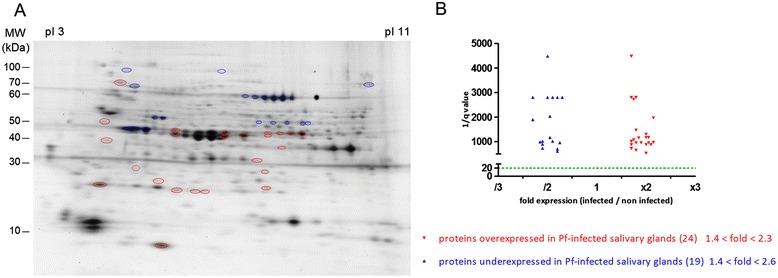
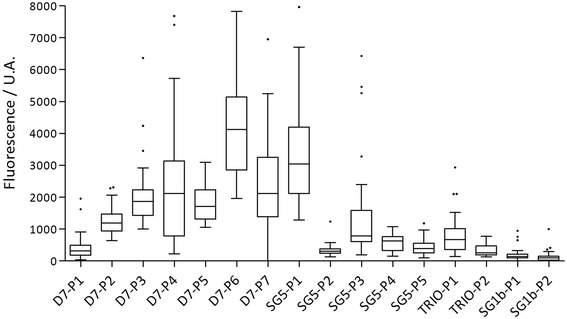
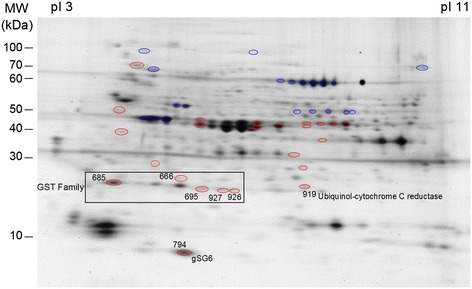
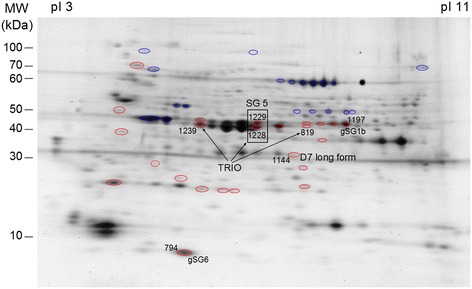
Experimental infections of An. gambiae by wild P. falciparum were carried out in semi-field conditions. Then a proteomic approach, combining 2D-DIGE and mass spectrometry, was used to identify the overexpressed salivary proteins in infected salivary glands compared to uninfected An. gambiae controls. Subsequently, a peptide design of each potential candidate was performed in silico and their antigenicity was tested by an epitope-mapping technique using blood from individuals exposed to Anopheles bites.
Five salivary proteins (gSG6, gSG1b, TRIO, SG5 and long form D7) were overexpressed in the infected salivary glands. Eighteen peptides were designed from these proteins and were found antigenic in children exposed to the Anopheles bites. Moreover, the results showed that the presence of wild P. falciparum in salivary glands modulates the expression of several salivary proteins and also appeared to induce post-translational modifications.
This study is, to our knowledge, the first that compares the sialome of An. gambiae both infected and not infected by wild P. falciparum, making it possible to mimic the natural conditions of infection. This is a first step toward a better understanding of the close interactions between the parasite and the salivary gland of mosquitoes. In addition, these results open the way to define biomarkers of infective bites of Anopheles, which could, in the future, improve the estimation of malaria transmission and the evaluation of malaria vector control tools.
疟疾是全球由疟原虫感染引起的主要寄生虫病。综合疟疾控制项目的目标是减少疟疾传播,这需要对特定工具进行准确评估。在传播率低或已大幅降低的地区,必须开发新的补充工具以改善监测。最近一种基于人体对按蚊唾液蛋白抗体反应的方法已被证明在评估人体受按蚊叮咬情况方面是有效的。本研究的目的是鉴定冈比亚按蚊新的唾液蛋白,作为人体暴露于恶性疟原虫感染性叮咬的潜在候选生物标志物。
在半野外条件下用野生恶性疟原虫对冈比亚按蚊进行实验感染。然后采用蛋白质组学方法,结合二维差异凝胶电泳(2D-DIGE)和质谱分析,以鉴定与未感染的冈比亚按蚊对照相比,感染的唾液腺中过表达的唾液蛋白。随后,对每个潜在候选蛋白进行计算机辅助肽设计,并使用暴露于按蚊叮咬个体的血液通过表位映射技术测试其抗原性。
五种唾液蛋白(gSG6、gSG1b、TRIO、SG5和长形式D7)在感染的唾液腺中过表达。从这些蛋白设计了18种肽,发现它们在暴露于按蚊叮咬的儿童中具有抗原性。此外,结果表明唾液腺中野生恶性疟原虫的存在调节了几种唾液蛋白的表达,并且似乎还诱导了翻译后修饰。
据我们所知,本研究首次比较了感染和未感染野生恶性疟原虫的冈比亚按蚊的唾液蛋白质组,从而能够模拟自然感染条件。这是朝着更好地理解寄生虫与蚊子唾液腺之间密切相互作用迈出的第一步。此外,这些结果为定义按蚊感染性叮咬的生物标志物开辟了道路,未来可能会改善对疟疾传播的估计以及对疟疾媒介控制工具的评估。