Kvernby Sofia, Warntjes Marcel Jan Bertus, Haraldsson Henrik, Carlhäll Carl-Johan, Engvall Jan, Ebbers Tino
Division of Cardiovascular Medicine, Department of Medical and Health Sciences, Linköping University, Linköping, Sweden.
J Cardiovasc Magn Reson. 2014 Dec 20;16(1):102. doi: 10.1186/s12968-014-0102-0.
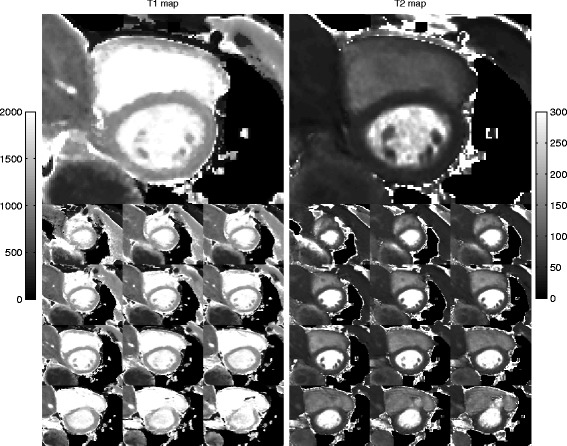
Quantification of the longitudinal- and transverse relaxation time in the myocardium has shown to provide important information in cardiac diagnostics. Methods for cardiac relaxation time mapping generally demand a long breath hold to measure either T1 or T2 in a single 2D slice. In this paper we present and evaluate a novel method for 3D interleaved T1 and T2 mapping of the whole left ventricular myocardium within a single breath hold of 15 heartbeats.
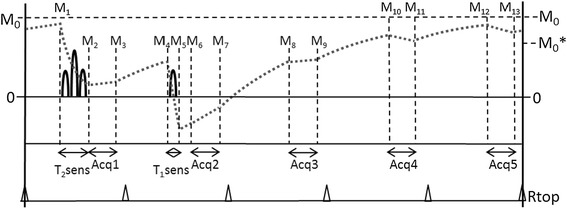
The 3D-QALAS (3D-quantification using an interleaved Look-Locker acquisition sequence with T2 preparation pulse) is based on a 3D spoiled Turbo Field Echo sequence using inversion recovery with interleaved T2 preparation. Quantification of both T1 and T2 in a volume of 13 slices with a resolution of 2.0x2.0x6.0 mm is obtained from five measurements by using simulations of the longitudinal magnetizations Mz. This acquisition scheme is repeated three times to sample k-space. The method was evaluated both in-vitro (validated against Inversion Recovery and Multi Echo) and in-vivo (validated against MOLLI and Dual Echo).
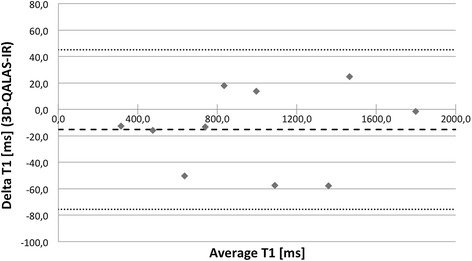
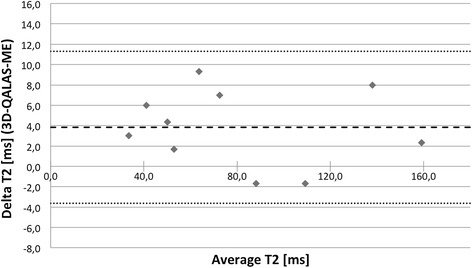
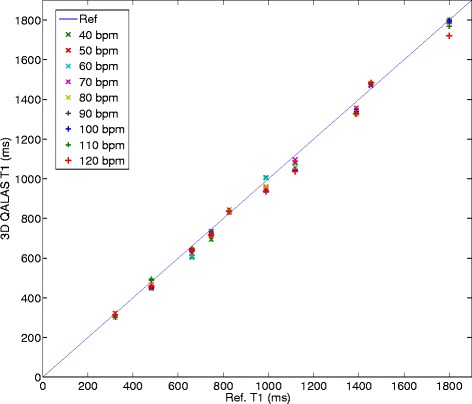
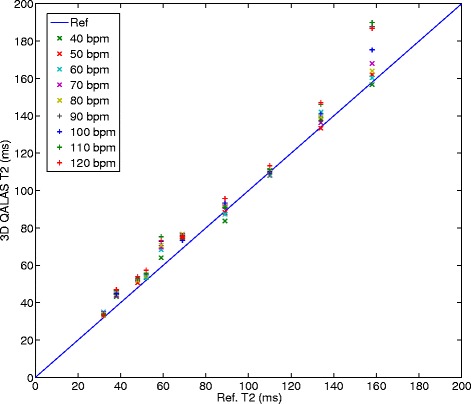
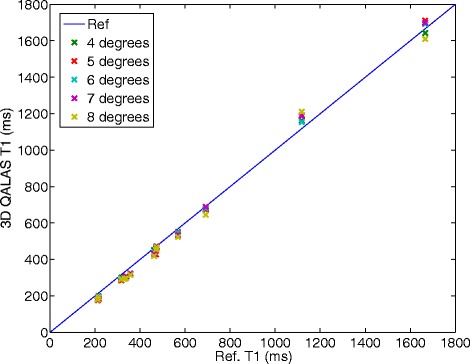
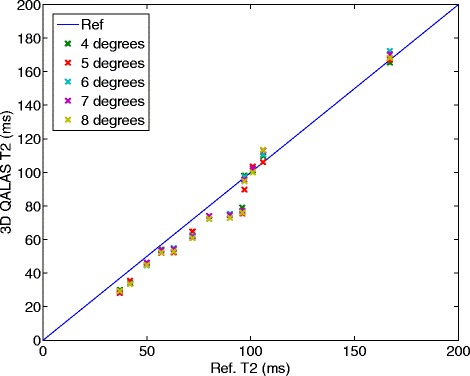
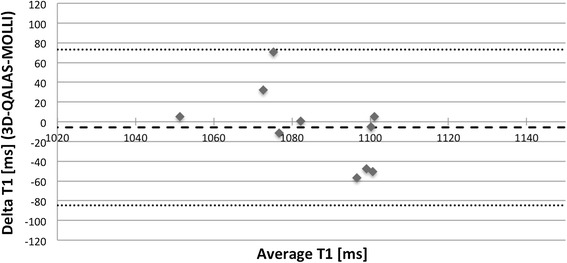
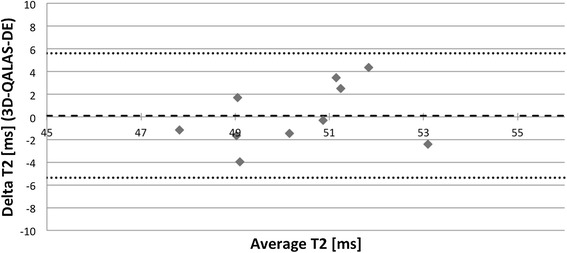
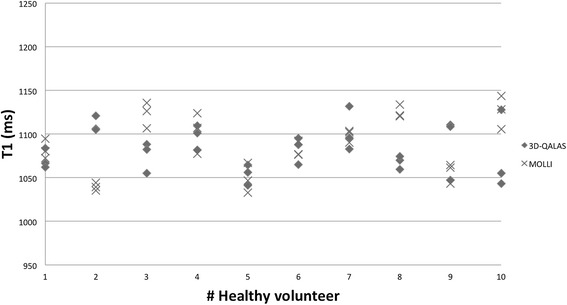
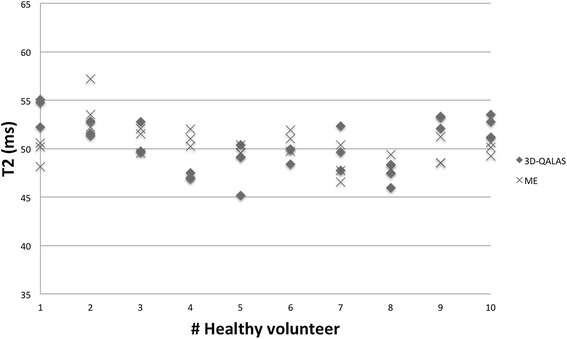
In-vitro, a strong relation was found between 3D-QALAS and Inversion Recovery (R = 0.998; N = 10; p < 0.01) and between 3D-QALAS and Multi Echo (R = 0.996; N = 10; p < 0.01). The 3D-QALAS method showed no dependence on e.g. heart rate in the interval of 40-120 bpm. In healthy myocardium, the mean T1 value was 1083 ± 43 ms (mean ± SD) for 3D-QALAS and 1089 ± 54 ms for MOLLI, while the mean T2 value was 50.4 ± 3.6 ms 3D-QALAS and 50.3 ± 3.5 ms for Dual Echo. No significant difference in in-vivo relaxation times was found between 3D-QALAS and MOLLI (N = 10; p = 0.65) respectively 3D-QALAS and Dual Echo (N = 10; p = 0.925) for the ten healthy volunteers.
The 3D-QALAS method has demonstrated good accuracy and intra-scan variability both in-vitro and in-vivo. It allows rapid acquisition and provides quantitative information of both T1 and T2 relaxation times in the same scan with full coverage of the left ventricle, enabling clinical application in a broader spectrum of cardiac disorders.
心肌纵向和横向弛豫时间的定量分析已被证明能为心脏诊断提供重要信息。心脏弛豫时间映射方法通常需要长时间屏气以在单个二维切片中测量T1或T2。在本文中,我们提出并评估了一种新方法,可在15次心跳的单次屏气内对整个左心室心肌进行三维交错T1和T2映射。
三维QALAS(使用带有T2准备脉冲的交错Look-Locker采集序列进行三维定量)基于一种三维扰相梯度回波序列,采用反转恢复和交错T2准备。通过对纵向磁化强度Mz进行模拟,从五次测量中获得13个切片、分辨率为2.0×2.0×6.0毫米的体积内T1和T2的定量结果。该采集方案重复三次以采样k空间。该方法在体外(与反转恢复和多回波进行验证)和体内(与MOLLI和双回波进行验证)均进行了评估。
在体外,三维QALAS与反转恢复之间(R = 0.998;N = 10;p < 0.01)以及三维QALAS与多回波之间(R = 0.996;N = 10;p < 0.01)发现有很强的相关性。三维QALAS方法在40 - 120次/分钟的心率区间内不依赖于例如心率。在健康心肌中,三维QALAS的平均T1值为1083±43毫秒(平均值±标准差),MOLLI为1089±54毫秒,而三维QALAS的平均T2值为50.4±3.6毫秒,双回波为50.3±3.5毫秒。对于十名健康志愿者,三维QALAS与MOLLI(N = 10;p = 0.65)以及三维QALAS与双回波(N = 10;p = 0.925)之间在体内弛豫时间上未发现显著差异。
三维QALAS方法在体外和体内均显示出良好的准确性和扫描内变异性。它允许快速采集,并在同一扫描中提供T1和T2弛豫时间的定量信息,且能完全覆盖左心室,从而能够在更广泛的心脏疾病中得到临床应用。