Department of Cardiovascular Imaging, King's College London, London, UK.
J Cardiovasc Magn Reson. 2013 Sep 11;15(1):78. doi: 10.1186/1532-429X-15-78.
T1 imaging based on pixel-wise quantification of longitudinal relaxation has the potential to differentiate between normal and abnormal myocardium. The accuracy of T1 measurement has not been established nor systematically tested in the presence of health and disease.
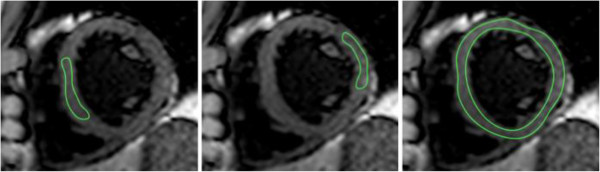
Intra-observer, inter-observer and inter-study reproducibility of T1 imaging was assessed in subjects with left ventricular hypertrophy (LVH, n = 25) or dilated cardiomyopathy (DCM, n = 43). Thirty-eight subjects with low-pretest likelihood of cardiomyopathy served as a control group. T1 values were acquired in a single mid-ventricular short axis slice using modified Look-Locker imaging prior and after the application of gadolinium contrast at 1.5 and 3 T. Analysis was performed with regions of interest (ROI) placed conservatively within the septum or to include the whole short axis (SAX) myocardium.
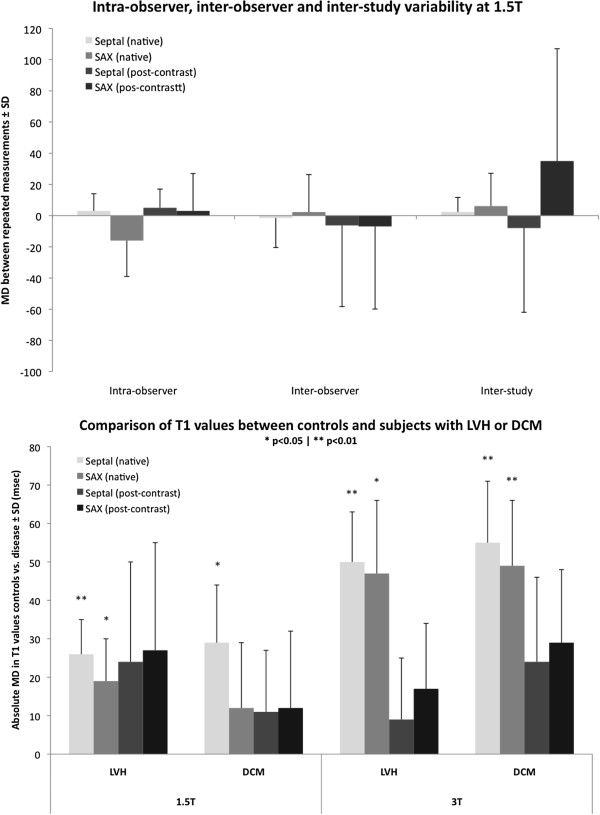
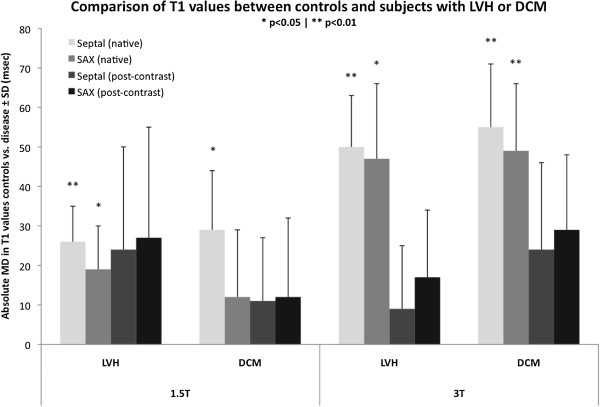
Intra-observer, inter-observer and inter-study repeated measurements within the septum showed smaller mean differences and narrower 95% confidence intervals than repeated short axis ROI measurements. Native T1 values were higher in septal ROIs compared with SAX values at both field strengths (1.5 T: 976 ± 37 vs. 952 ± 41, p < 0.01; 3 T: 1108 ± 67 vs. 1087 ± 60, p < 0.01). Native T1 values revealed significant mean differences between controls and patients with LVH for both septal (1.5 T: 26 ± 9, p < 0.01; 3 T: 50 ± 13, p < 0.01) and SAX ROIs (1.5 T: 19 ± 11, p < 0.05; 3 T: 47 ± 19, p < 0.05) with greater differences observed at 3 T versus 1.5 T field strength. Native T1 values revealed significant mean differences between controls and patients with DCM for septal ROI (1.5 T: 29 ± 15, p < 0.05; 3 T: 55 ± 16, p < 0.01) at both 1.5 T and 3 T, but only for SAX ROIs at 3 T (49 ± 17, p < 0.01). There were no significant differences in post-contrast T1 values or partition coefficient (λ) between controls and patients.
Conservative septal ROI T1 measurement is a robust technique with excellent intra-observer, inter-observer and inter-study reproducibility for native and post-contrast T1 value and partition coefficient measurements. Moreover, native septal T1 values reveal the greatest difference between normal and abnormal myocardium, which is independent of geometrical alterations of cardiac chamber and wall thickness. We propose the use of native T1 measurements using conservative septal technique as the standardized approach to distinguish health from disease assuming diffuse myocardial involvement.
基于像素的纵向弛豫定量的 T1 成像有可能区分正常和异常心肌。T1 测量的准确性尚未在健康和疾病存在的情况下得到确定或系统测试。
在左心室肥厚 (LVH,n = 25) 或扩张型心肌病 (DCM,n = 43) 患者中评估 T1 成像的观察者内、观察者间和研究间可重复性。38 名低心肌病变可能性的受试者作为对照组。使用改良的 Look-Locker 成像技术,在 1.5 和 3 T 时,在单个中室短轴切片上获取 T1 值,并在应用钆对比剂前后进行。使用感兴趣区域 (ROI) 进行分析,ROI 放置在间隔内保守,或包括整个短轴 (SAX) 心肌。
间隔内的观察者内、观察者间和研究间重复测量的平均差异较小,95%置信区间较狭窄,而 SAX ROI 测量的重复测量的平均差异较大。在两种场强下,间隔 ROI 的 T1 值均高于 SAX 值 (1.5 T:976 ± 37 与 952 ± 41,p < 0.01;3 T:1108 ± 67 与 1087 ± 60,p < 0.01)。在两种场强下,与对照组相比,LVH 患者的 T1 值均有显著的平均差异,无论是间隔 (1.5 T:26 ± 9,p < 0.01;3 T:50 ± 13,p < 0.01) 还是 SAX ROI (1.5 T:19 ± 11,p < 0.05;3 T:47 ± 19,p < 0.05),在 3 T 时差异大于 1.5 T。在两种场强下,与对照组相比,DCM 患者的 T1 值均有显著的平均差异,间隔 ROI 有差异 (1.5 T:29 ± 15,p < 0.05;3 T:55 ± 16,p < 0.01),而在 3 T 时 SAX ROI 有差异 (49 ± 17,p < 0.01)。在对照组和患者之间,没有观察到钆后 T1 值或分割系数 (λ) 的差异。
采用保守的间隔 ROI T1 测量技术,对于 T1 值和分割系数的固有和钆后测量,具有出色的观察者内、观察者间和研究间可重复性。此外,间隔的固有 T1 值显示了正常和异常心肌之间的最大差异,这与心脏腔室和壁厚度的几何变化无关。我们建议使用保守的间隔技术测量固有 T1 值,作为区分健康与疾病的标准方法,假设弥漫性心肌受累。