Kilford Emma J, Foulkes Lucy, Potter Robert, Collishaw Stephan, Thapar Anita, Rice Frances
(a)Department of Clinical, Educational and Health Psychology, University College London, 26 Bedford Way, London WC1H 0AP, United Kingdom.
Institute of Psychological Medicine and Clinical Neurosciences, MRC Centre for Neuropsychiatric Genetics and Genomics, Cardiff University, Cardiff, United Kingdom.
J Affect Disord. 2015 Mar 15;174:265-71. doi: 10.1016/j.jad.2014.11.046. Epub 2014 Nov 29.
Affective bias is a common feature of depressive disorder. However, a lack of longitudinal studies means that the temporal relationship between affective bias and depression is not well understood. One group where studies of affective bias may be particularly warranted is the adolescent offspring of depressed parents, given observations of high rates of depression and a severe and impairing course of disorder in this group.
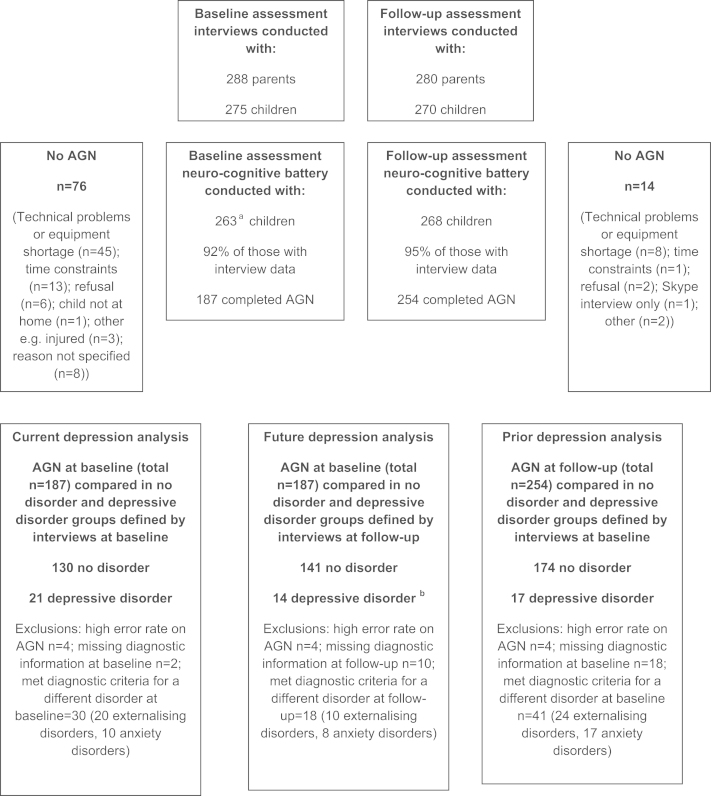
A two wave panel design was used in which adolescent offspring of parents with recurrent depression completed a behavioural task assessing affective bias (The Affective Go/No Go Task) and a psychiatric interview. The affective processing of adolescents with current, prior and future depressive disorder was compared to that of adolescents free from disorder.
Adolescents with current depression and those who developed depression at follow-up made more commission errors for sad than happy targets compared to adolescents free from disorder. There was no effect of prior depression on later affective processing.
Small cell sizes meant we were unable to separately compare those with new onset and recurrent depressive disorder.
Valence-specific errors in behavioural inhibition index future vulnerability to depression in adolescents already at increased risk and may represent a measure of affective control. Currently depressed adolescents show a similar pattern of affective bias or deficits in affective control.
情感偏差是抑郁症的一个常见特征。然而,缺乏纵向研究意味着情感偏差与抑郁症之间的时间关系尚未得到很好的理解。鉴于观察到该群体中抑郁症发病率高且病程严重并具有损害性,情感偏差研究可能特别有必要的一个群体是抑郁症患者的青少年后代。
采用两波面板设计,患有复发性抑郁症的父母的青少年后代完成一项评估情感偏差的行为任务(情感Go/No Go任务)和一次精神科访谈。将患有当前、既往和未来抑郁症的青少年的情感加工与无疾病的青少年进行比较。
与无疾病的青少年相比,患有当前抑郁症的青少年以及在随访中出现抑郁症的青少年在悲伤目标上比快乐目标犯更多的错误。既往抑郁症对后期情感加工没有影响。
样本量小意味着我们无法分别比较新发抑郁症和复发性抑郁症患者。
行为抑制中的效价特异性错误表明,处于高风险的青少年未来易患抑郁症,可能代表一种情感控制的指标。目前患有抑郁症的青少年表现出类似的情感偏差模式或情感控制缺陷。