Hobbs Catherine, Murphy Susannah E, Wright Lucy, Carson James, Assche Indra Van, O'Brien Jessica, Oyesanya Mayowa, Sui Jie, Munafò Marcus R, Kessler David, Harmer Catherine J, Button Katherine S
Department of Psychology, University of Bath, UK.
Department of Psychiatry, University of Oxford, and NHS Foundation Trust, Warneford Hospital, Oxford, UK.
BJPsych Open. 2020 Oct 19;6(6):e124. doi: 10.1192/bjo.2020.107.
Depression is characterised by negative views of the self. Antidepressant treatment may remediate negative self-schema through increasing processing of positive information about the self. Changes in affective processing during social interactions may increase expression of prosocial behaviours, improving interpersonal communications.
To examine whether acute administration of citalopram is associated with an increase in positive affective learning biases about the self and prosocial behaviour.
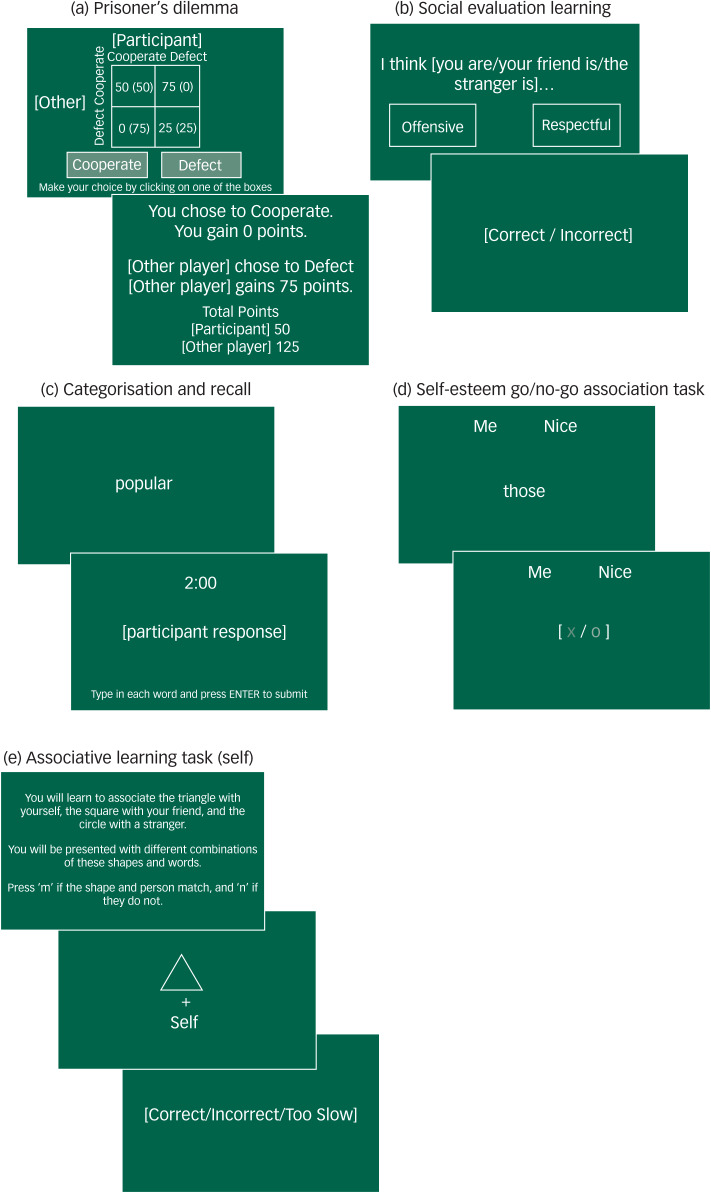
Healthy volunteers (n = 41) were randomised to either an acute 20 mg dose of citalopram or matched placebo in a between-subjects double-blind design. Participants completed computer-based cognitive tasks designed to measure referential affective processing, social cognition and expression of prosocial behaviours.
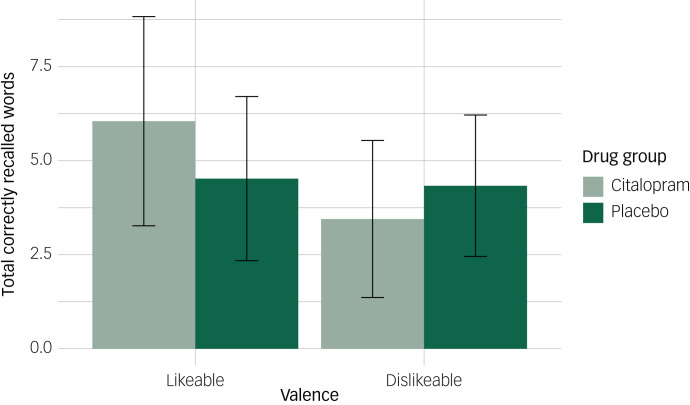
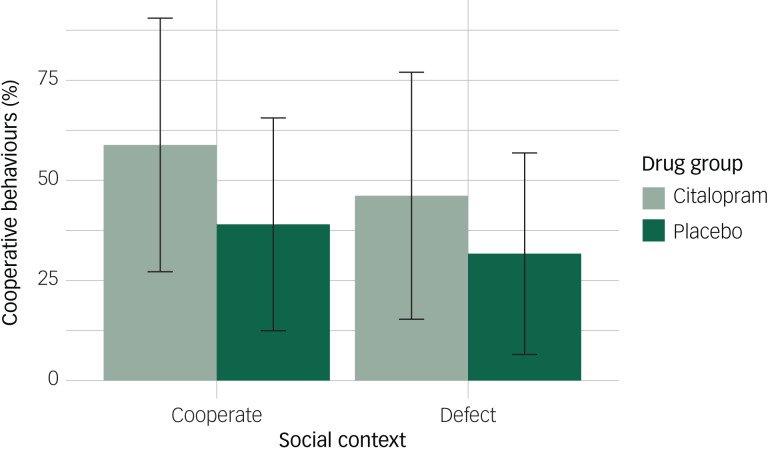
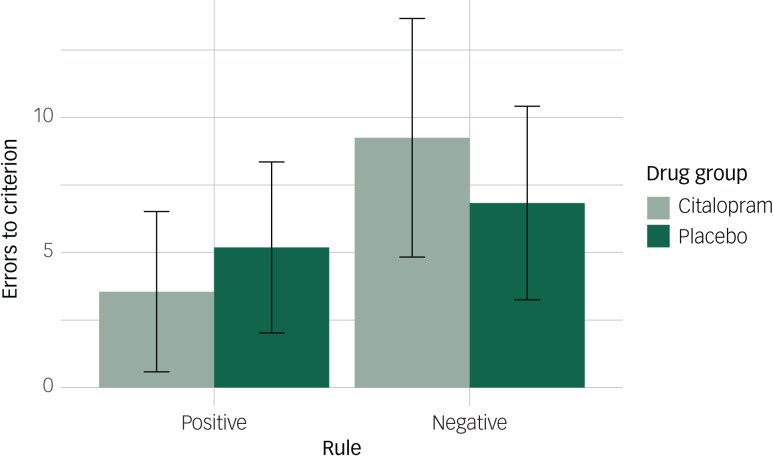
Participants administered citalopram made more cooperative choices than those administered placebo in a prisoner's dilemma task (β = 20%, 95% CI: 2%, 37%). Exploratory analyses indicated that participants administered citalopram showed a positive bias when learning social evaluations about a friend (β = 4.06, 95% CI: 0.88, 7.24), but not about the self or a stranger. Similarly, exploratory analyses found evidence of increased recall of positive words and reduced recall of negative words about others (β = 2.41, 95% CI: 0.89, 3.93), but not the self, in the citalopram group.
Participants administered citalopram showed greater prosocial behaviours, increased positive recall and increased positive learning of social evaluations towards others. The increase in positive affective bias and prosocial behaviours towards others may, at least partially, be a mechanism of antidepressant effect. However, we found no evidence that citalopram influenced self-referential processing.
抑郁症的特点是对自我持负面看法。抗抑郁治疗可能通过增加对自我积极信息的处理来纠正负面自我图式。社交互动中情感处理的变化可能会增加亲社会行为的表现,改善人际沟通。
研究西酞普兰的急性给药是否与对自我的积极情感学习偏差和亲社会行为的增加有关。
41名健康志愿者在受试者间双盲设计中被随机分为急性服用20毫克西酞普兰组或匹配的安慰剂组。参与者完成了旨在测量参照性情感处理、社会认知和亲社会行为表现的计算机化认知任务。
在囚徒困境任务中,服用西酞普兰的参与者比服用安慰剂的参与者做出了更多合作选择(β = 20%,95%置信区间:2%,37%)。探索性分析表明,服用西酞普兰的参与者在学习关于朋友的社会评价时表现出积极偏差(β = 4.06,95%置信区间:0.88,7.24),但在学习关于自我或陌生人的社会评价时没有。同样,探索性分析发现,西酞普兰组中存在对他人积极词汇回忆增加和消极词汇回忆减少的证据(β = 2.41,95%置信区间:0.89,3.93),但对自我没有。
服用西酞普兰的参与者表现出更大的亲社会行为、积极回忆增加以及对他人社会评价的积极学习增加。对他人的积极情感偏差和亲社会行为的增加可能至少部分是抗抑郁作用的一种机制。然而,我们没有发现西酞普兰影响自我参照处理的证据。