Ledda-Columbano G M, Columbano A, Coni P, Faa G, Pani P
Istituto di Farmacologia e Patologia Biochimica, Università degli Studi di Cagliari, Italy.
Am J Pathol. 1989 Oct;135(4):657-62.
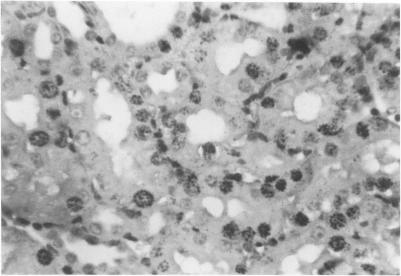
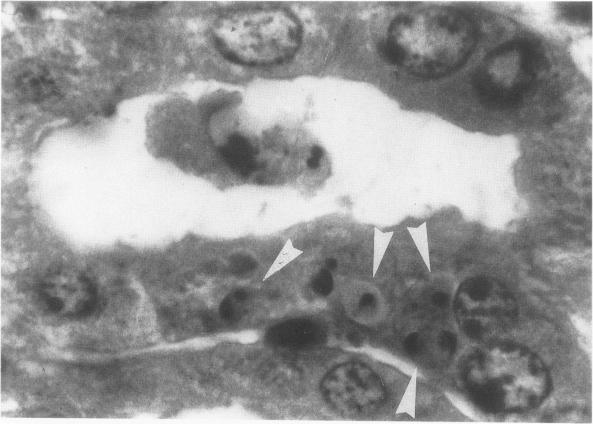
Regression of renal hyperplasia after withdrawal of the mitogenic stimulus induced by a single injection of lead nitrate was studied in male Wistar rats. Lead nitrate administration (10 mumol/100 g body weight) resulted in a ninefold increase in the incorporation of labeled thymidine into renal DNA and in an enhancement in the mitotic index; these changes were accompanied by an increase in the organ weight and DNA content that reached a maximum at 2 days. Regression of the renal hyperplasia was observed as early as 3 days after treatment and was completed within 2 weeks. Although lytic necrosis was not responsible for cell loss, the elimination of the excess renal cells took the form of apoptosis. This distinctive mode of cell death, which has been implicated in the involution of hyperplasia in other tissues and organs, was characterized by the occurrence of intracellular and extracellular membrane-bounded eosinophilic globules that often contained nuclear fragments. It affected mainly cells of the proximal tubules, and it was not detected once the kidney had regressed to its original mass. These results support the hypothesis that apoptosis is involved in the regulation of organ size.
在雄性Wistar大鼠中,研究了单次注射硝酸铅诱导的有丝分裂刺激撤除后肾增生的消退情况。给予硝酸铅(10 μmol/100 g体重)导致标记胸腺嘧啶核苷掺入肾DNA增加9倍,有丝分裂指数升高;这些变化伴随着器官重量和DNA含量增加,在2天时达到最大值。早在治疗后3天就观察到肾增生的消退,并在2周内完成。虽然溶解性坏死不是细胞丢失的原因,但多余肾细胞的清除形式为凋亡。这种独特的细胞死亡方式,已被认为与其他组织和器官增生的消退有关,其特征是出现细胞内和细胞外有膜包绕的嗜酸性小球,小球内常含有核碎片。它主要影响近端小管的细胞,一旦肾脏恢复到原始质量就检测不到了。这些结果支持了凋亡参与器官大小调节的假说。