Ansari A W Wahid, Schmidt Reinhold E, Shankar Esaki M, Kamarulzaman Adeeba
Centre of Excellence for Research in AIDS, Faculty of Medicine, University of Malaya, Lambah Pantai 50603, Kuala Lumpur, Malaysia.
J Transl Med. 2014 Dec 10;12:341. doi: 10.1186/s12967-014-0341-8.
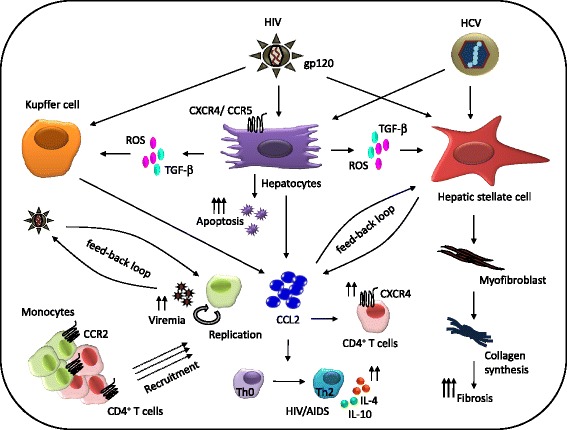
Even in the era of successful combination antiretroviral therapy (cART), co-infection of Hepatitis C virus (HCV) remains one of the leading causes of non-AIDS-related mortality and morbidity among HIV-positive individuals as a consequence of accelerated liver fibrosis and end-stage liver disease (ESLD). The perturbed liver microenvironment and induction of host pro-inflammatory mediators in response to HIV and HCV infections, play a pivotal role in orchestrating the disease pathogenesis and clinical outcomes. How these viruses communicate each other via chemokine CCL2 and exploit the liver specific cellular environment to exacerbate liver fibrosis in HIV/HCV co-infection setting is a topic of intense discussion. Herein, we provide recent views and insights on potential mechanisms of CCL2 mediated immuno-pathogenesis, and HIV-HCV cross-talk in driving liver inflammation. We believe CCL2 may potentially serve an attractive target of anti-fibrotic intervention against HIV/HCV co-infection associated co-morbidities.
即使在成功进行联合抗逆转录病毒治疗(cART)的时代,丙型肝炎病毒(HCV)合并感染仍是HIV阳性个体中非艾滋病相关死亡率和发病率的主要原因之一,这是由于肝纤维化加速和终末期肝病(ESLD)所致。HIV和HCV感染导致肝脏微环境紊乱以及宿主促炎介质的诱导,在协调疾病发病机制和临床结果中起关键作用。在HIV/HCV合并感染的情况下,这些病毒如何通过趋化因子CCL2相互交流,并利用肝脏特定的细胞环境加剧肝纤维化,是一个激烈讨论的话题。在此,我们提供了关于CCL2介导的免疫发病机制以及HIV-HCV相互作用驱动肝脏炎症的潜在机制的最新观点和见解。我们认为,CCL2可能是针对HIV/HCV合并感染相关合并症进行抗纤维化干预的一个有吸引力的靶点。