Serra Monica C, Hafer-Macko Charlene E, Ivey Frederick M, Macko Richard F, Ryan Alice S
Department of Medicine, University of Maryland School of Medicine, 10 N Greene Street (BT/18/GR), Baltimore, MD 21201, USA ; Geriatric Research Education and Clinical Center, Baltimore Department of Veterans Affairs Medical Center (VAMC), Baltimore, MD 21201, USA.
Department of Neurology, University of Maryland School of Medicine, Baltimore, MD 21201, USA ; Rehabilitation Research and Development's Maryland Exercise and Robotics Center of Excellence, Baltimore VAMC, Baltimore, MD 21201, USA.
Stroke Res Treat. 2014;2014:174308. doi: 10.1155/2014/174308. Epub 2014 Oct 29.
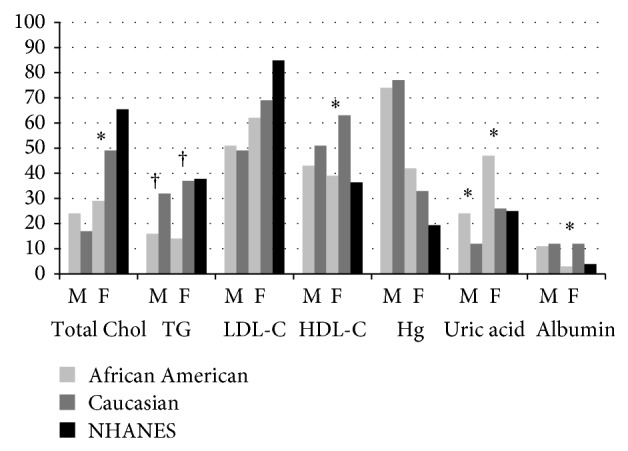
Background. The purpose of this study is to compare serum nutritional profiles in chronic stroke survivors to a representative sample of US Adults (NHANESIII) and determine whether these serum markers differed by race and impact physical function in stroke. Methods. Fasting serum samples were collected for analysis of lipids, uric acid, and albumin in 145 African American (AA) and 111 Caucasian (C) stroke survivors (age: 60 ± 1 years [mean ± SEM]). A six-minute walk was performed in a subset of stroke survivors (N = 134). Results. Triglycerides were higher and HDL-cholesterol and albumin lower in C than AA women stroke survivors (Ps < 0.05). Uric acid was lower in C than AA stroke survivors (P < 0.05). Compared to NHANESIII, HDL-cholesterol, albumin, and hemoglobin generally were lower (Ps < 0.05) and lipids were more favorable in stroke (Ps < 0.01). Uric acid was related to six-minute walk performance among a subset of stroke survivors (P < 0.05). Conclusion. In stroke, racial differences exist with regard to serum nutritional risk, but these differences are similar to that observed in the general population. Regardless of race, nutritional risk appears elevated above that of the general population with regard to many of the serum markers. As a modifiable biomarker, uric acid should be monitored closely as it may provide insight into the functional risk of stroke survivors.
背景。本研究的目的是比较慢性卒中幸存者与美国成年人代表性样本(NHANESIII)的血清营养状况,并确定这些血清标志物是否因种族而异以及对卒中患者的身体功能产生影响。方法。收集了145名非裔美国(AA)和111名白人(C)卒中幸存者(年龄:60±1岁[均值±标准误])的空腹血清样本,用于分析血脂、尿酸和白蛋白。对一部分卒中幸存者(N = 134)进行了六分钟步行测试。结果。白人卒中女性幸存者的甘油三酯水平高于非裔美国女性幸存者,而高密度脂蛋白胆固醇和白蛋白水平则较低(P<0.05)。白人卒中幸存者的尿酸水平低于非裔美国卒中幸存者(P<0.05)。与NHANESIII相比,卒中患者的高密度脂蛋白胆固醇、白蛋白和血红蛋白水平普遍较低(P<0.05),而血脂情况则更有利(P<0.01)。尿酸与一部分卒中幸存者的六分钟步行表现相关(P<0.05)。结论。在卒中方面,血清营养风险存在种族差异,但这些差异与一般人群中观察到的差异相似。无论种族如何,就许多血清标志物而言,卒中患者的营养风险似乎高于一般人群。作为一种可改变的生物标志物,应密切监测尿酸,因为它可能有助于了解卒中幸存者的功能风险。