Rodiño-Janeiro Bruno K, Alonso-Cotoner Carmen, Pigrau Marc, Lobo Beatriz, Vicario María, Santos Javier
Neuro-Immuno-Gastroenterology Group, Digestive Diseases Research Unit, Gastroenterology Department, Hospital Universitari Vall d'Hebron, Vall d' Hebron Research Institute; and Department of Medicine, Universitat Autònoma de Barcelona, Centro de Investigación Biomédica en Red de Enfermedades Hepáticas y Digestivas (Ciberehd), Barcelona, Spain.
J Neurogastroenterol Motil. 2015 Jan 1;21(1):33-50. doi: 10.5056/jnm14084.
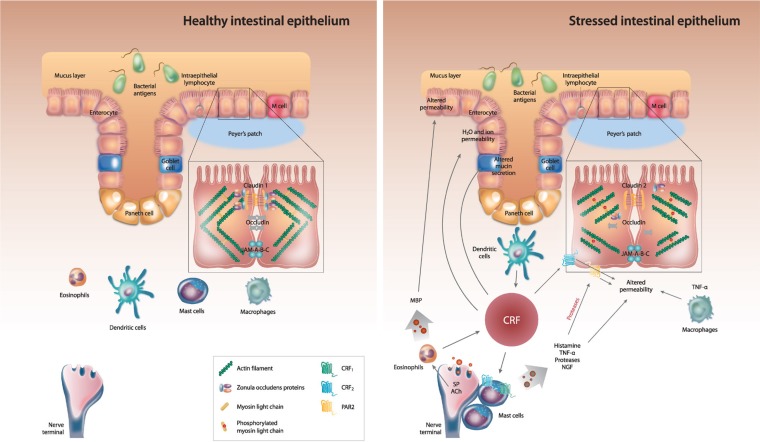
The interface between the intestinal lumen and the mucosa is the location where the majority of ingested immunogenic particles face the scrutiny of the vast gastrointestinal immune system. Upon regular physiological conditions, the intestinal microflora and the epithelial barrier are well prepared to process daily a huge amount of food-derived antigens and non-immunogenic particles. Similarly, they are ready to prevent environmental toxins and microbial antigens to penetrate further and interact with the mucosal-associated immune system. These functions promote the development of proper immune responses and oral tolerance and prevent disease and inflammation. Brain-gut axis structures participate in the processing and execution of response signals to external and internal stimuli. The brain-gut axis integrates local and distant regulatory networks and supersystems that serve key housekeeping physiological functions including the balanced functioning of the intestinal barrier. Disturbance of the brain-gut axis may induce intestinal barrier dysfunction, increasing the risk of uncontrolled immunological reactions, which may indeed trigger transient mucosal inflammation and gut disease. There is a large body of evidence indicating that stress, through the brain-gut axis, may cause intestinal barrier dysfunction, mainly via the systemic and peripheral release of corticotropin-releasing factor. In this review, we describe the role of stress and corticotropin-releasing factor in the regulation of gastrointestinal permeability, and discuss the link to both health and pathological conditions.
肠腔与黏膜之间的界面是大多数摄入的免疫原性颗粒接受庞大的胃肠免疫系统检查的部位。在正常生理条件下,肠道微生物群和上皮屏障已做好充分准备,每日处理大量源自食物的抗原和非免疫原性颗粒。同样,它们也能防止环境毒素和微生物抗原进一步渗透并与黏膜相关免疫系统相互作用。这些功能促进了适当免疫反应和口服耐受性的发展,并预防疾病和炎症。脑-肠轴结构参与对外部和内部刺激的反应信号的处理和执行。脑-肠轴整合了局部和远距离的调节网络及超级系统,这些系统发挥着关键的维持生理功能的作用,包括肠道屏障的平衡运作。脑-肠轴的紊乱可能导致肠道屏障功能障碍,增加不受控制的免疫反应风险,这确实可能引发短暂的黏膜炎症和肠道疾病。有大量证据表明,压力通过脑-肠轴可能导致肠道屏障功能障碍,主要是通过促肾上腺皮质激素释放因子的全身和外周释放。在本综述中,我们描述了压力和促肾上腺皮质激素释放因子在调节胃肠通透性中的作用,并讨论了与健康和病理状况的联系。