Maheshwari Rajesh A, Balaraman R, Sen Ashim K, Seth A K
Department of Pharmacy, Sumandeep Vidyapeeth, Piparia, Vadodara, Gujarat, India.
Indian J Pharmacol. 2014 Nov-Dec;46(6):627-32. doi: 10.4103/0253-7613.144924.
This study was aimed to investigate the therapeutic potential of coenzyme Q10 and its combination with metformin on streptozotocin (STZ)-nicotinamide-induced diabetic nephropathy (DN).
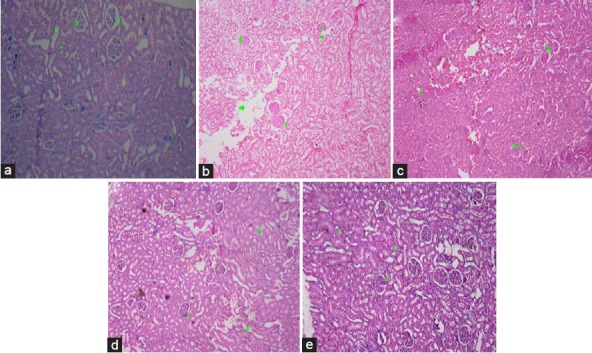
Type 2 diabetes in rats was induced with STZ-nicotinamide. The diabetic rats were treated with coenzyme Q10 (10 mg/kg, p.o.) alone or coenzyme Q10 + metformin. Various parameters of renal function tests such as serum creatinine, urea, uric acid, and markers of oxidative stress such as renal malondialdehyde (MDA) level, superoxide dismutase (SOD), and catalase (CAT) activities were measured. Tumor necrosis factor-α (TNF-α), myeloperoxidase (MPO) activity, transforming growth factor-β (TGF-β), and nitrite content were estimated in renal tissues. All treated animal were subjected to histopathological changes of kidney.
Diabetic rats showed a significant reduction in renal function, which was reflected with an increase in serum urea, serum creatinine, uric acid. In addition, STZ-nicotinamide caused renal tubular damage with a higher MDA level, depletion of SOD and CAT activity and glutathione (GSH) level. Moreover, TNF-α, MPO activity, TGF-β, and nitrite content were significantly increased in diabetic rats, while treatment with coenzyme Q10 or metformin or their combination ameliorate STZ-nicotinamide induced renal damage due to improvement in renal function, oxidative stress, suppression of TNF-α, MPO activity, TGF-β and nitrite content along with histopathological changes.
This finding suggests that the treatment with coenzyme Q10 or metformin showed significant renoprotective effect against STZ-nicotinamide-induced DN. However, concomitant administration of both showed a better renoprotective effect than coenzyme Q10 or metformin alone treatment.
本研究旨在探讨辅酶Q10及其与二甲双胍联合应用对链脲佐菌素(STZ)-烟酰胺诱导的糖尿病肾病(DN)的治疗潜力。
用STZ-烟酰胺诱导大鼠患2型糖尿病。糖尿病大鼠单独接受辅酶Q10(10mg/kg,口服)或辅酶Q10+二甲双胍治疗。测量了各种肾功能测试参数,如血清肌酐、尿素、尿酸,以及氧化应激指标,如肾丙二醛(MDA)水平、超氧化物歧化酶(SOD)和过氧化氢酶(CAT)活性。评估了肾组织中的肿瘤坏死因子-α(TNF-α)、髓过氧化物酶(MPO)活性、转化生长因子-β(TGF-β)和亚硝酸盐含量。对所有接受治疗的动物进行肾脏组织病理学变化检查。
糖尿病大鼠的肾功能显著降低,表现为血清尿素、血清肌酐、尿酸升高。此外,STZ-烟酰胺导致肾小管损伤,MDA水平升高,SOD和CAT活性以及谷胱甘肽(GSH)水平降低。而且,糖尿病大鼠的TNF-α、MPO活性、TGF-β和亚硝酸盐含量显著增加,而辅酶Q10或二甲双胍或它们的联合治疗可改善STZ-烟酰胺诱导的肾损伤,这是由于肾功能、氧化应激得到改善,TNF-α、MPO活性、TGF-β和亚硝酸盐含量受到抑制,同时伴有组织病理学变化。
这一发现表明,辅酶Q10或二甲双胍治疗对STZ-烟酰胺诱导的DN具有显著的肾脏保护作用。然而,两者联合给药显示出比单独使用辅酶Q10或二甲双胍更好地肾脏保护作用。