Medical Physics and Cluster of Excellence Hearing4all, Oldenburg University Germany.
Front Neurosci. 2014 Dec 4;8:391. doi: 10.3389/fnins.2014.00391. eCollection 2014.
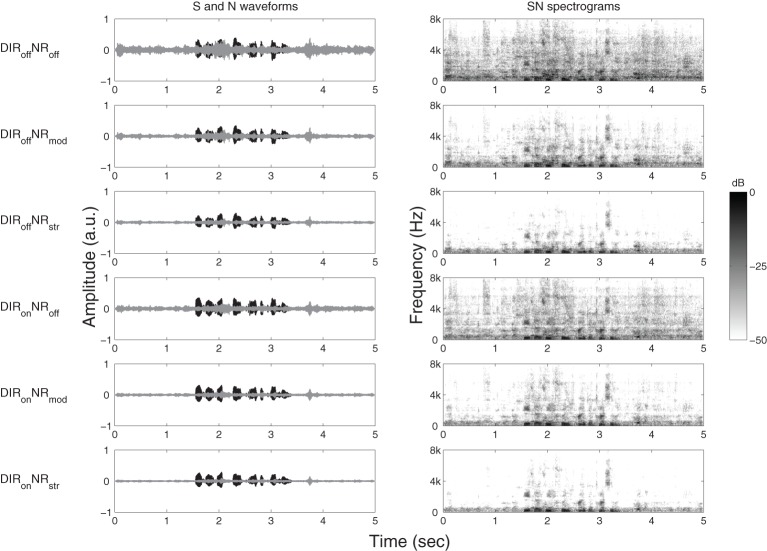
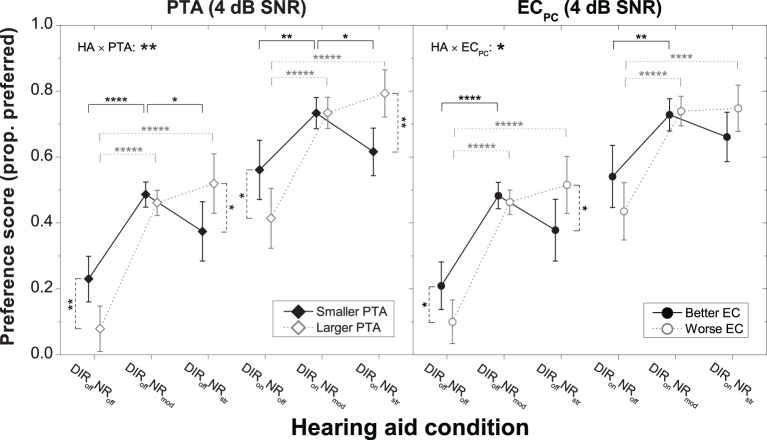
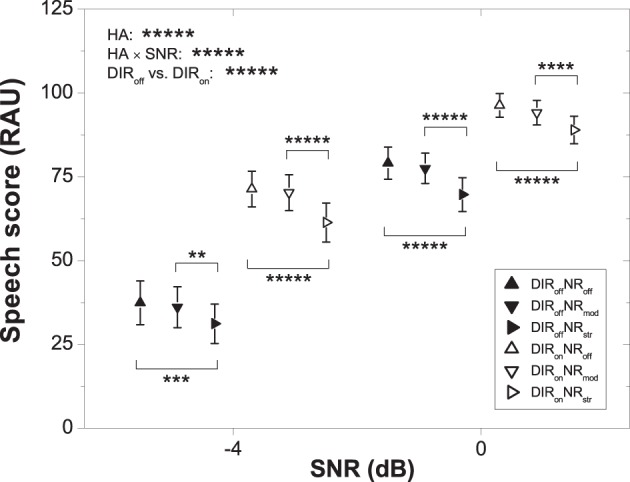
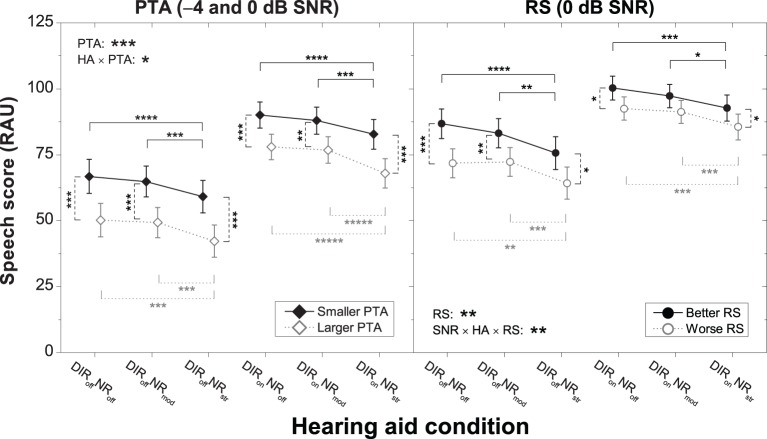
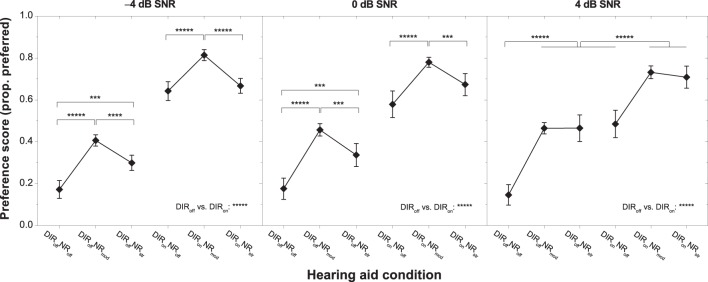
Knowledge of how executive functions relate to preferred hearing aid (HA) processing is sparse and seemingly inconsistent with related knowledge for speech recognition outcomes. This study thus aimed to find out if (1) performance on a measure of reading span (RS) is related to preferred binaural noise reduction (NR) strength, (2) similar relations exist for two different, non-verbal measures of executive function, (3) pure-tone average hearing loss (PTA), signal-to-noise ratio (SNR), and microphone directionality (DIR) also influence preferred NR strength, and (4) preference and speech recognition outcomes are similar. Sixty elderly HA users took part. Six HA conditions consisting of omnidirectional or cardioid microphones followed by inactive, moderate, or strong binaural NR as well as linear amplification were tested. Outcome was assessed at fixed SNRs using headphone simulations of a frontal target talker in a busy cafeteria. Analyses showed positive effects of active NR and DIR on preference, and negative and positive effects of, respectively, strong NR and DIR on speech recognition. Also, while moderate NR was the most preferred NR setting overall, preference for strong NR increased with SNR. No relation between RS and preference was found. However, larger PTA was related to weaker preference for inactive NR and stronger preference for strong NR for both microphone modes. Equivalent (but weaker) relations between worse performance on one non-verbal measure of executive function and the HA conditions without DIR were found. For speech recognition, there were relations between HA condition, PTA, and RS, but their pattern differed from that for preference. Altogether, these results indicate that, while moderate NR works well in general, a notable proportion of HA users prefer stronger NR. Furthermore, PTA and executive functions can account for some of the variability in preference for, and speech recognition with, different binaural NR and DIR settings.
关于执行功能与首选助听器 (HA) 处理之间的关系的知识还很匮乏,而且似乎与言语识别结果的相关知识不一致。因此,本研究旨在探讨以下问题:(1) 阅读广度 (RS) 测试的表现是否与首选双耳降噪 (NR) 强度有关;(2) 对于两种不同的非言语执行功能测试,是否存在类似的关系;(3) 纯音平均听力损失 (PTA)、信噪比 (SNR) 和麦克风指向性 (DIR) 是否也会影响首选 NR 强度;(4) 偏好和言语识别结果是否相似。共有 60 名老年 HA 用户参与了研究。测试了六种 HA 条件,包括全向或心型麦克风,以及不活跃、中度或高强度的双耳 NR 以及线性放大。使用头戴耳机模拟正面目标说话者在嘈杂餐厅中的情况,在固定 SNR 下评估结果。分析显示,主动 NR 和 DIR 对偏好有积极影响,而强烈 NR 和 DIR 则分别对言语识别有负面影响和积极影响。此外,虽然中度 NR 总体上是最受欢迎的 NR 设置,但随着 SNR 的增加,人们对强烈 NR 的偏好也会增加。没有发现 RS 与偏好之间的关系。但是,较大的 PTA 与不活跃 NR 的偏好较弱以及对强烈 NR 的偏好较强有关,无论使用哪种麦克风模式。在不使用 DIR 的情况下,一个非言语执行功能测试的表现越差,与 HA 条件的关系就越强,结果也是如此。对于言语识别,HA 条件、PTA 和 RS 之间存在关系,但与偏好的模式不同。总的来说,这些结果表明,虽然中度 NR 通常效果很好,但相当一部分 HA 用户更喜欢更强的 NR。此外,PTA 和执行功能可以解释不同双耳 NR 和 DIR 设置的偏好和言语识别能力的一些可变性。