Department of Neurology, University of Munich Munich, Germany ; German Center for Vertigo and Balance Disorders (DSGZ), University of Munich Munich, Germany.
German Center for Vertigo and Balance Disorders (DSGZ), University of Munich Munich, Germany ; Institute for Clinical Neurosciences, University of Munich Munich, Germany.
Front Hum Neurosci. 2014 Dec 4;8:963. doi: 10.3389/fnhum.2014.00963. eCollection 2014.
Visual height intolerance (vHI) manifests as instability at heights with apprehension of losing balance or falling. We investigated contributions of visual feedback and attention on gait performance of subjects with vHI.
Sixteen subjects with vHI walked over a gait mat (GAITRite®) on a 15-m-high balcony and at ground-level. Subjects walked at different speeds (slow, preferred, fast), during changes of the visual input (gaze straight/up/down; eyes open/closed), and while doing a cognitive task. An rmANOVA with the factors "height situation" and "gait condition" was performed. Subjects were also asked to estimate the height of the balcony over ground level. The individual estimates were used for correlations with the gait parameters.
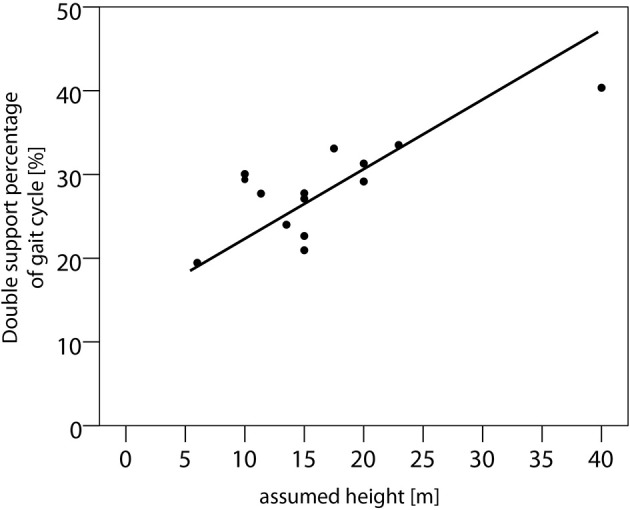
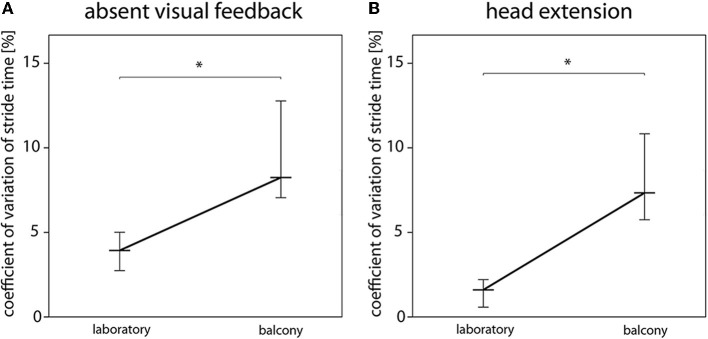
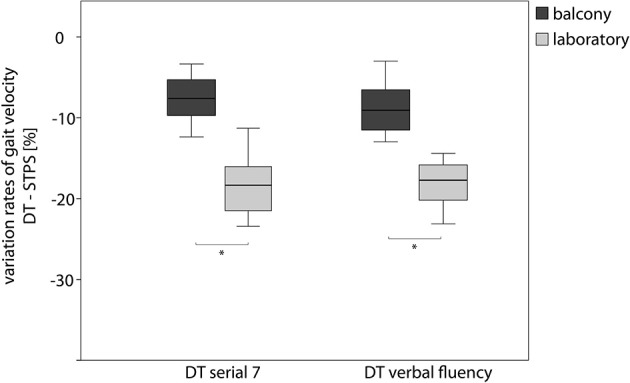
Study participants walked slower at heights, with reduced cadence and stride length. The double support phases were increased (all p < 0.01), which correlated with the estimated height of the balcony (R (2) = 0.453, p < 0.05). These changes were still present when walking with upward gaze or closure of the eyes. Under the conditions walking and looking down to the floor of the balcony, during dual-task and fast walking, there were no differences between the gait performance on the balcony and at ground-level.
The found gait changes are features of a cautious gait control. Internal, cognitive models with anxiety play an important role for vHI; gait was similarly affected when the visual perception of the depth was prevented. Improvement by dual task at heights may be associated by a reduction of the anxiety level.
It is conceivable that mental distraction by dual task or increasing the walking speed might be useful recommendations to reduce the imbalance during locomotion in subjects susceptible to vHI.
视觉高度不耐受(vHI)表现为在高处时不稳定,伴有失去平衡或摔倒的恐惧。我们研究了视觉反馈和注意力对 vHI 患者步态表现的影响。
16 名 vHI 患者在 15 米高的阳台上和地面上行走于步态垫(GAITRite®)上。受试者以不同速度(慢、舒适、快)、改变视觉输入(直视/向上/向下看;睁眼/闭眼)和进行认知任务时行走。采用“高度情况”和“步态情况”的重复测量方差分析。还要求受试者估计阳台相对于地面的高度。将个体估计值与步态参数进行相关分析。
研究参与者在高处行走速度较慢,步频和步长减小。双支撑阶段增加(均 p < 0.01),与阳台估计高度相关(R (2) = 0.453,p < 0.05)。当向上看或闭眼行走时,这些变化仍然存在。在向地面看和在双重任务及快速行走时,在阳台上和地面上的步态表现没有差异。
所发现的步态变化是谨慎步态控制的特征。焦虑的内部、认知模型在 vHI 中起着重要作用;当深度的视觉感知受到阻碍时,步态也会受到同样的影响。在高处进行双重任务可以改善,这可能与焦虑水平降低有关。
可以想象,通过双重任务或提高行走速度来分散注意力,可能有助于减少易患 vHI 的患者在运动中出现平衡失调的情况。