Department of Developmental Biology and Cancer Research, Institute for Medical Research Israel Canada, Hebrew University Medical School , Jerusalem , Israel.
Front Immunol. 2014 Dec 5;5:625. doi: 10.3389/fimmu.2014.00625. eCollection 2014.
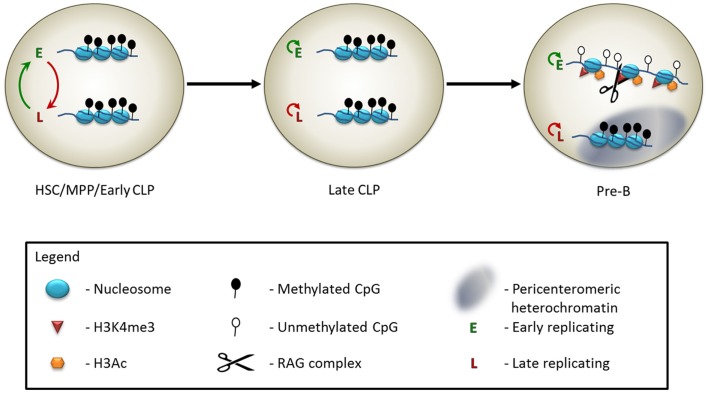
While most genes in the mammalian genome are transcribed from both parental chromosomes in cells where they are expressed, approximately 10% of genes are expressed monoallelically, so that any given cell will express either the paternal or maternal allele, but not both. The antigen receptor genes in B and T cells are well-studied examples of a gene family, which is expressed in a monoallelic manner, in a process coined "allelic exclusion." During lymphocyte development, only one allele of each antigen receptor undergoes V(D)J rearrangement at a time, and once productive rearrangement is sensed, rearrangement of the second allele is prevented. In this mini review, we discuss the epigenetic processes, including asynchronous replication, nuclear localization, chromatin condensation, histone modifications, and DNA methylation, which appear to regulate the primary rearrangement of a single allele, while blocking the rearrangement of the second allele.
虽然哺乳动物基因组中的大多数基因在表达它们的细胞中都从双亲染色体转录,但大约 10%的基因以单等位基因的方式表达,因此任何给定的细胞都将表达父本或母本等位基因,但不会同时表达两者。B 和 T 细胞中的抗原受体基因是一个基因家族的很好的例子,该基因家族以单等位基因的方式表达,这个过程被称为“等位基因排斥”。在淋巴细胞发育过程中,每次只有一个抗原受体的等位基因发生 V(D)J 重排,一旦感知到有产物性的重排,就会阻止第二个等位基因的重排。在这篇迷你综述中,我们讨论了似乎调节单等位基因的初始重排,同时阻止第二个等位基因重排的表观遗传过程,包括非同步复制、核定位、染色质浓缩、组蛋白修饰和 DNA 甲基化。