Chair of Genetics, Department of Biology, Nikolaus-Fiebiger-Center for Molecular Medicine, Friedrich-Alexander-University Erlangen-Nuremberg, Erlangen, Germany.
Department of Rheumatology and Inflammation Research, Institute of Medicine, The Sahlgrenska Academy, University of Gothenburg, Gothenburg, Sweden.
Front Immunol. 2018 Nov 15;9:2423. doi: 10.3389/fimmu.2018.02423. eCollection 2018.
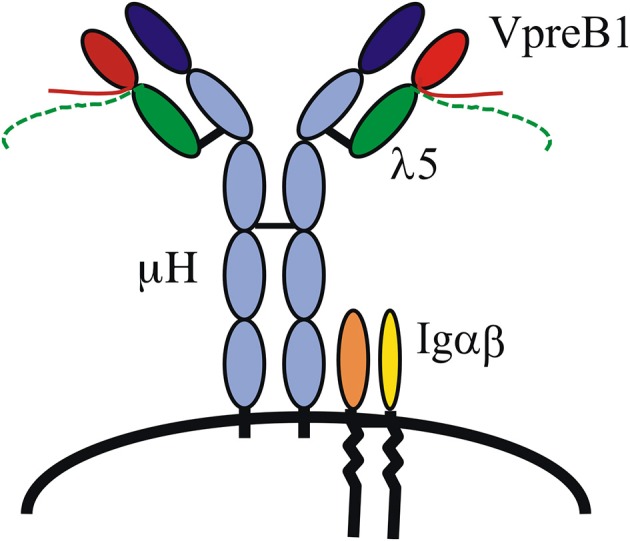
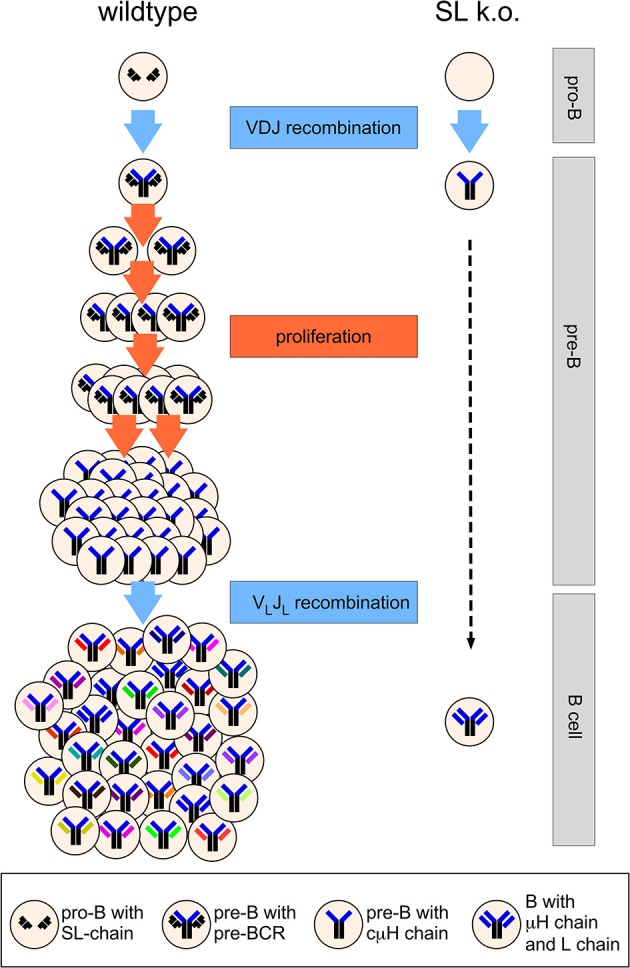
Around four decades ago, it had been observed that there were cell lines as well as cells in the fetal liver that expressed antibody μ heavy (μH) chains in the apparent absence of light chains. It was thus possible that these cells expressed another molecule(s), that assembled with μH chains. The ensuing studies led to the discovery of the pre-B cell receptor (pre-BCR), which is assembled from Ig μH and surrogate light (SL) chains, together with the signaling molecules Igα and β. It is expressed on a fraction of pro-B (pre-BI) cells and most large pre-B(II) cells, and has been implicated in IgH chain allelic exclusion and down-regulation of the recombination machinery, assessment of the expressed μH chains and shaping the IgH repertoire, transition from the pro-B to pre-B stage, pre-B cell expansion, and cessation.
大约四十年前,人们观察到胎肝中有细胞系和细胞表达抗体μ重(μH)链,而明显没有轻链。因此,这些细胞可能表达另一种分子(或多种分子),与μH 链组装在一起。随后的研究发现了前 B 细胞受体(pre-BCR),它由 IgμH 和替代轻(SL)链与信号分子 Igα 和β组装而成。它表达于一部分前 B(pre-BI)细胞和大多数大前 B(II)细胞上,并被认为参与 IgH 链等位基因排斥和重组机制下调、评估表达的μH 链和塑造 IgH 库、从前 B 到 pre-B 阶段的转变、前 B 细胞扩增和终止。