Ellison Amy R, Tunstall Tate, DiRenzo Graziella V, Hughey Myra C, Rebollar Eria A, Belden Lisa K, Harris Reid N, Ibáñez Roberto, Lips Karen R, Zamudio Kelly R
Department of Ecology and Evolutionary Biology, Cornell University
Department of Biology, University of Maryland, College Park.
Genome Biol Evol. 2014 Dec 23;7(1):286-98. doi: 10.1093/gbe/evu285.
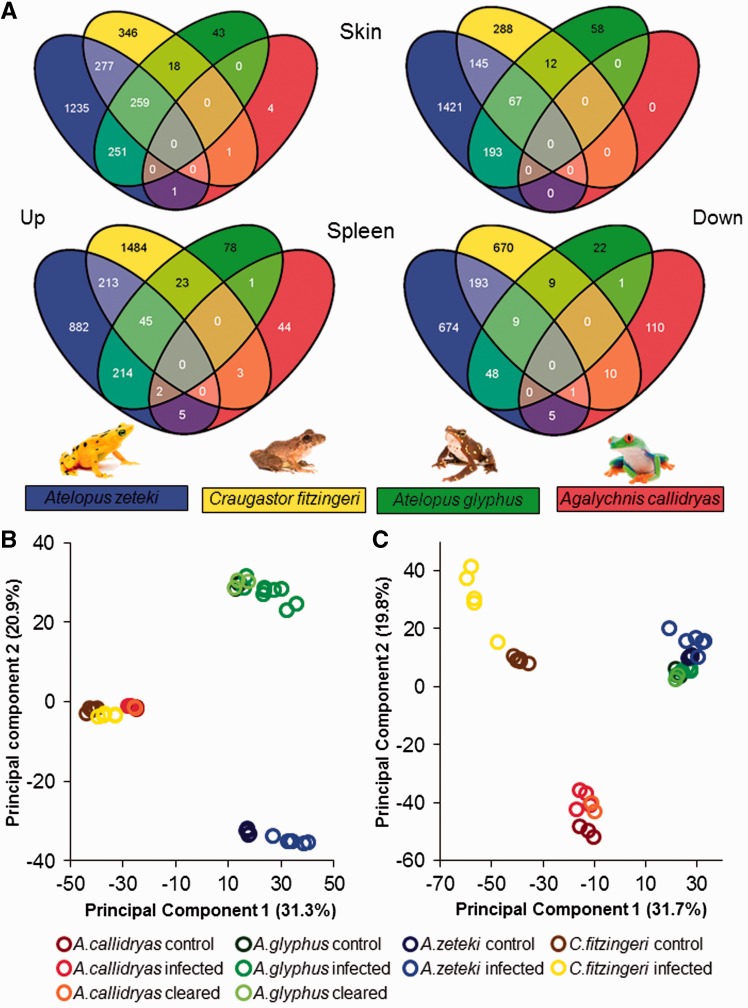
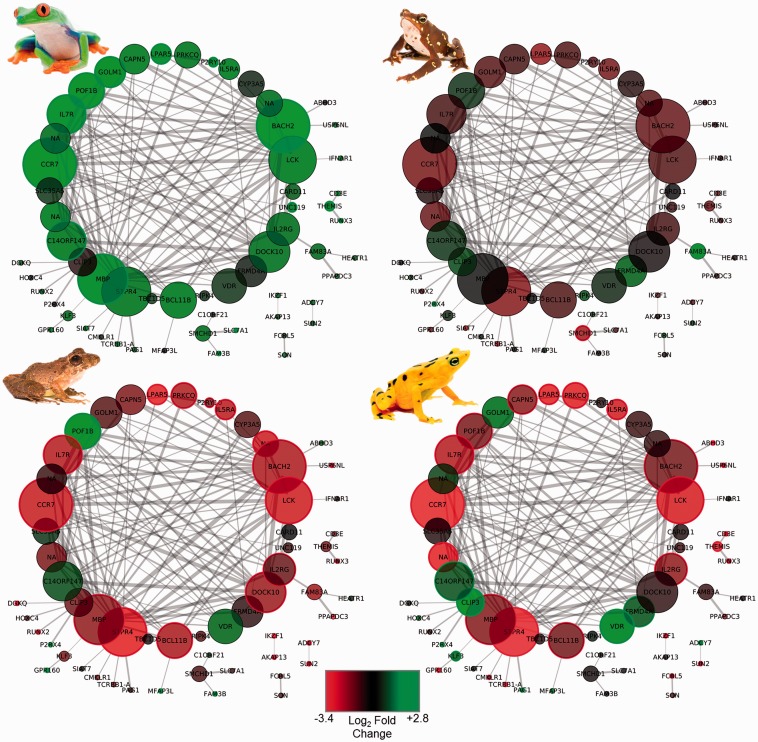
The amphibian-killing chytrid fungus Batrachochytrium dendrobatidis (Bd) is one of the most generalist pathogens known, capable of infecting hundreds of species globally and causing widespread population declines and extinctions. However, some host species are seemingly unaffected by Bd, tolerating or clearing infections without clinical signs of disease. Variation in host immune responses is commonly evoked for these resistant or tolerant species, yet to date, we have no direct comparison of amphibian species responses to infection at the level of gene expression. In this study, we challenged four Central American frog species that vary in Bd susceptibility, with a sympatric virulent strain of the pathogen. We compared skin and spleen orthologous gene expression using differential expression tests and coexpression gene network analyses. We found that resistant species have reduced skin inflammatory responses and increased expression of genes involved in skin integrity. In contrast, only highly susceptible species exhibited suppression of splenic T-cell genes. We conclude that resistance to chytridiomycosis may be related to a species' ability to escape the immunosuppressive activity of the fungus. Moreover, our results indicate that within-species differences in splenic proteolytic enzyme gene expression may contribute to intraspecific variation in survival. This first comparison of amphibian functional immunogenomic architecture in response to Bd provides insights into key genetic mechanisms underlying variation in disease outcomes among amphibian species.
导致两栖动物死亡的壶菌——蛙壶菌(Batrachochytrium dendrobatidis,简称Bd)是已知的最具广谱性的病原体之一,能够感染全球数百个物种,并导致大量种群数量下降和物种灭绝。然而,一些宿主物种似乎不受Bd影响,能够耐受或清除感染且无疾病的临床症状。对于这些具有抗性或耐受性的物种,通常认为是宿主免疫反应存在差异,但迄今为止,我们尚未在基因表达水平上对两栖动物物种对感染的反应进行直接比较。在本研究中,我们用一种同域分布的致病力强的菌株对四种对Bd易感性不同的中美洲蛙类物种进行了挑战。我们使用差异表达测试和共表达基因网络分析比较了皮肤和脾脏的直系同源基因表达。我们发现,抗性物种的皮肤炎症反应减弱,参与皮肤完整性的基因表达增加。相比之下,只有高度易感物种的脾脏T细胞基因受到抑制。我们得出结论,对蛙壶菌病的抗性可能与一个物种逃避真菌免疫抑制活性的能力有关。此外,我们的结果表明,脾脏蛋白水解酶基因表达的种内差异可能导致种内存活率的差异。这首次对两栖动物对Bd反应的功能免疫基因组结构进行的比较,为两栖动物物种间疾病结果差异背后的关键遗传机制提供了见解。