Upadhyay Priti, Liabsuetrakul Tippawan, Shrestha Amir Babu, Pradhan Neelam
Epidemiology Unit, Faculty of Medicine, Prince of Songkla University, Hat Yai, Songkhla, Thailand, 90110.
Reprod Health. 2014 Dec 23;11:92. doi: 10.1186/1742-4755-11-92.
In some developing countries a woman's decision to utilize maternal health care services is not made by the woman herself but by other family members. The perception of family members regarding who is the most influential person for making the decision to utilize these services is inconclusive. Hence, this study aimed to determine the perceived influential person on utilization of antenatal care (ANC) and delivery care services among teen, young adult and adult pregnant women from the perspective of the woman themselves, their husband and their mother-in-law, identify the factors associated with the woman being the most influential person, and assess the level of agreement between the woman's and her husband's response to the woman being the most influential person.
A cross-sectional study was conducted at Paropakar Maternity and Women's Hospital and Tribhuvan University Teaching Hospital. Purposive sampling technique was used to select 315 women of which 105 were from each age group and their accompanied husbands (n = 315) and mothers-in-law (n = 315). The proportion of perceived influential person and mean priority score of the perceived influence with its 95% confidence interval was calculated. The factors associated with the woman perceived as the most influential person were analyzed by multivariate logistic regression model. The agreement was analyzed using kappa statistic.
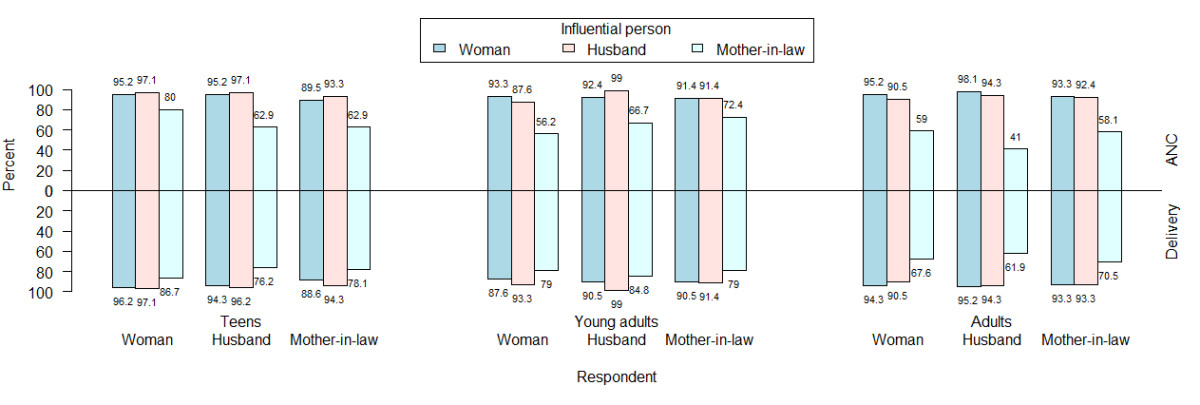
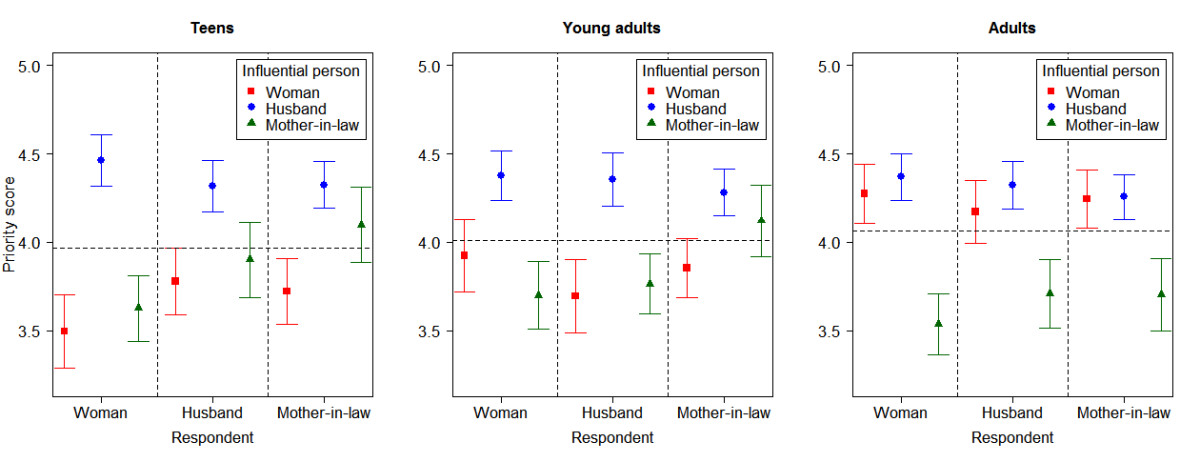
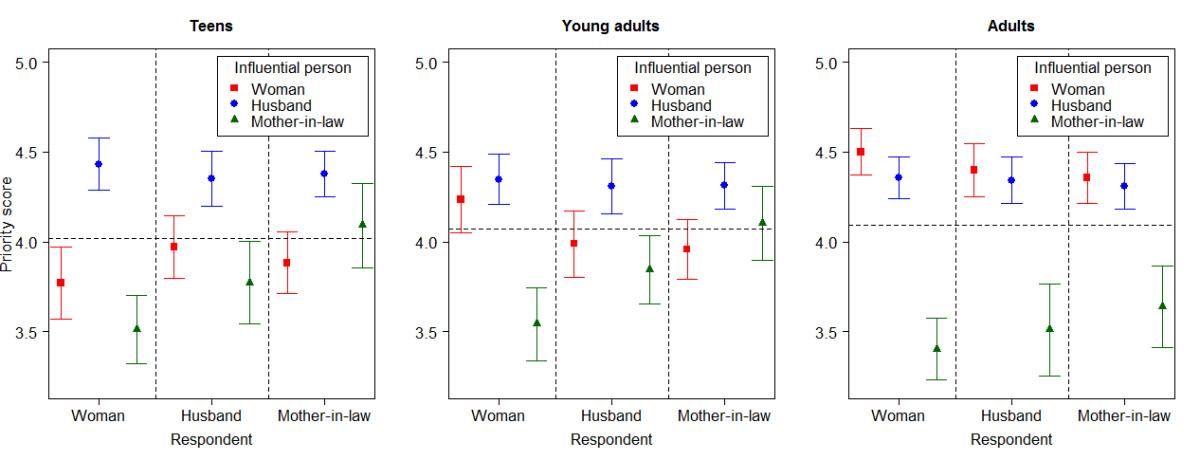
Among teens and young adults and their husband and mother-in-law, the woman's husband was perceived as the most influential person. Among adults, the most influential person for ANC was the woman herself but for delivery care was the woman's husband. A woman of adult age, having a non-indigenous ethnicity or who was not referred was more likely to perceive herself as the most influential person in the decision to utilize delivery care. A fair to poor level of agreement was found on the perception of the most influential person for ANC and delivery care utilization.
Both women and their husbands influenced the decision to utilize ANC and delivery care but husbands were more influential, especially in teens and young adults. Thus, husband's involvement is crucial as a strategy to improve maternal health care utilization in Nepal.
在一些发展中国家,女性是否使用孕产妇保健服务的决定并非由其本人做出,而是由其他家庭成员决定。家庭成员对于谁是做出使用这些服务决定的最有影响力的人看法不一。因此,本研究旨在从女性自身、其丈夫和婆婆的角度,确定青少年、年轻成年人及成年孕妇在使用产前保健(ANC)和分娩护理服务方面被认为最有影响力的人,确定与女性成为最有影响力的人相关的因素,并评估女性及其丈夫对于女性是最有影响力的人这一回答的一致程度。
在帕罗帕卡尔妇产医院和特里布万大学教学医院进行了一项横断面研究。采用目的抽样技术选取了315名女性,每个年龄组105名,以及她们陪同的丈夫(n = 315)和婆婆(n = 315)。计算被认为最有影响力的人的比例以及感知影响力的平均优先级得分及其95%置信区间。通过多变量逻辑回归模型分析与被认为最有影响力的女性相关的因素。使用kappa统计量分析一致性。
在青少年、年轻成年人及其丈夫和婆婆中,女性的丈夫被认为是最有影响力的人。在成年人中,产前保健最有影响力的人是女性本人,但分娩护理方面是女性的丈夫。成年女性、非本地族裔或未被转诊的女性更有可能认为自己是使用分娩护理决定中最有影响力的人。在产前保健和分娩护理使用方面,对于最有影响力的人的认知存在中等至较差程度的一致性。
女性及其丈夫都影响了使用产前保健和分娩护理的决定,但丈夫的影响力更大,尤其是在青少年和年轻成年人中。因此,丈夫的参与作为提高尼泊尔孕产妇保健利用率的一项策略至关重要。