Wong Stephen Q, Behren Andreas, Mar Victoria J, Woods Katherine, Li Jason, Martin Claire, Sheppard Karen E, Wolfe Rory, Kelly John, Cebon Jonathan, Dobrovic Alexander, McArthur Grant A
Division of Cancer Research, Peter MacCallum Cancer Centre, East Melbourne, Victoria, Australia.
Ludwig Institute for Cancer Research, Olivia Newton-John Cancer and Wellness Centre Heidelberg, Victoria, Australia.
Oncotarget. 2015 Jan 20;6(2):1115-27. doi: 10.18632/oncotarget.2747.
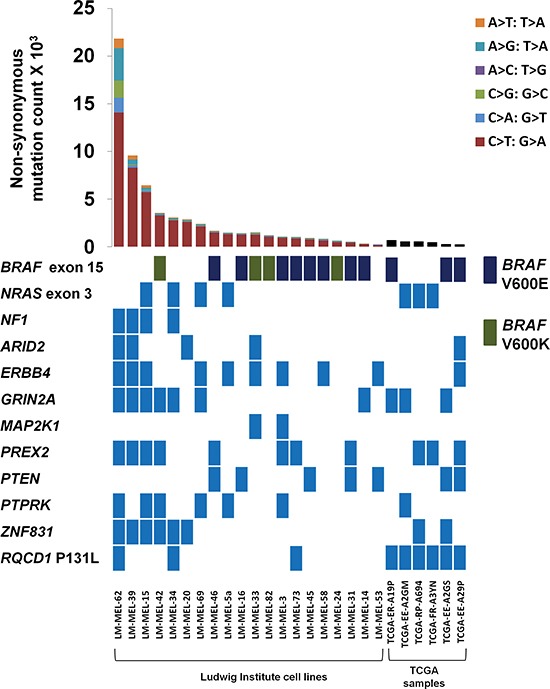
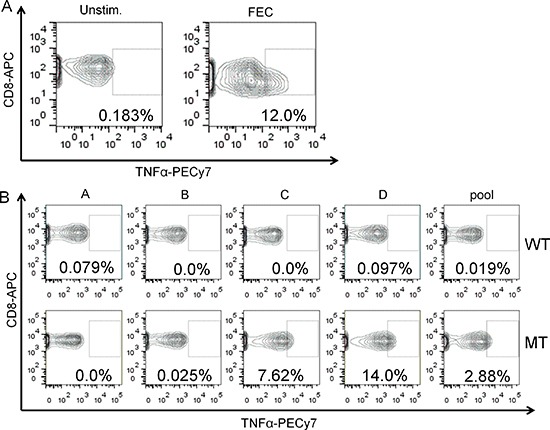
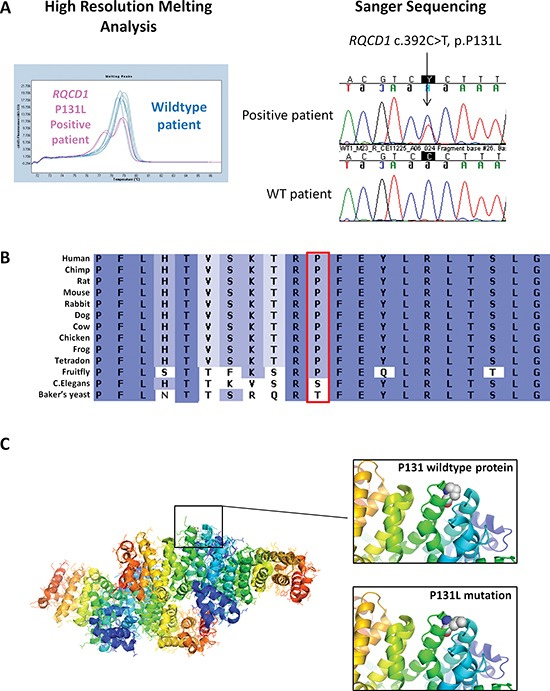
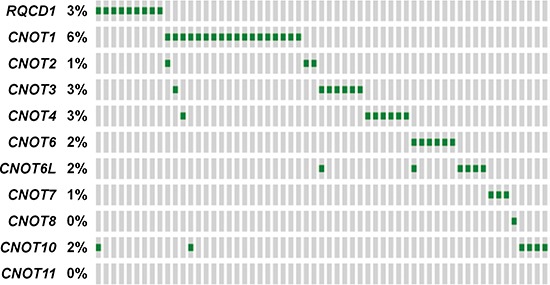
Melanoma is often caused by mutations due to exposure to ultraviolet radiation. This study reports a recurrent somatic C > T change causing a P131L mutation in the RQCD1 (Required for Cell Differentiation1 Homolog) gene identified through whole exome sequencing of 20 metastatic melanomas. Screening in 715 additional primary melanomas revealed a prevalence of ~4%. This represents the first reported recurrent mutation in a member of the CCR4-NOT complex in cancer. Compared to tumors without the mutation, the P131L mutant positive tumors were associated with increased thickness (p = 0.02), head and neck (p = 0.009) and upper limb (p = 0.03) location, lentigo maligna melanoma subtype (p = 0.02) and BRAF V600K (p = 0.04) but not V600E or NRAS codon 61 mutations. There was no association with nodal disease (p = 0.3). Mutually exclusive mutations of other members of the CCR4-NOT complex were found in ~20% of the TCGA melanoma dataset suggesting the complex may play an important role in melanoma biology. Mutant RQCD1 was predicted to bind strongly to HLA-A0201 and HLA-Cw3 MHC1 complexes. From thirteen patients with mutant RQCD1, an anti-tumor CD8⁺ T cell response was observed from a single patient's peripheral blood mononuclear cell population stimulated with mutated peptide compared to wildtype indicating a neoantigen may be formed.
黑色素瘤通常由暴露于紫外线辐射导致的突变引起。本研究报告了一种复发性体细胞C>T变化,通过对20例转移性黑色素瘤进行全外显子测序,在RQCD1(细胞分化所需蛋白1同源物)基因中发现了导致P131L突变。对另外715例原发性黑色素瘤进行筛查,发现患病率约为4%。这是首次报道癌症中CCR4-NOT复合物成员的复发性突变。与无该突变的肿瘤相比,P131L突变阳性肿瘤与肿瘤厚度增加(p=0.02)、头颈部(p=0.009)和上肢(p=0.03)部位、恶性雀斑样痣黑色素瘤亚型(p=0.02)以及BRAF V600K(p=0.04)相关,但与V600E或NRAS密码子61突变无关。与淋巴结疾病无关(p=0.3)。在约20%的TCGA黑色素瘤数据集中发现了CCR4-NOT复合物其他成员的相互排斥性突变,这表明该复合物可能在黑色素瘤生物学中起重要作用。预测突变型RQCD1与HLA-A0201和HLA-Cw3 MHC1复合物有强结合。在13例RQCD1突变患者中,与野生型相比,在用突变肽刺激的单个患者外周血单个核细胞群体中观察到抗肿瘤CD8⁺T细胞反应,这表明可能形成了新抗原。