Vanni Irene, Tanda Enrica Teresa, Dalmasso Bruna, Pastorino Lorenza, Andreotti Virginia, Bruno William, Boutros Andrea, Spagnolo Francesco, Ghiorzo Paola
Genetics of Rare Cancers, IRCCS Ospedale Policlinico San Martino, Genova, Italy.
Genetics of Rare Cancers, Department of Internal Medicine and Medical Specialties, University of Genoa, Genova, Italy.
Front Mol Biosci. 2020 Jul 24;7:172. doi: 10.3389/fmolb.2020.00172. eCollection 2020.
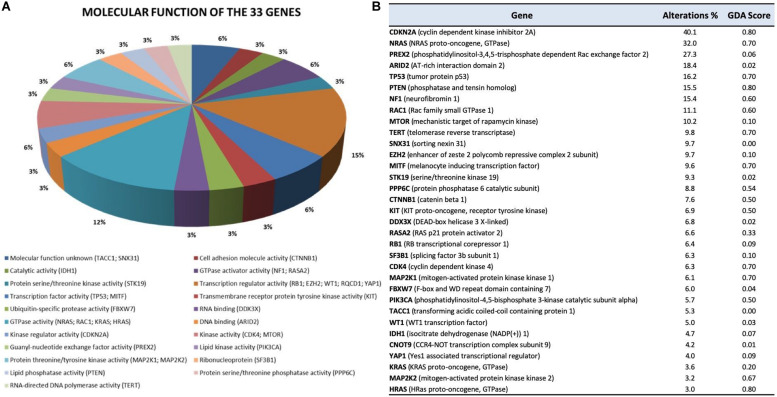
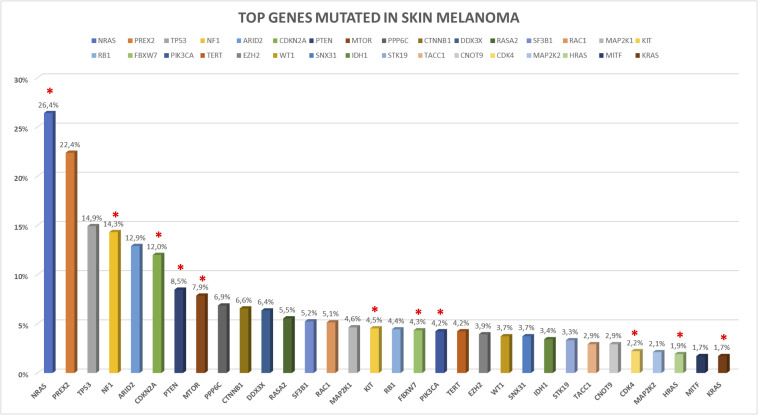
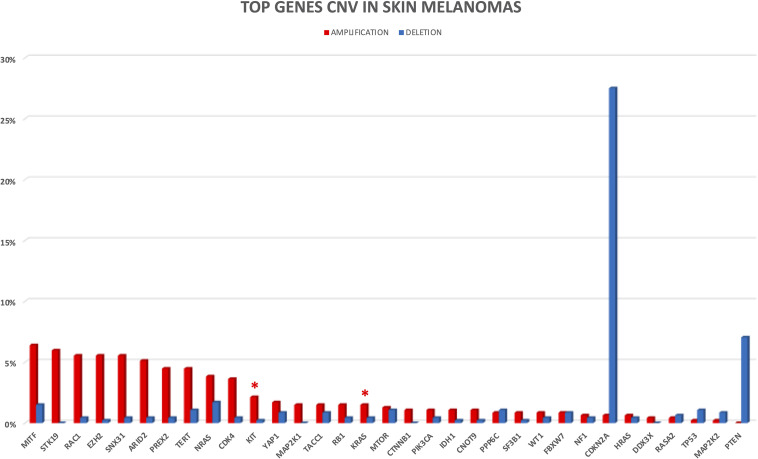
Melanoma is one of the most aggressive tumors of the skin, and its incidence is growing worldwide. Historically considered a drug resistant disease, since 2011 the therapeutic landscape of melanoma has radically changed. Indeed, the improved knowledge of the immune system and its interactions with the tumor, and the ever more thorough molecular characterization of the disease, has allowed the development of immunotherapy on the one hand, and molecular target therapies on the other. The increased availability of more performing technologies like Next-Generation Sequencing (NGS), and the availability of increasingly large genetic panels, allows the identification of several potential therapeutic targets. In light of this, numerous clinical and preclinical trials are ongoing, to identify new molecular targets. Here, we review the landscape of mutated non- skin melanoma, in light of recent data deriving from Whole-Exome Sequencing (WES) or Whole-Genome Sequencing (WGS) studies on melanoma cohorts for which information on the mutation rate of each gene was available, for a total of 10 NGS studies and 992 samples, focusing on available, or in experimentation, targeted therapies beyond those targeting mutated BRAF. Namely, we describe 33 established and candidate driver genes altered with frequency greater than 1.5%, and the current status of targeted therapy for each gene. Only 1.1% of the samples showed no coding mutations, whereas 30% showed at least one mutation in the genes (mostly ) and 70% showed mutations outside of the genes, suggesting potential new roads for targeted therapy. Ongoing clinical trials are available for 33.3% of the most frequently altered genes.
黑色素瘤是皮肤最具侵袭性的肿瘤之一,其发病率在全球范围内呈上升趋势。黑色素瘤在历史上被认为是一种耐药性疾病,但自2011年以来,其治疗格局发生了根本性变化。事实上,对免疫系统及其与肿瘤相互作用的深入了解,以及对该疾病越来越全面的分子特征分析,一方面推动了免疫疗法的发展,另一方面也推动了分子靶向疗法的发展。像新一代测序(NGS)这样性能更优的技术越来越普及,以及越来越大的基因检测板的出现,使得人们能够识别出多个潜在的治疗靶点。有鉴于此,目前正在进行大量的临床和临床前试验,以确定新的分子靶点。在此,我们根据对黑色素瘤队列进行全外显子测序(WES)或全基因组测序(WGS)研究得出的最新数据,综述突变型非皮肤黑色素瘤的情况,这些研究提供了每个基因的突变率信息,总共涉及10项NGS研究和992个样本,重点关注除靶向突变BRAF之外的现有或正在试验的靶向疗法。具体而言,我们描述了33个已确定的和候选的驱动基因,其改变频率大于1.5%,以及针对每个基因的靶向治疗现状。只有1.1%的样本未显示编码突变,而30%的样本在这些基因(主要是)中至少有一个突变,70%的样本在这些基因之外有突变,这为靶向治疗提示了潜在的新途径。针对33.3%的最常改变的基因,正在进行临床试验。