Nowakowski Andrzej, de Souza Sabrina Collas, Jach Robert, Rosillon Dominique, Książek Alicja, Holl Katsiaryna
Department of Oncologic Gynecology and Gynecology, Medical University of Lublin, ul. Staszica 16, 20-081, Lublin, Poland,
Pathol Oncol Res. 2015 Jul;21(3):703-11. doi: 10.1007/s12253-014-9877-4. Epub 2014 Dec 30.
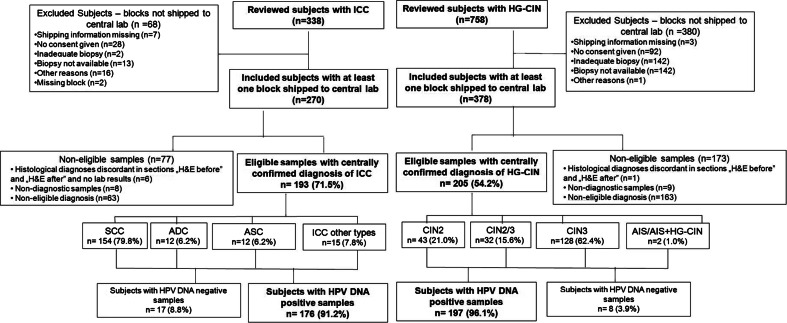
This study was performed to assess attribution of high grade cervical intraepithelial neoplasia (HG-CIN) and invasive cervical cancer (ICC) to human papillomavirus (HPV) genotypes and secondarily to assess reproducibility of HG-CIN/ICC diagnosis obtained in Poland. Formaldehyde fixed, paraffin embedded blocks of HG-CIN/ICC from two distant institutions were sent to a central laboratory together with original histological diagnoses. Central/expert review of histopathological specimens was performed and agreement between local and central/expert diagnoses was calculated. HPV detection and genotyping in the samples was carried out with the use of SPF10-LiPA25 technology. Results were analyzed for 205 HG-CIN and 193 ICC cases with centrally confirmed diagnoses. Kappa coefficients and 95 % confidence intervals for HG-CIN and ICC diagnoses were: 0.13 (0.09;0.17) and 0.19 (0.11;0.26) respectively. Cohen's kappa coefficients for lesions with representative number of samples ranged from 0.01 for cervical intraepithelial neoplasia grade 2 to 0.75 for adenocarcinoma. HPV DNA was detected in 96.1 and 91.2 % of the confirmed HG-CIN and ICC specimens respectively. HPV positive HG-CIN was most commonly attributed to HPV types: 16 (62.8), 33 (7.8), 31 (6.6), 52 (3.7), 45 (2.6) and 58 (2.6 %). HPV positive ICC was most commonly attributed to HPV types: 16 (72.1), 18 (10.8), 33 (5.7), 45 (3.4) and 31 (1.7 %). Reproducibility of histological diagnosis of HG-CIN/ICC obtained in Poland generally increases with the severity of lesion and is lowest for cervical intraepithelial neoplasia grade 2 and highest for adenocarcinoma. Over 80 % of ICC cases are vaccine-preventable in Poland.
本研究旨在评估高级别宫颈上皮内瘤变(HG-CIN)和浸润性宫颈癌(ICC)与人乳头瘤病毒(HPV)基因型的相关性,并其次评估在波兰获得的HG-CIN/ICC诊断的可重复性。来自两个不同机构的HG-CIN/ICC甲醛固定、石蜡包埋块与原始组织学诊断一起被送至中央实验室。对组织病理学标本进行中央/专家审查,并计算局部与中央/专家诊断之间的一致性。使用SPF10-LiPA25技术对样本进行HPV检测和基因分型。对205例经中央确诊的HG-CIN和193例ICC病例的结果进行了分析。HG-CIN和ICC诊断的Kappa系数及95%置信区间分别为:0.13(0.09;0.17)和0.19(0.11;0.26)。具有代表性样本数量的病变的Cohen's kappa系数范围从宫颈上皮内瘤变2级的0.01到腺癌的0.75。分别在96.1%和91.2%经确诊的HG-CIN和ICC标本中检测到HPV DNA。HPV阳性的HG-CIN最常见的归因于HPV类型:16型(62.8%)、33型(7.8%)、31型(6.6%)、52型(3.7%)、45型(2.6%)和58型(2.6%)。HPV阳性的ICC最常见的归因于HPV类型:16型(72.1%)、18型(10.8%)、33型(5.7%)、45型(3.4%)和31型(1.7%)。在波兰获得的HG-CIN/ICC组织学诊断的可重复性通常随病变严重程度增加,在宫颈上皮内瘤变2级时最低,在腺癌时最高。在波兰,超过80%的ICC病例是可通过疫苗预防的。