Oken Barry S, Chamine Irina, Wakeland Wayne
Department of Neurology, Oregon Health & Science University, CR-120, 3181 SW Sam Jackson Park Road, Portland, OR 97239, USA; Department of Behavioral Neuroscience & Biomedical Engineering, Oregon Health & Science University, CR-120, 3181 SW Sam Jackson Park Road, Portland, OR 97239, USA.
Department of Neurology, Oregon Health & Science University, CR-120, 3181 SW Sam Jackson Park Road, Portland, OR 97239, USA.
Behav Brain Res. 2015 Apr 1;282:144-54. doi: 10.1016/j.bbr.2014.12.047. Epub 2014 Dec 27.
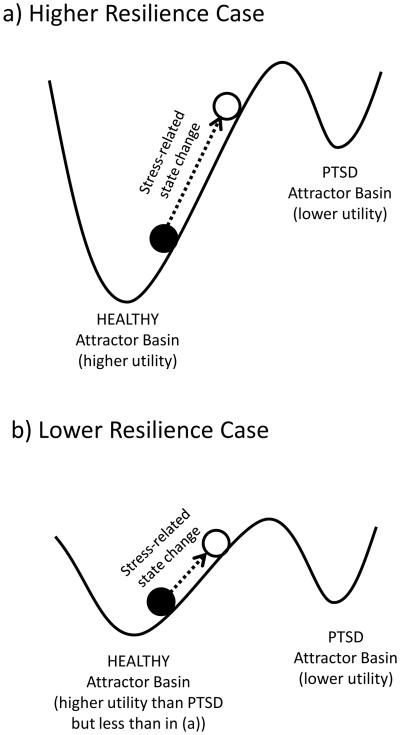
The paper focuses on the biology of stress and resilience and their biomarkers in humans from the system science perspective. A stressor pushes the physiological system away from its baseline state toward a lower utility state. The physiological system may return toward the original state in one attractor basin but may be shifted to a state in another, lower utility attractor basin. While some physiological changes induced by stressors may benefit health, there is often a chronic wear and tear cost due to implementing changes to enable the return of the system to its baseline state and maintain itself in the high utility baseline attractor basin following repeated perturbations. This cost, also called allostatic load, is the utility reduction associated with both a change in state and with alterations in the attractor basin that affect system responses following future perturbations. This added cost can increase the time course of the return to baseline or the likelihood of moving into a different attractor basin following a perturbation. Opposite to this is the system's resilience which influences its ability to return to the high utility attractor basin following a perturbation by increasing the likelihood and/or speed of returning to the baseline state following a stressor. This review paper is a qualitative systematic review; it covers areas most relevant for moving the stress and resilience field forward from a more quantitative and neuroscientific perspective.
本文从系统科学的角度聚焦于人类应激与恢复力的生物学及其生物标志物。应激源会使生理系统从其基线状态偏离至效用更低的状态。生理系统可能在一个吸引子盆地中回归至原始状态,但也可能转变至另一个效用更低的吸引子盆地中的状态。虽然应激源引发的一些生理变化可能对健康有益,但由于实施使系统回归基线状态并在反复扰动后保持在高效用基线吸引子盆地的变化,往往存在慢性损耗成本。这种成本,也称为应激负荷,是与状态变化以及吸引子盆地改变相关的效用降低,而吸引子盆地的改变会影响未来扰动后系统的反应。这种额外成本可能会延长回归基线的时间进程,或者增加扰动后进入不同吸引子盆地的可能性。与之相反的是系统的恢复力,它通过增加应激源后回归基线状态的可能性和/或速度,影响系统在受到扰动后回归高效用吸引子盆地的能力。这篇综述文章是一项定性系统综述;它从更定量和神经科学的角度涵盖了与推动应激和恢复力领域发展最相关的领域。