Guo Chenyi, Yang Xianwei, Wu Yarong, Yang Huiying, Han Yanping, Yang Ruifu, Hu Liangping, Cui Yujun, Zhou Dongsheng
Consulting Center of Biomedical Statistics, Beijing 100850, China.
State Key Laboratory of Pathogen and Biosecurity, Beijing Institute of Microbiology and Epidemiology, Beijing 100071, China.
Sci Rep. 2015 Jan 5;5:7612. doi: 10.1038/srep07612.
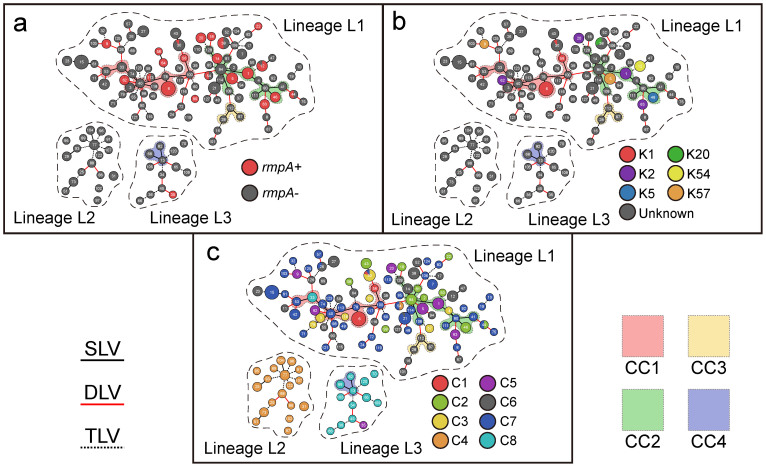
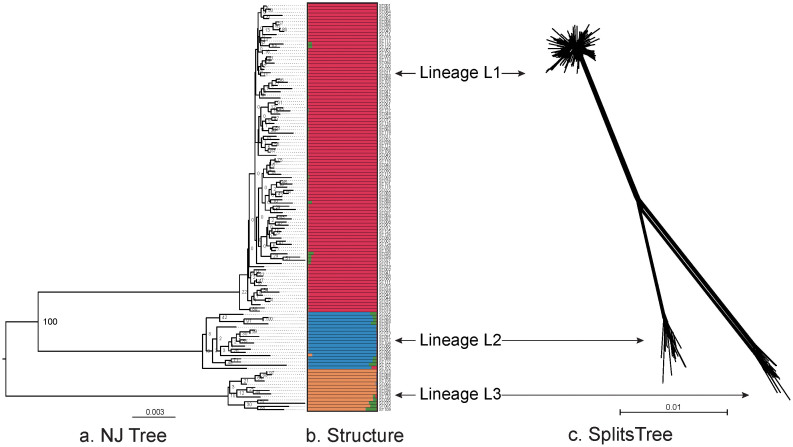
Multilocus sequence typing was applied to a collection of 327 clinical isolates of Klebsiella pneumoniae from China, which was proven to be a good representative of the global diversity of K. pneumoniae. Three lineages L1 to L3 are presented in the population with limited genetic flow across different lineages. However, extremely high levels of recombination can be observed within lineages to the extent at which the alleles are associated almost randomly. Lineages L2 and L3 most likely represent highly specific subgroups of less-virulent K. pneumoniae with modified metabolic networks, while lineage L1 contains not only hypervirulent clones with massive acquisition of virulent genes but also 'primitive and intermediate forms' during evolution of hypervirulent K. pneumoniae.
多位点序列分型技术应用于来自中国的327株肺炎克雷伯菌临床分离株,结果证明这些分离株很好地代表了全球肺炎克雷伯菌的多样性。该群体中存在L1至L3三个谱系,不同谱系间的基因流动有限。然而,在谱系内可观察到极高水平的重组,以至于等位基因几乎是随机关联的。谱系L2和L3很可能代表代谢网络有所改变的低毒力肺炎克雷伯菌的高度特异性亚群,而谱系L1不仅包含大量获取毒力基因的高毒力克隆,还包含高毒力肺炎克雷伯菌进化过程中的“原始和中间形式”。