Department of Animal Resource Technology, Gyeongnam National University of Science and Technology, Jinju 660-758, Korea .
Department of Life Science, Chung-Ang University, Seoul 156-756, Korea .
Asian-Australas J Anim Sci. 2015 Jan;28(1):50-7. doi: 10.5713/ajas.14.0555.
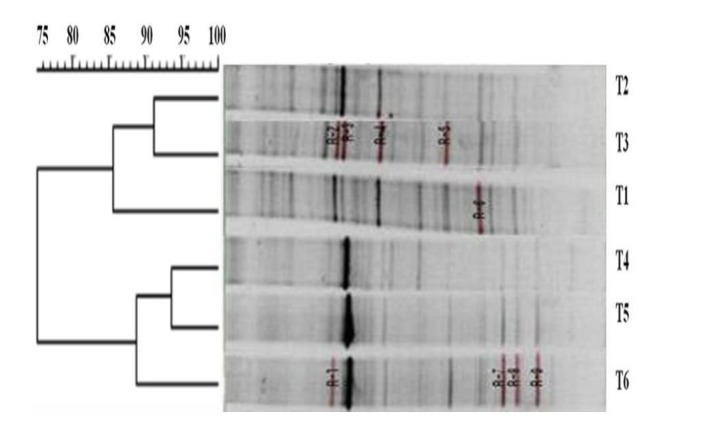
This study was conducted to investigate the effect of soybean meal (SM) and soluble starch (SS) on biogenic amine production and microbial diversity using in vitro ruminal fermentation. Treatments comprised of incubation of 2 g of mixture (expressed as 10 parts) containing different ratios of SM to SS as: 0:0, 10:0, 7:3, 5:5, 3:7, or 0:10. In vitro ruminal fermentation parameters were determined at 0, 12, 24, and 48 h of incubation while the biogenic amine and microbial diversity were determined at 48 h of incubation. Treatment with highest proportion of SM had higher (p<0.05) gas production than those with higher proportions of SS. Samples with higher proportion of SS resulted in lower pH than those with higher proportion of SM after 48 h of incubation. The largest change in NH3-N concentration from 0 to 48 h was observed on all SM while the smallest was observed on exclusive SS. Similarly, exclusive SS had the lowest NH3-N concentration among all groups after 24 h of incubation. Increasing methane (CH4) concentrations were observed with time, and CH4 concentrations were higher (p<0.05) with greater proportions of SM than SS. Balanced proportion of SM and SS had the highest (p<0.05) total volatile fatty acid (TVFA) while propionate was found highest in higher proportion of SS. Moreover, biogenic amine (BA) was higher (p<0.05) in samples containing greater proportions of SM. Histamines, amine index and total amines were highest in exclusive SM followed in sequence mixtures with increasing proportion of SS (and lowered proportion of SM) at 48 h of incubation. Nine dominant bands were identified by denaturing gradient gel electrophoresis (DGGE) and their identity ranged from 87% to 100% which were mostly isolated from rumen and feces. Bands R2 (uncultured bacterium clone RB-5E1) and R4 (uncultured rumen bacterium clone L7A_C10) bands were found in samples with higher proportions of SM while R3 (uncultured Firmicutes bacterium clone NI_52), R7 (Selenomonas sp. MCB2), R8 (Selenomonas ruminantium gene) and R9 (Selenomonas ruminantium strain LongY6) were found in samples with higher proportions of SS. Different feed ratios affect rumen fermentation in terms of pH, NH3-N, CH4, BA, volatile fatty acid and other metabolite concentrations and microbial diversity. Balanced protein and carbohydrate ratios are needed for rumen fermentation.
本研究旨在通过体外瘤胃发酵,研究豆粕(SM)和可溶性淀粉(SS)对生物胺产生和微生物多样性的影响。处理组由不同比例 SM 和 SS 的混合物(表示为 10 部分)孵育组成:0:0、10:0、7:3、5:5、3:7 或 0:10。在孵育 0、12、24 和 48 小时时测定体外瘤胃发酵参数,在孵育 48 小时时测定生物胺和微生物多样性。高比例 SM 处理的产气量高于高 SS 比例处理(p<0.05)。孵育 48 小时后,SS 比例较高的样品 pH 低于 SM 比例较高的样品。从 0 到 48 小时,所有 SM 组的 NH3-N 浓度变化最大,而仅 SS 组的 NH3-N 浓度变化最小。同样,在 24 小时孵育后,仅 SS 组的 NH3-N 浓度最低。随着时间的推移,甲烷(CH4)浓度增加,SM 比例较高的 CH4 浓度高于 SS(p<0.05)。SM 和 SS 的平衡比例具有最高(p<0.05)的总挥发性脂肪酸(TVFA),而丙酸在 SS 比例较高的情况下含量最高。此外,含有较高比例 SM 的样品中的生物胺(BA)较高(p<0.05)。组氨酸、胺指数和总胺在仅 SM 中最高,随后随着 SS 比例的增加(SM 比例降低),在 48 小时孵育时依次升高。变性梯度凝胶电泳(DGGE)鉴定了 9 个主要条带,其同源性为 87%至 100%,主要从瘤胃和粪便中分离得到。在 SM 比例较高的样品中发现了 R2(未培养细菌克隆 RB-5E1)和 R4(未培养瘤胃细菌克隆 L7A_C10)条带,而 R3(未培养厚壁菌门细菌克隆 NI_52)、R7(唾液单胞菌 MCB2)、R8(反刍月形单胞菌基因)和 R9(反刍月形单胞菌菌株 LongY6)条带在 SS 比例较高的样品中发现。不同的饲料比例会影响瘤胃发酵的 pH 值、NH3-N、CH4、BA、挥发性脂肪酸和其他代谢物浓度以及微生物多样性。瘤胃发酵需要平衡的蛋白质和碳水化合物比例。