Trendowski Matthew, Mitchell Joan M, Corsette Christine M, Acquafondata Christopher, Fondy Thomas P
Department of Biology, Syracuse University, 107 College Place, Syracuse, NY, 13244, USA,
Invest New Drugs. 2015 Apr;33(2):280-9. doi: 10.1007/s10637-014-0202-6. Epub 2015 Jan 6.
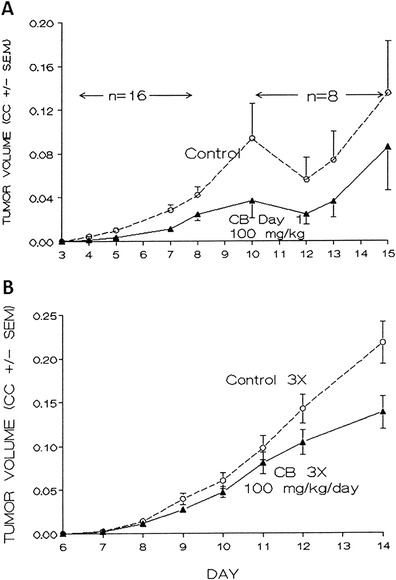
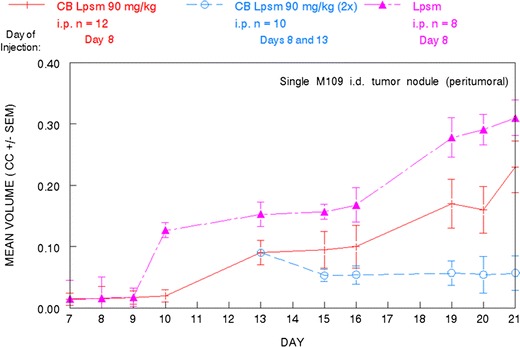
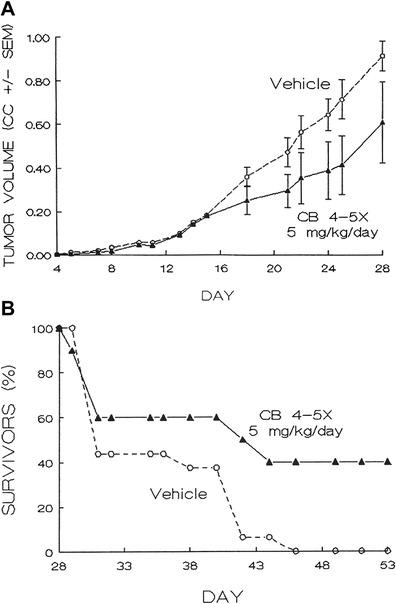
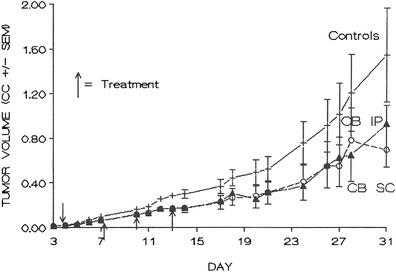
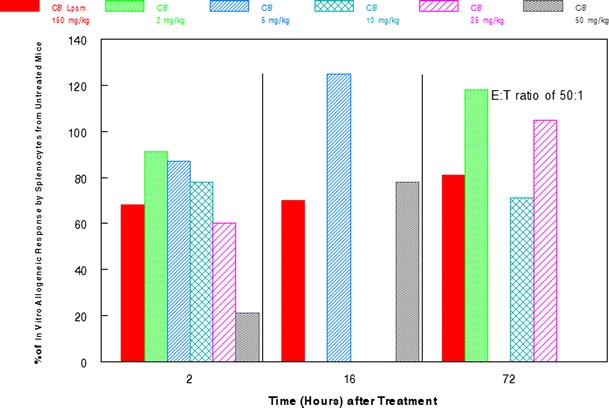
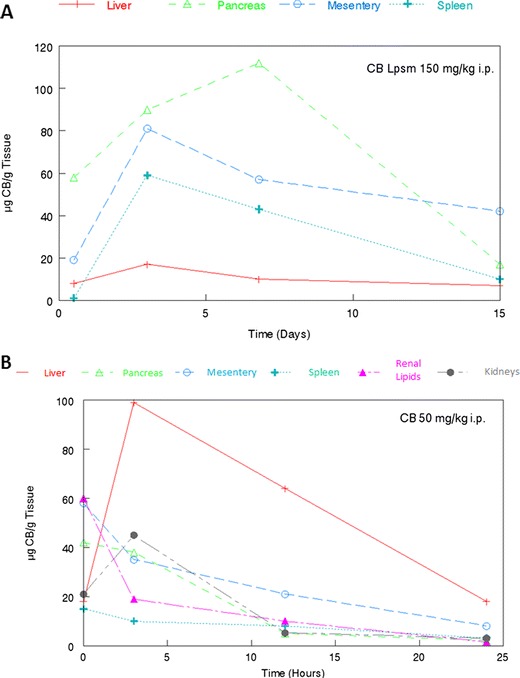
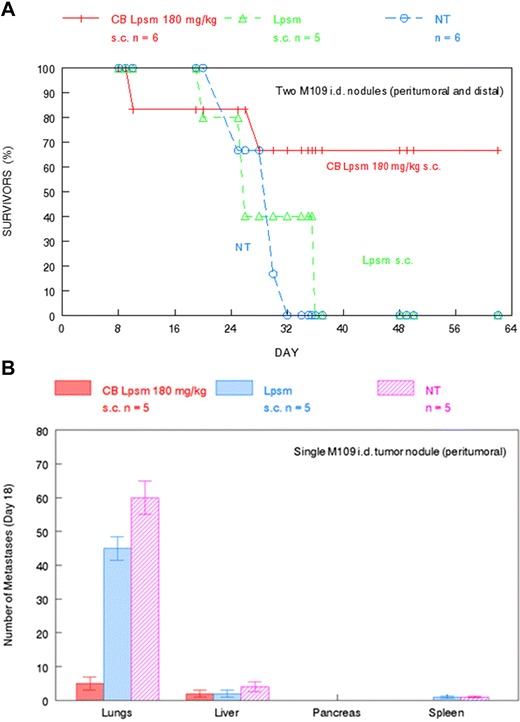
Cytochalasin B is a potentially novel microfilament-directed chemotherapeutic agent that prevents actin polymerization, thereby inhibiting cytokinesis. Although cytochalasin B has been extensively studied in vitro, only limited data are available to assess its in vivo potential. Cytochalasin B was administered to Balb/c mice challenged i.d. with M109 murine lung carcinoma to determine whether the agent could affect an established i.d. tumor when the compound is administered s.c. in the region of the i.d. tumor, but not in direct contact with it. Cytochalasin B was also administered either i.p. or s.c. at a distant site or i.v. to determine whether it could affect the long-term development of an established i.d. tumor. Cytochalasin B was then liposome encapsulated to determine whether the maximum tolerated dose (MTD) of the compound could be increased, while reducing immunosuppression that we have previously characterized. Liposomal cytochalasin B was also administered to mice challenged i.d. with M109 lung carcinoma to assess its chemotherapeutic efficacy. The results can be summarized as follows: 1) cytochalasin B substantially delayed the growth of i.d. M109 tumor nodules, inhibited metastatic progression in surrounding tissues, and produced long-term cures in treated mice; 2) liposomal cytochalasin B increased the i.p. MTD by more than 3-fold, produced a different distribution in tissue concentrations, and displayed antitumor effects against M109 lung carcinoma similar to non-encapsulated cytochalasin B. These data show that cytochalasin B exploits unique chemotherapeutic mechanisms and is an effective antineoplastic agent in vivo in pre-clinical models, either in bolus form or after liposome encapsulation.
细胞松弛素B是一种潜在的新型微丝导向化疗药物,可阻止肌动蛋白聚合,从而抑制胞质分裂。尽管细胞松弛素B已在体外进行了广泛研究,但评估其体内潜力的数据有限。将细胞松弛素B给予经皮下接种M109小鼠肺癌的Balb/c小鼠,以确定当该化合物经皮下注射到皮下肿瘤区域但不与肿瘤直接接触时,是否能影响已形成的皮下肿瘤。细胞松弛素B还通过腹腔注射、皮下注射到远处部位或静脉注射给药,以确定其是否能影响已形成的皮下肿瘤的长期发展。然后将细胞松弛素B脂质体包封,以确定该化合物的最大耐受剂量(MTD)是否可以增加,同时减少我们之前所描述的免疫抑制作用。脂质体包裹的细胞松弛素B也被给予经皮下接种M109肺癌的小鼠,以评估其化疗效果。结果总结如下:1)细胞松弛素B显著延迟了皮下M109肿瘤结节的生长,抑制了周围组织的转移进展,并使治疗的小鼠长期治愈;2)脂质体包裹的细胞松弛素B使腹腔MTD增加了3倍以上,在组织浓度中产生了不同的分布,并显示出与未包裹的细胞松弛素B相似的对M109肺癌的抗肿瘤作用。这些数据表明,细胞松弛素B利用独特的化疗机制,在临床前模型中,无论是大剂量形式还是脂质体包裹后,在体内都是一种有效的抗肿瘤药物。