Pizzimenti C L, Lattal K M
Department of Behavioral Neuroscience, Oregon Health & Science University, Portland, OR, USA.
Genes Brain Behav. 2015 Jan;14(1):73-84. doi: 10.1111/gbb.12187.
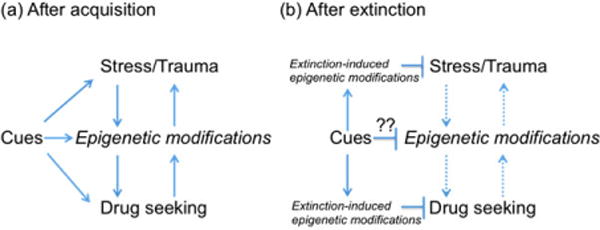
Understanding the interaction between fear and reward at the circuit and molecular levels has implications for basic scientific approaches to memory and for understanding the etiology of psychiatric disorders. Both stress and exposure to drugs of abuse induce epigenetic changes that result in persistent behavioral changes, some of which may contribute to the formation of a drug addiction or a stress-related psychiatric disorder. Converging evidence suggests that similar behavioral, neurobiological and molecular mechanisms control the extinction of learned fear and drug-seeking responses. This may, in part, account for the fact that individuals with post-traumatic stress disorder have a significantly elevated risk of developing a substance use disorder and have high rates of relapse to drugs of abuse, even after long periods of abstinence. At the behavioral level, a major challenge in treatments is that extinguished behavior is often not persistent, returning with changes in context, the passage of time or exposure to mild stressors. A common goal of treatments is therefore to weaken the ability of stressors to induce relapse. With the discovery of epigenetic mechanisms that create persistent molecular signals, recent work on extinction has focused on how modulating these epigenetic targets can create lasting extinction of fear or drug-seeking behavior. Here, we review recent evidence pointing to common behavioral, systems and epigenetic mechanisms in the regulation of fear and drug seeking. We suggest that targeting these mechanisms in combination with behavioral therapy may promote treatment and weaken stress-induced relapse.
在神经回路和分子水平上理解恐惧与奖赏之间的相互作用,对于记忆的基础科学研究方法以及理解精神疾病的病因具有重要意义。应激和滥用药物都会引起表观遗传变化,进而导致持续的行为改变,其中一些改变可能会促使药物成瘾或与应激相关的精神疾病的形成。越来越多的证据表明,类似的行为、神经生物学和分子机制控制着习得性恐惧的消退以及觅药反应。这可能部分解释了为什么创伤后应激障碍患者患物质使用障碍的风险显著升高,并且即使在长期戒断后,滥用药物的复发率也很高。在行为层面,治疗中的一个主要挑战是消退的行为往往不持久,会随着环境变化、时间推移或接触轻度应激源而复发。因此,治疗的一个共同目标是削弱应激源诱发复发的能力。随着能够产生持久分子信号的表观遗传机制的发现,最近关于消退的研究集中在如何调节这些表观遗传靶点以实现恐惧或觅药行为的持久消退。在此,我们综述了近期有关恐惧调节和觅药行为中共同的行为、系统和表观遗传机制的证据。我们认为,将这些机制与行为疗法相结合可能会促进治疗并削弱应激诱发的复发。