Makris Thomas M, Vu Van V, Meier Katlyn K, Komor Anna J, Rivard Brent S, Münck Eckard, Que Lawrence, Lipscomb John D
Department of Biochemistry, Molecular Biology, and Biophysics, ¶Center for Metals in Biocatalysis, and ‡Department of Chemistry, University of Minnesota , Minneapolis, Minnesota 55455, United States.
J Am Chem Soc. 2015 Feb 4;137(4):1608-17. doi: 10.1021/ja511649n. Epub 2015 Jan 21.
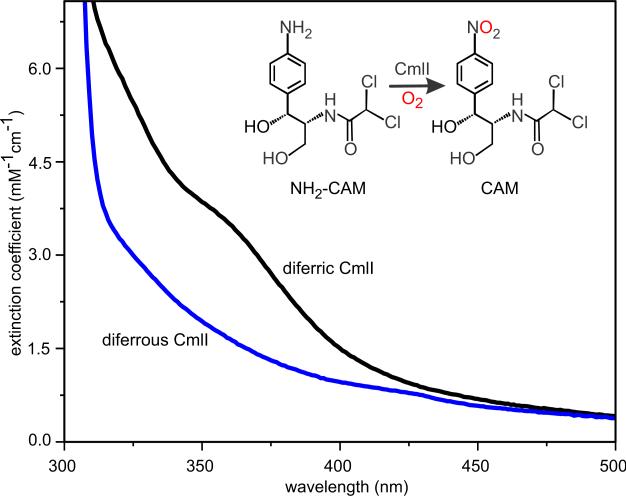
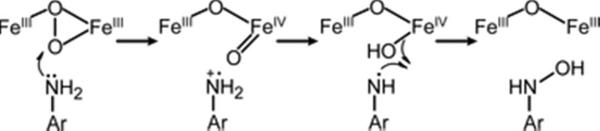
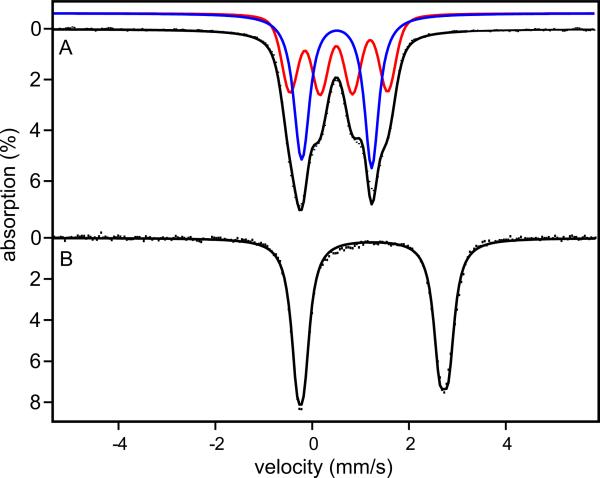
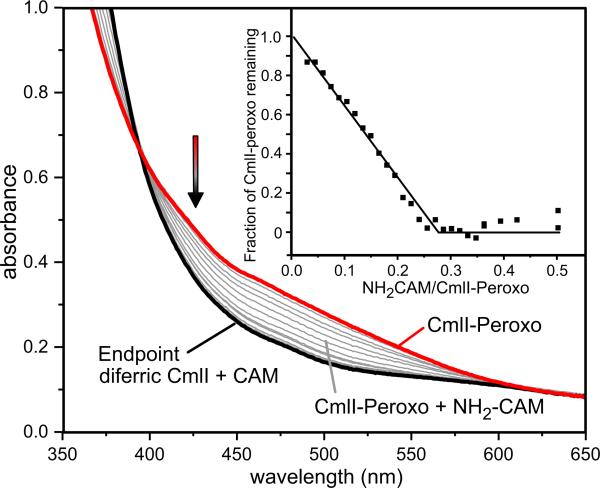
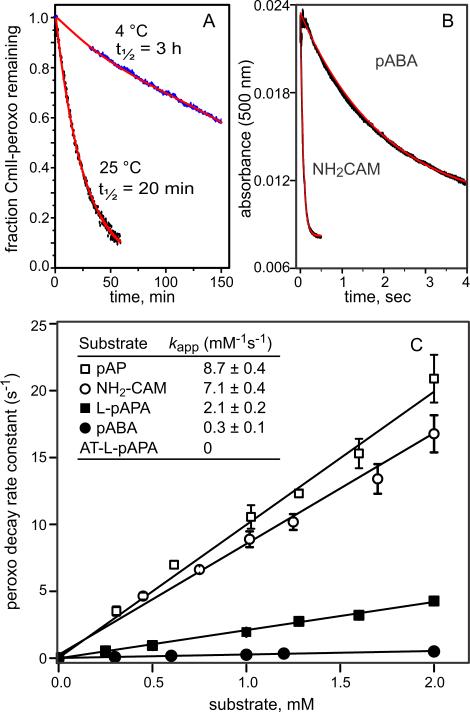
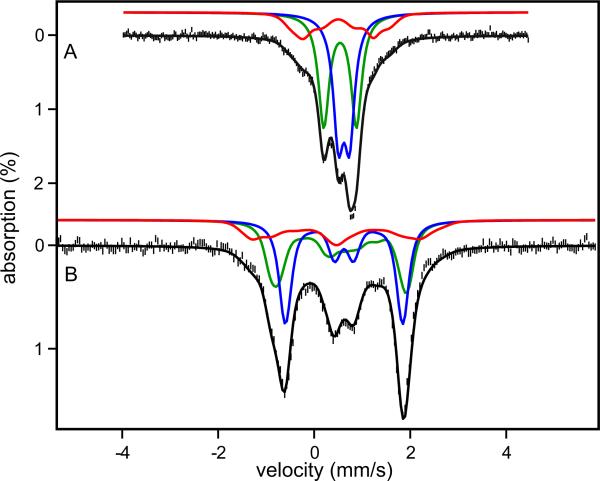
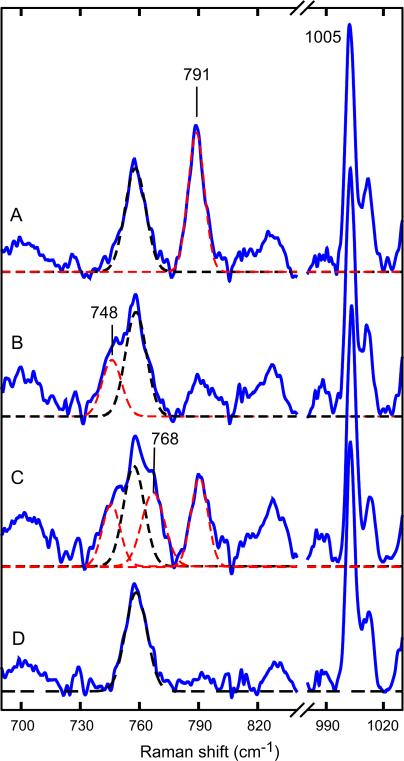
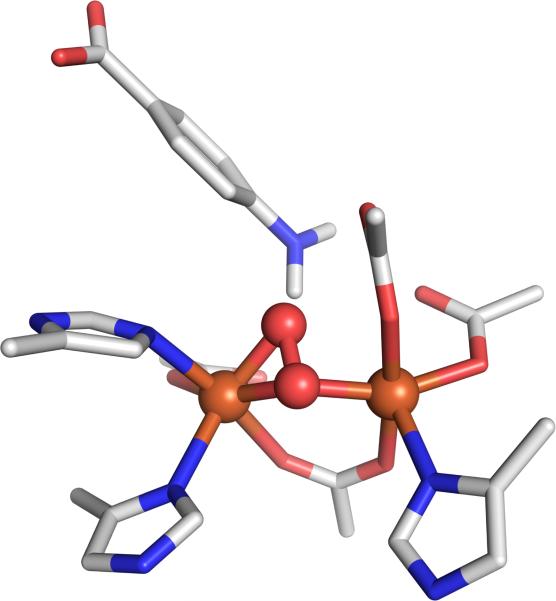
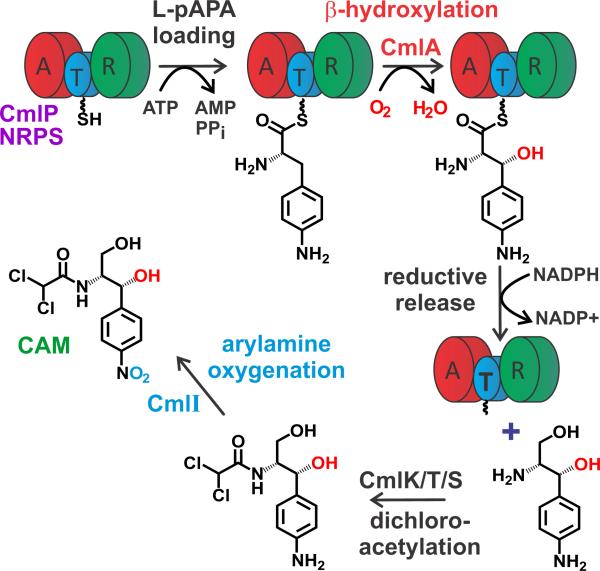
Streptomyces venezuelae CmlI catalyzes the six-electron oxygenation of the arylamine precursor of chloramphenicol in a nonribosomal peptide synthetase (NRPS)-based pathway to yield the nitroaryl group of the antibiotic. Optical, EPR, and Mössbauer studies show that the enzyme contains a nonheme dinuclear iron cluster. Addition of O(2) to the diferrous state of the cluster results in an exceptionally long-lived intermediate (t(1/2) = 3 h at 4 °C) that is assigned as a peroxodiferric species (CmlI-peroxo) based upon the observation of an (18)O(2)-sensitive resonance Raman (rR) vibration. CmlI-peroxo is spectroscopically distinct from the well characterized and commonly observed cis-μ-1,2-peroxo (μ-η(1):η(1)) intermediates of nonheme diiron enzymes. Specifically, it exhibits a blue-shifted broad absorption band around 500 nm and a rR spectrum with a ν(O-O) that is at least 60 cm(-1) lower in energy. Mössbauer studies of the peroxo state reveal a diferric cluster having iron sites with small quadrupole splittings and distinct isomer shifts (0.54 and 0.62 mm/s). Taken together, the spectroscopic comparisons clearly indicate that CmlI-peroxo does not have a μ-η(1):η(1)-peroxo ligand; we propose that a μ-η(1):η(2)-peroxo ligand accounts for its distinct spectroscopic properties. CmlI-peroxo reacts with a range of arylamine substrates by an apparent second-order process, indicating that CmlI-peroxo is the reactive species of the catalytic cycle. Efficient production of chloramphenicol from the free arylamine precursor suggests that CmlI catalyzes the ultimate step in the biosynthetic pathway and that the precursor is not bound to the NRPS during this step.
委内瑞拉链霉菌CmlI在基于非核糖体肽合成酶(NRPS)的途径中催化氯霉素芳胺前体的六电子氧化反应,生成抗生素的硝基芳基基团。光学、电子顺磁共振(EPR)和穆斯堡尔谱研究表明,该酶含有一个非血红素双核铁簇。向该簇的二价铁状态添加O₂会产生一个寿命极长的中间体(4℃下t(1/2)=3小时),基于对一个对¹⁸O₂敏感的共振拉曼(rR)振动的观察,该中间体被指定为过氧二价铁物种(CmlI-过氧)。CmlI-过氧在光谱上与特征明确且常见的非血红素二铁酶的顺式-μ-1,2-过氧(μ-η¹:η¹)中间体不同。具体而言,它在500nm左右呈现一个蓝移的宽吸收带,并且其rR光谱中的ν(O-O)能量至少低60cm⁻¹。过氧状态的穆斯堡尔谱研究揭示了一个二价铁簇,其铁位点具有小的四极分裂和不同的同质异能位移(0.54和0.62mm/s)。综合起来,光谱比较清楚地表明CmlI-过氧不具有μ-η¹:η¹-过氧配体;我们提出μ-η¹:η²-过氧配体解释了其独特的光谱性质。CmlI-过氧通过一个明显的二级过程与一系列芳胺底物反应,表明CmlI-过氧是催化循环中的活性物种。从游离芳胺前体高效生产氯霉素表明CmlI催化生物合成途径中的最终步骤,并且在此步骤中前体不与NRPS结合。