Tanase Cristiana, Albulescu Radu, Codrici Elena, Calenic Bogdan, Popescu Ionela Daniela, Mihai Simona, Necula Laura, Cruceru Maria Linda, Hinescu Mihail Eugen
"Victor Babes" National Institute of Pathology, Biochemistry-Proteomics Department, Bucharest, Romania.
"Victor Babes" National Institute of Pathology, Biochemistry-Proteomics Department, Bucharest, Romania ; National Institute for Chemical Pharmaceutical R&D, Department of Biochemistry, Bucharest, Romania.
Onco Targets Ther. 2014 Dec 22;8:81-90. doi: 10.2147/OTT.S70886. eCollection 2015.
Apoptotic protease-activating factor-1 (APAF-1) and cathepsin B are important functional proteins in apoptosis; the former is involved in the intrinsic (mitochondrial) pathway, while the latter is associated with both intrinsic and extrinsic pathways. Changes in the expression of apoptosome-related proteins could be useful indicators of tumor development since a priori defects in the mitochondrial pathway might facilitate the inception and progression of human neoplasms. Our aim was to evaluate the profiles of APAF-1 and cathepsin B in relation with other molecules involved in apoptosis/proliferation and to correlate them with the aggressive behavior of invasive pituitary adenomas.
APAF-1 and cathepsin B were assessed in tissue samples from 30 patients with pituitary adenomas, of which 16 were functional adenomas and 22 were invasive adenomas.
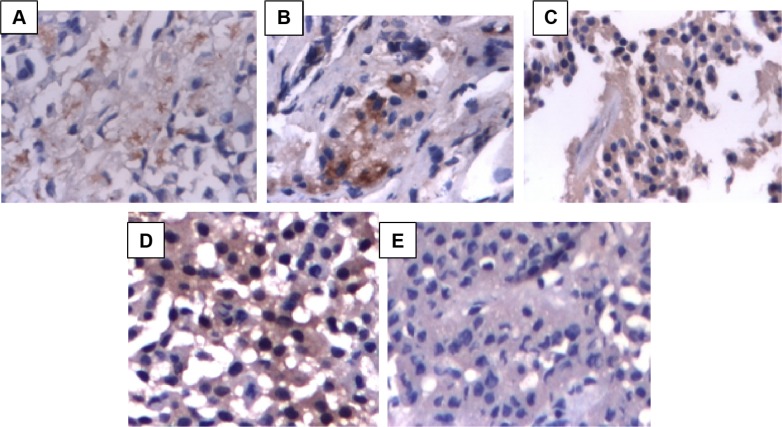
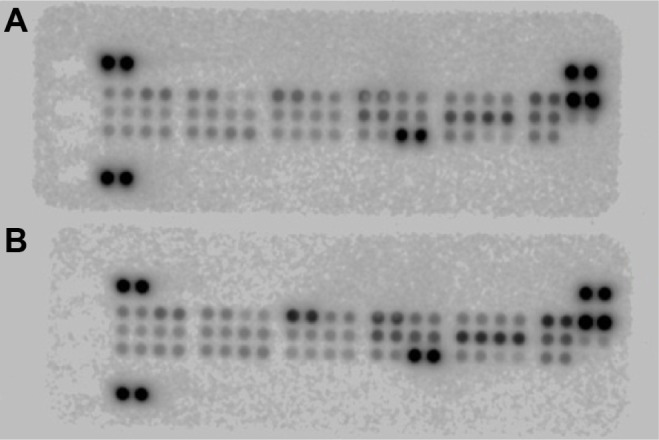
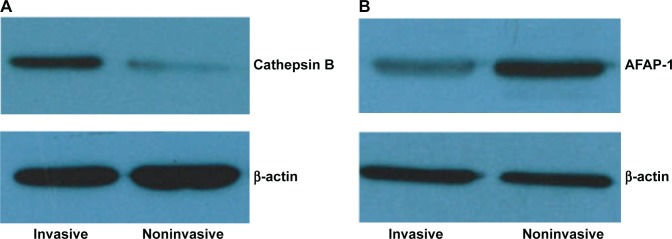
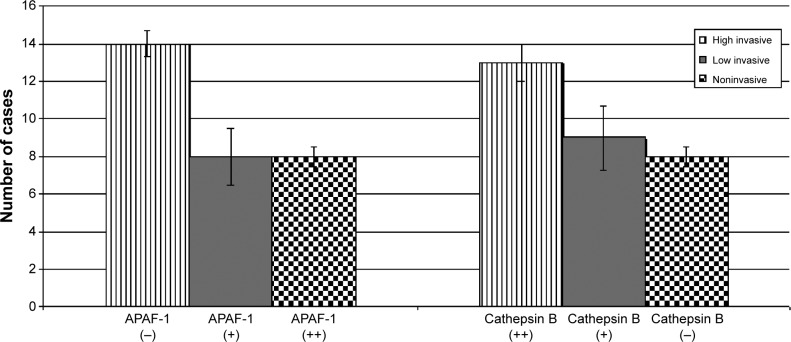
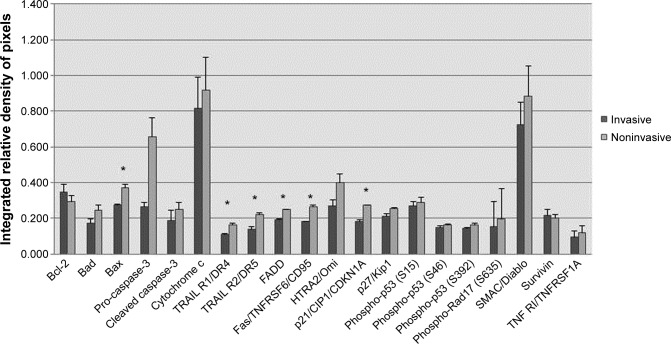
A positive relationship between high proliferation and invasiveness was observed in invasive pituitary adenomas when compared to their noninvasive counterparts (Ki-67 labeling index - 4.72% versus 1.75%). Decreased expression of APAF-1 was recorded in most of the invasive adenomas with a high proliferation index, while the cathepsin B level was elevated in this group. We have noticed a negative correlation between the low level of APAF-1 and invasiveness (63.63%; P<0.01); at the same time, a positive correlation between cathepsin B expression and invasiveness (59.09%; P<0.01) was found. In all, 81.25% out of the total APAF-1-positive samples were cathepsin B negative (P<0.01); 76.92% out of the total cathepsin B-positive samples were APAF-1-negative (P<0.01). These results were reinforced by an apoptosis protein array examination, which showed inhibition of the extrinsic apoptotic pathway in an invasive pituitary adenoma.
A bidirectional-inverted relationship between APAF-1 and cathepsin B expressions was noticed. One might hypothesize that shifting the balance between mediators of cell death could result in changes in tumor behavior.
凋亡蛋白酶激活因子-1(APAF-1)和组织蛋白酶B是凋亡过程中的重要功能蛋白;前者参与内源性(线粒体)途径,而后者与内源性和外源性途径均相关。凋亡小体相关蛋白表达的变化可能是肿瘤发展的有用指标,因为线粒体途径的先天缺陷可能促进人类肿瘤的发生和发展。我们的目的是评估APAF-1和组织蛋白酶B与凋亡/增殖相关的其他分子的表达谱,并将它们与侵袭性垂体腺瘤的侵袭性行为相关联。
对30例垂体腺瘤患者的组织样本进行APAF-1和组织蛋白酶B评估,其中16例为功能性腺瘤,22例为侵袭性腺瘤。
与非侵袭性垂体腺瘤相比,侵袭性垂体腺瘤中高增殖与侵袭性之间存在正相关(Ki-67标记指数分别为4.72%和1.75%)。在大多数增殖指数高的侵袭性腺瘤中,APAF-1表达降低,而该组组织蛋白酶B水平升高。我们注意到APAF-1低水平与侵袭性之间存在负相关(63.63%;P<0.01);同时,发现组织蛋白酶B表达与侵袭性之间存在正相关(59.09%;P<0.01)。总的来说,APAF-1阳性样本中共有81.25%组织蛋白酶B阴性(P<0.01);组织蛋白酶B阳性样本中共有76.92%APAF-1阴性(P<0.01)。凋亡蛋白阵列检查进一步证实了这些结果,该检查显示侵袭性垂体腺瘤中外源性凋亡途径受到抑制。
注意到APAF-1和组织蛋白酶B表达之间存在双向倒置关系。人们可能会推测,细胞死亡介质之间平衡的改变可能导致肿瘤行为的变化。