Jurado Sandra
Department of Pharmacology, University of Maryland School of Medicine Baltimore, MD, USA.
Front Cell Neurosci. 2014 Dec 22;8:407. doi: 10.3389/fncel.2014.00407. eCollection 2014.
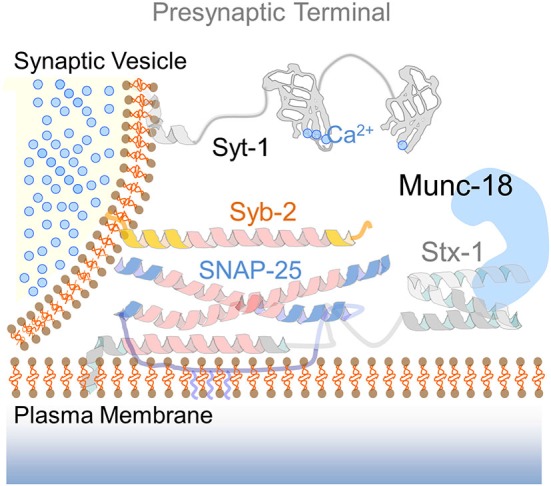
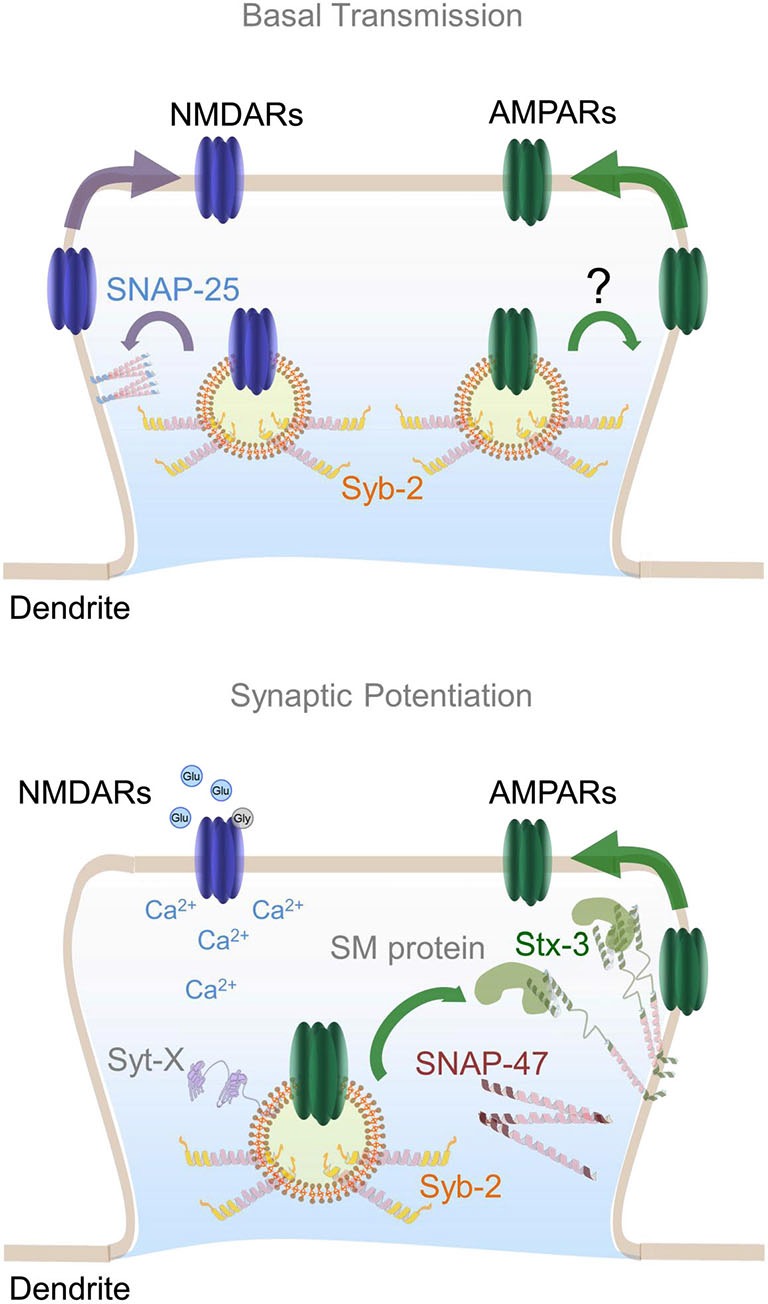
Sorting endosomes carry α-amino-3-hydroxy-5-methyl-4-isoxazolepropionic acid (AMPA)-type glutamate receptors (AMPARs) from their maturation sites to their final destination at the dendritic plasma membrane through both constitutive and regulated exocytosis. Insertion of functional AMPARs into the postsynaptic membrane is essential for maintaining fast excitatory synaptic transmission and plasticity. Despite this crucial role in neuronal function, the machinery mediating the fusion of AMPAR-containing endosomes in dendrites has been largely understudied in comparison to presynaptic vesicle exocytosis. Increasing evidence suggests that similarly to neurotransmitter release, AMPARs insertion relies on the formation of a SNARE complex (soluble NSF-attachment protein receptor), whose composition in dendrites has just begun to be elucidated. This review analyzes recent findings of the fusion machinery involved in regulated AMPARs insertion and discusses how dendritic exocytosis and AMPARs lateral diffusion may work together to support synaptic plasticity.
分拣内体通过组成型和调节型胞吐作用,将α-氨基-3-羟基-5-甲基-4-异恶唑丙酸(AMPA)型谷氨酸受体(AMPARs)从其成熟位点转运至树突质膜的最终目的地。功能性AMPARs插入突触后膜对于维持快速兴奋性突触传递和可塑性至关重要。尽管在神经元功能中起关键作用,但与突触前囊泡胞吐作用相比,介导树突中含AMPAR内体融合的机制在很大程度上仍未得到充分研究。越来越多的证据表明,与神经递质释放类似,AMPARs插入依赖于SNARE复合体(可溶性NSF附着蛋白受体)的形成,其在树突中的组成刚刚开始被阐明。本综述分析了参与调节AMPARs插入的融合机制的最新发现,并讨论了树突胞吐作用和AMPARs侧向扩散如何共同作用以支持突触可塑性。