Keast Russell S J, Swinburn Boyd A, Sayompark Dhoungsiri, Whitelock Susie, Riddell Lynn J
Centre for Physical Activity and Nutrition Research, School of Exercise and Nutrition Sciences, Deakin University,221 Burwood Highway,Burwood,VIC3125,Australia.
WHO Collaborating Centre for Obesity Prevention, Deakin University,221 Burwood Highway,Burwood,VIC3125,Australia.
Br J Nutr. 2015 Jan 28;113(2):366-71. doi: 10.1017/S000711451400378X. Epub 2015 Jan 8.
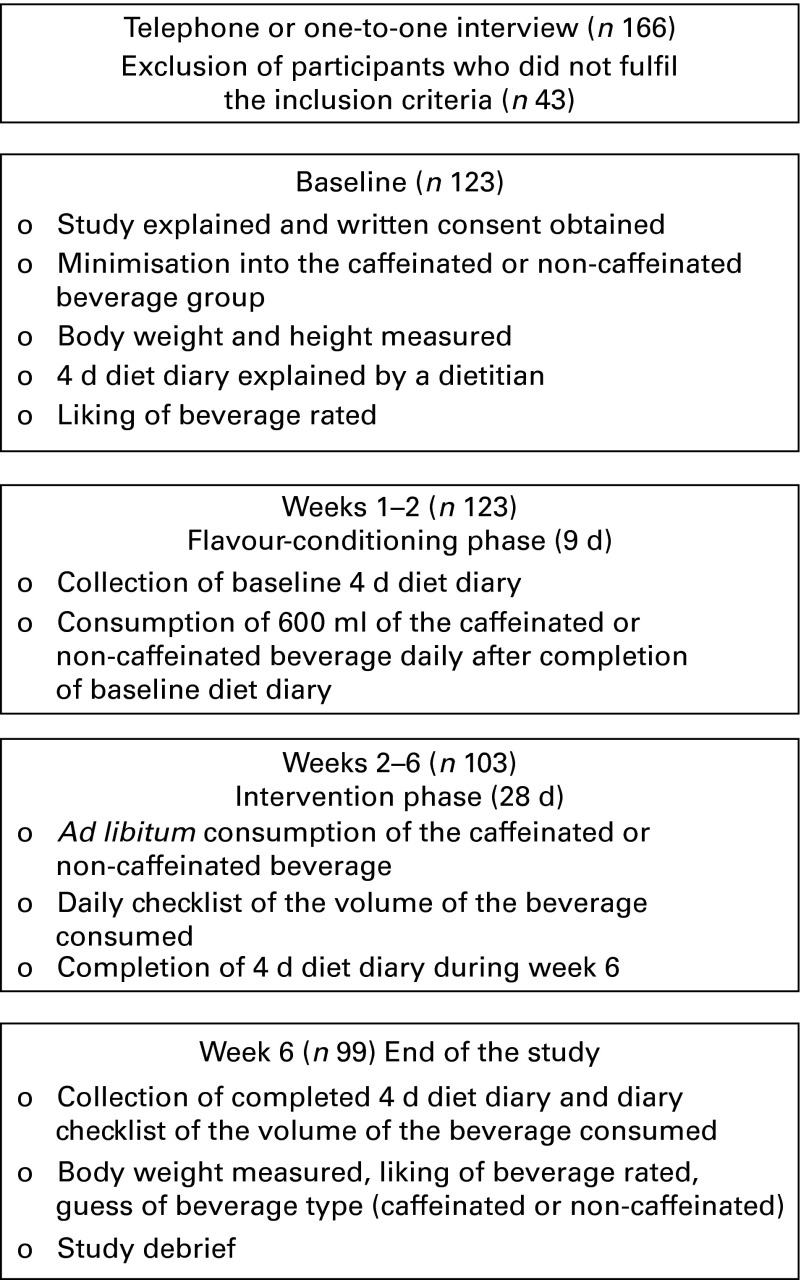
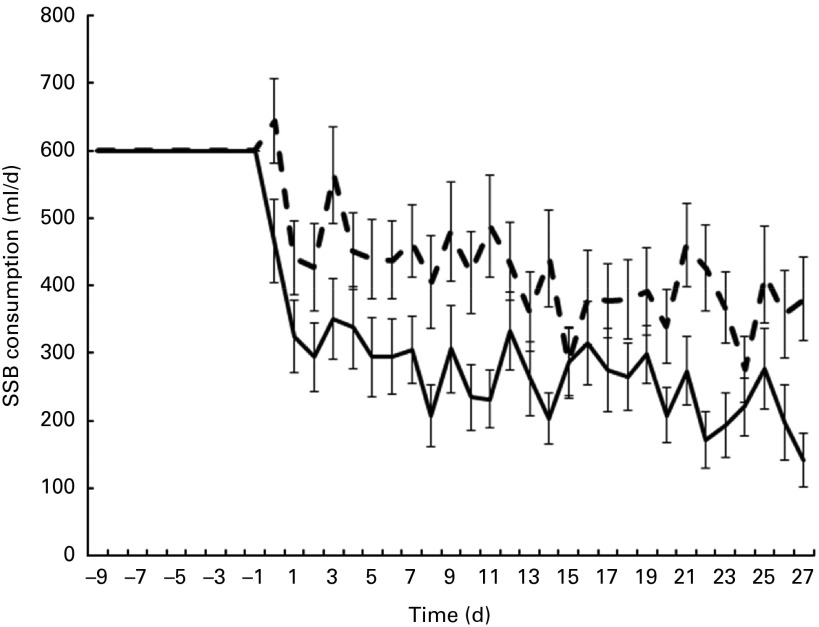
Excessive sugar-sweetened beverage (SSB) consumption has been associated with overweight and obesity. Caffeine is a common additive to SSB, and through dependence effects, it has the potential to promote the consumption of caffeine-containing foods. The objective of the present study was to assess the influence that caffeine has on the consumption of SSB. Participants (n 99) were blindly assigned to either a caffeinated SSB (C-SSB) or a non-caffeinated SSB (NC-SSB) group. Following randomisation, all participants completed a 9 d flavour-conditioning paradigm. They then completed a 28 d ad libitum intake intervention where they consumed as much or as little of C-SSB or NC-SSB as desired. The amount consumed (ml) was recorded daily, 4 d diet diaries were collected and liking of SSB was assessed at the start and end of the intervention. Participants (n 50) consuming the C-SSB had a daily SSB intake of 419 (sd 298) ml (785 (sd 559) kJ/d) over the 28 d intervention, significantly more than participants (n 49) consuming the NC-SSB (273 (sd 278) ml/d, 512 (sd 521) kJ/d) (P=0.05). However, participants who consumed the C-SSB liked the SSB more than those who consumed the NC-SSB (6.3 v. 6.0 on a nine-point hedonic scale, P= 0.022). The addition of low concentrations of caffeine to the SSB significantly increases the consumption of the SSB. Regulating caffeine as a food additive may be an effective strategy to decrease the consumption of nutrient-poor high-energy foods and beverages.
过量饮用含糖饮料(SSB)与超重和肥胖有关。咖啡因是SSB中常见的添加剂,通过依赖效应,它有可能促进含咖啡因食物的消费。本研究的目的是评估咖啡因对SSB消费的影响。参与者(n = 99)被随机分为含咖啡因的SSB(C-SSB)组或不含咖啡因的SSB(NC-SSB)组。随机分组后,所有参与者完成了一个为期9天的风味调节范式。然后他们完成了一个为期28天的随意摄入干预,在此期间他们根据自己的意愿饮用尽可能多或尽可能少的C-SSB或NC-SSB。每天记录摄入量(毫升),收集4天的饮食日记,并在干预开始和结束时评估对SSB的喜好程度。在28天的干预期间,饮用C-SSB的参与者(n = 50)每天的SSB摄入量为419(标准差298)毫升(785(标准差559)千焦/天),显著高于饮用NC-SSB的参与者(n = 49)(273(标准差278)毫升/天,512(标准差521)千焦/天)(P = 0.05)。然而,饮用C-SSB的参与者比饮用NC-SSB的参与者更喜欢SSB(在九点享乐量表上分别为6.3和6.0,P = 0.022)。向SSB中添加低浓度的咖啡因会显著增加SSB的消费量。将咖啡因作为食品添加剂进行监管可能是减少营养匮乏的高能量食品和饮料消费的有效策略。