Rossi Monica, Bitocchi Elena, Bellucci Elisa, Nanni Laura, Rau Domenico, Attene Giovanna, Papa Roberto
Scienze Ambientali e delle Produzioni Vegetali, Università Politecnica delle Marche Ancona, Italy.
Scienze Agronomiche e Genetica Vegetale Agraria, Università degli Studi di Sassari Sassari, Italy.
Evol Appl. 2009 Nov;2(4):504-22. doi: 10.1111/j.1752-4571.2009.00082.x. Epub 2009 Jul 3.
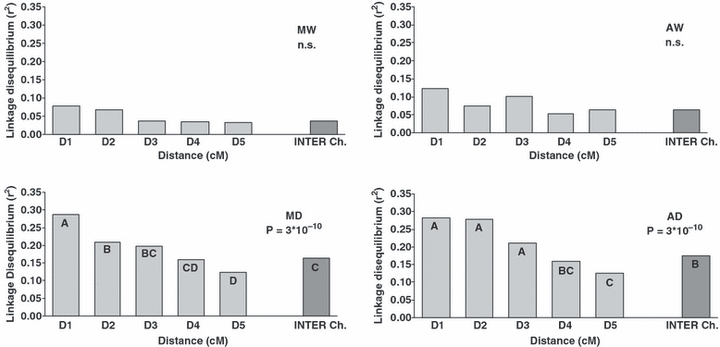
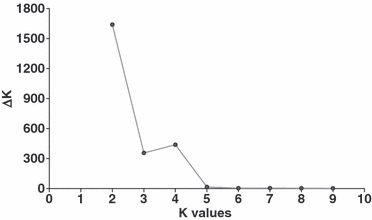
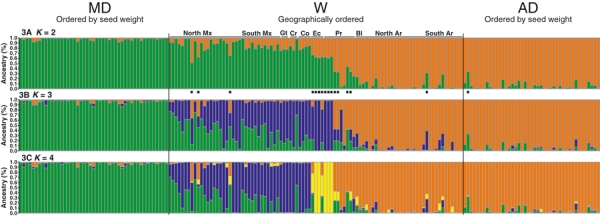
Together with the knowledge of the population structure, a critical aspect for the planning of association and/or population genomics studies is the level of linkage disequilibrium (LD) that characterizes the species and the population used for such an analysis. We have analyzed the population structure and LD in wild and domesticated populations of Phaseolus vulgaris L. using amplified fragment length polymorphism markers, most of which were genetically mapped in two recombinant inbred populations. Our results reflect the previous knowledge of the occurrence of two major wild gene pools of P. vulgaris, from which two independent domestication events originated, one in the Andes and one in Mesoamerica. The high level of LD in the whole sample was mostly due to the gene pool structure, with a much higher LD in domesticated compared to wild populations. In relation to association studies, our results also suggest that whole-genome-scan approaches are feasible in the common bean. Interestingly, an excess of inter-chromosomal LD was found in the domesticated populations, which suggests an important role for epistatic selection during domestication. Moreover, our results indicate the occurrence of a strong bottleneck in the Andean wild population before domestication, suggesting a Mesoamerican origin of P. vulgaris. Finally, our data support the occurrence of a single domestication event in Mesoamerica, and the same scenario in the Andes.
结合种群结构的知识,对于关联研究和/或群体基因组学研究的规划而言,一个关键方面是连锁不平衡(LD)水平,它表征了用于此类分析的物种和种群。我们使用扩增片段长度多态性标记分析了菜豆野生和驯化种群的种群结构和LD,其中大部分标记已在两个重组自交系群体中进行了遗传定位。我们的结果反映了先前关于菜豆两个主要野生基因库存在的认识,两个独立的驯化事件由此起源,一个在安第斯地区,一个在中美洲。整个样本中较高的LD水平主要归因于基因库结构,驯化种群中的LD比野生种群高得多。关于关联研究,我们的结果还表明全基因组扫描方法在菜豆中是可行的。有趣的是,在驯化种群中发现了染色体间LD的过量现象,这表明上位性选择在驯化过程中起重要作用。此外,我们的结果表明安第斯野生种群在驯化前发生了强烈的瓶颈效应,这表明菜豆起源于中美洲。最后,我们的数据支持中美洲发生了单一驯化事件,安第斯地区也是同样的情况。