Thomassen Henri A, Fuller Trevon, Buermann Wolfgang, Milá Borja, Kieswetter Charles M, Jarrín-V Pablo, Cameron Susan E, Mason Eliza, Schweizer Rena, Schlunegger Jasmin, Chan Janice, Wang Ophelia, Peralvo Manuel, Schneider Christopher J, Graham Catherine H, Pollinger John P, Saatchi Sassan, Wayne Robert K, Smith Thomas B
Center for Tropical Research, Institute of the Environment, University of California Los Angeles, CA, USA.
Center for Tropical Research, Institute of the Environment, University of California Los Angeles, CA, USA ; Department of Atmospheric and Oceanic Sciences, University of California Los Angeles, CA, USA.
Evol Appl. 2011 Mar;4(2):397-413. doi: 10.1111/j.1752-4571.2010.00172.x.
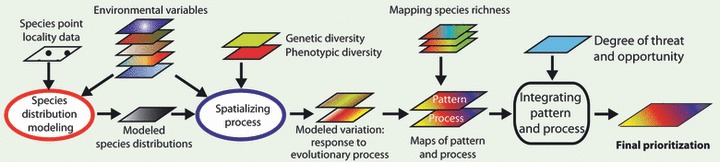
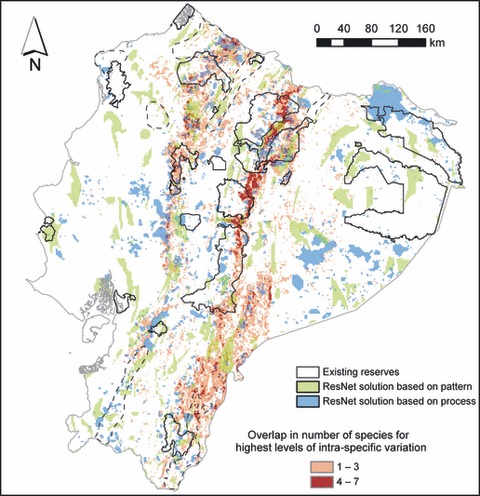
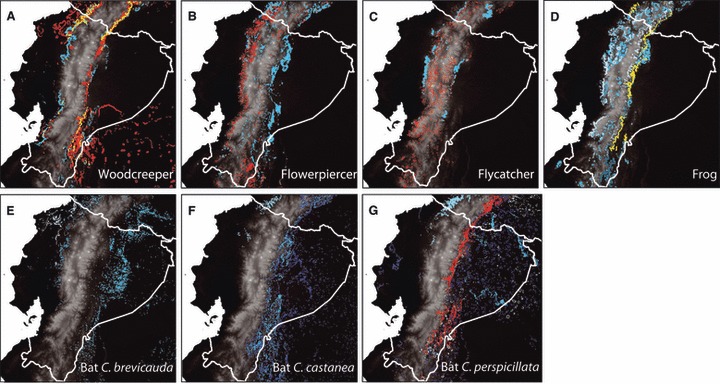
Human-induced land use changes are causing extensive habitat fragmentation. As a result, many species are not able to shift their ranges in response to climate change and will likely need to adapt in situ to changing climate conditions. Consequently, a prudent strategy to maintain the ability of populations to adapt is to focus conservation efforts on areas where levels of intraspecific variation are high. By doing so, the potential for an evolutionary response to environmental change is maximized. Here, we use modeling approaches in conjunction with environmental variables to model species distributions and patterns of genetic and morphological variation in seven Ecuadorian amphibian, bird, and mammal species. We then used reserve selection software to prioritize areas for conservation based on intraspecific variation or species-level diversity. Reserves selected using species richness and complementarity showed little overlap with those based on genetic and morphological variation. Priority areas for intraspecific variation were mainly located along the slopes of the Andes and were largely concordant among species, but were not well represented in existing reserves. Our results imply that in order to maximize representation of intraspecific variation in reserves, genetic and morphological variation should be included in conservation prioritization.
人为导致的土地利用变化正在造成广泛的栖息地破碎化。因此,许多物种无法根据气候变化改变其分布范围,可能需要在原地适应不断变化的气候条件。所以,一项维护种群适应能力的审慎策略是将保护工作集中在种内变异水平较高的区域。这样做可以使对环境变化的进化响应潜力最大化。在此,我们结合环境变量使用建模方法,对七种厄瓜多尔两栖动物、鸟类和哺乳动物物种的分布以及遗传和形态变异模式进行建模。然后,我们使用保护区选择软件,根据种内变异或物种水平的多样性对保护区域进行优先排序。利用物种丰富度和互补性选择的保护区与基于遗传和形态变异选择的保护区几乎没有重叠。种内变异的优先区域主要位于安第斯山脉的山坡上,并且在物种之间基本一致,但在现有保护区中没有得到很好的体现。我们的结果表明,为了使保护区内种内变异的代表性最大化,在保护优先级排序中应纳入遗传和形态变异。