Graduate Institute of Medical Sciences, National Defense Medical Center, Taipei, Taiwan (Drs Yeh, Kuo, Chen, Liang, and S-Y Huang); Department of Psychiatry, Tri-Service General Hospital, National Defense Medical Center, Taipei, Taiwan (Drs Yeh, Kuo, Chen, Shyu, Wan, and S-Y Huang); Department of Psychiatry, Beitou Branch, Tri-Service General Hospital, Taipei, Taiwan (Drs Ho and Liang); Department of Neurology, Tri-Service General Hospital, National Defense Medical Center, Taipei, Taiwan (Dr Yen); Department of Psychiatry, Taipei Branch, Buddhist Tzu Chi General Hospital, New Taipei, Taiwan (Dr C-C Huang); Department of Biology & Anatomy, National Defense Medical Center, Taipei, Taiwan (Professor Ma and Dr Shyu); Department of Nuclear Medicine, Tri-Service General Hospital, National Defense Medical Center, Taipei, Taiwan (Professor Shiue and Dr W-S Huang); Department of Nuclear Medicine, Changhua Christian Hospital, Changhua, Taiwan (Dr W-S Huang); Department of Psychiatry, National Cheng Kung University, Tainan, Taiwan (Dr Lu).
Int J Neuropsychopharmacol. 2015 Jan 7;18(7):pyu120. doi: 10.1093/ijnp/pyu120.
Many lines of evidence suggest the role of serotonin transporter (SERT)-mediated reuptake of serotonin in the pathophysiology and treatment of major depressive disorder (MDD). This study aimed to examine whether the pretreatment of SERT binding potential or SERT binding ratio between terminal projection regions relative to the midbrain raphe nuclei was associated with treatment outcomes to SERT-targeted antidepressants.
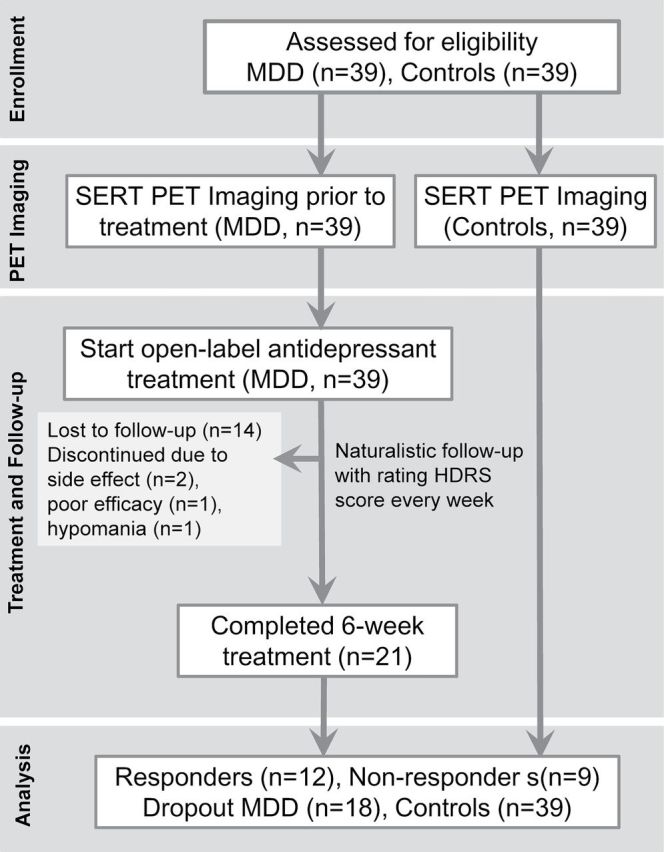
We recruited 39 antidepressant-naïve patients with MDD and 39 heathy controls. Positron emission tomography with N,N-dimethyl-2-(2-amino-4-[(18)F]fluorophenylthio)benzylamine (4-[(18)F]-ADAM) was used to measure in vivo SERT availability prior to antidepressant treatment. The 21-item Hamilton Depression Rating Scale (HDRS) was use to assess the severity of depression from baseline to week 6. All the patients with MDD had HDRS scores of 18 or more.
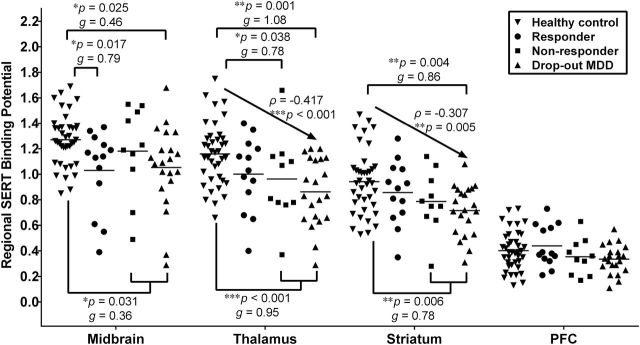
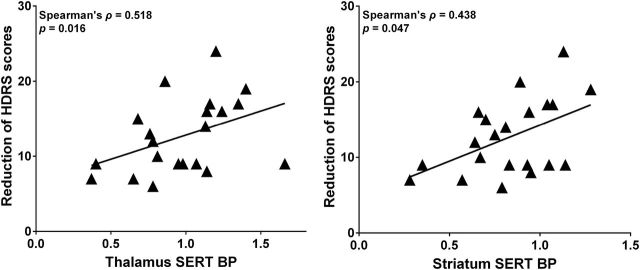
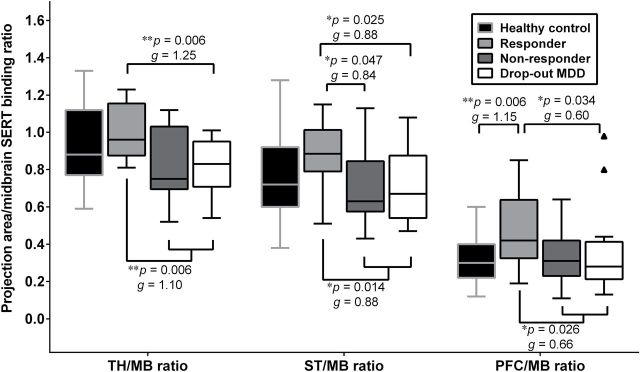
Pretreatment SERT binding in the thalamus and striatum positively correlated with an early reduction in HDRS scores at week 3. Nonresponders and dropout patients showed a proportionate reduction in SERT binding in the terminal projection regions and midbrain compared to healthy controls. In contrast, a disproportionate reduction in SERT binding in the terminal projection regions relative to midbrain was observed in responders.
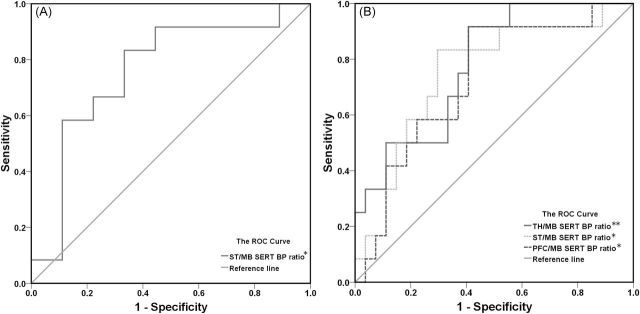
The results of this study suggested that a disproportionate reduction in SERT binding between terminal projection regions and midbrain may predict better treatment outcomes in patients with MDD.
大量证据表明,5-羟色胺转运体(SERT)介导的 5-羟色胺再摄取在重性抑郁障碍(MDD)的病理生理学和治疗中起作用。本研究旨在探讨终末投射区 SERT 结合潜能或 SERT 结合比率与中脑蓝斑核的比值与 SERT 靶向抗抑郁药治疗结果之间的关系。
我们招募了 39 名抗抑郁药初治的 MDD 患者和 39 名健康对照者。采用 N,N-二甲基-2-[2-氨基-4-[(18)F]氟苯硫基]苯甲胺(4-[(18)F]-ADAM)正电子发射断层扫描术(PET)在抗抑郁治疗前测量体内 SERT 的可用性。采用汉密尔顿抑郁量表(HDRS)的 21 项条目从基线到第 6 周评估抑郁严重程度。所有 MDD 患者的 HDRS 评分均为 18 分或以上。
丘脑和纹状体的 SERT 结合在治疗前与第 3 周时 HDRS 评分的早期降低呈正相关。无反应者和脱落者的终末投射区和中脑 SERT 结合呈比例下降,与健康对照组相比。相比之下,反应者的终末投射区与中脑的 SERT 结合呈不成比例的下降。
本研究结果表明,终末投射区与中脑之间 SERT 结合的不成比例下降可能预示着 MDD 患者的治疗效果更好。