Alsammani Mohamed Alkhatim, Ahmed Mohamed Issa, Abdelatif Nahla Farouk
Department of Medical Biochemistry, College of Applied Medical Sciences, Qassim University, Bahri, Sudan.
Med Arch. 2014 Aug;68(4):239-43. doi: 10.5455/medarh.2014.68.239-243. Epub 2014 Jul 31.
Childhood urinary infections are among the most common febrile illnesses occurring during this period with varying susceptibility to antibiotic.
The aim of this study was to identify uropathogens responsible to for urinarytract infection (UTIs) in children less than 5 years of age, and determine the antibiograms of the isolates to commonly used antibiotics.
Hundred and four children (2 months - 5 years old) seen at the Gadarif Teaching Hospital from January 2012 and December 2013 were evaluated. A urine specimen was obtained by a plastic bag with an adhesive backing around an opening or by direct voiding into sterile container. Urine was examined microscopically and those with significant pyuria and bacteruria were further cultured and microorganisms were identified and tested for antimicrobial susceptibility.
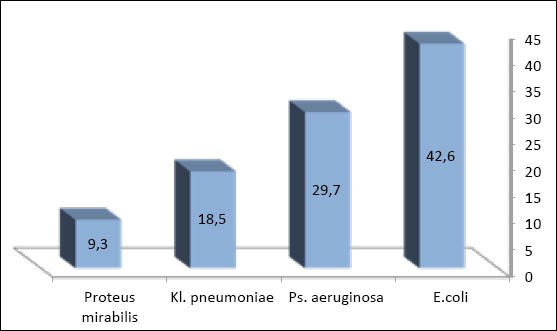
Out of 304 children suffering from UTIs; 145(47.7%) had significant pyuria of them; 54(17.8 %) had positive bacterial growth. The frequency of sex and residency were almost the same. E. coli (42.6%) was the most common uropathogen, sensitive to ciprofloxacin (91.3%), followed by Pseudomonas aeruginosa (29.6%) sensitive to Ciprofloxacin (75%)and Norofloxacin (68.8%), Klebsiellapneumoniae (18.5%) sensitive to Ciprofloxacin and Norofloxacin and Nalidixic acid (90%) and Proteus mirabilis sensitive to Ciprofloxacin and Norofloxacin (90%), Amoxicillin / clavulanic acid (Augmentin(80%).
The most common uropathogens were E. coli, Pseudomonas aeruginosa,Klebsiellapneumoniae, and Proteus mirabilis. Ciprofloxacin is the recommended initial empirical therapy while awaiting the culture and sensitivity results.
儿童期泌尿系统感染是该时期最常见的发热性疾病之一,对抗生素的敏感性各不相同。
本研究旨在确定5岁以下儿童尿路感染(UTIs)的致病病原体,并确定分离菌株对常用抗生素的抗菌谱。
对2012年1月至2013年12月在加达里夫教学医院就诊的104名儿童(2个月至5岁)进行了评估。通过带有开口周围粘性背衬的塑料袋或直接排入无菌容器获取尿液标本。对尿液进行显微镜检查,对有明显脓尿和菌尿的患者进一步培养,并鉴定微生物并检测其抗菌敏感性。
在304名患有UTIs的儿童中,145名(47.7%)有明显脓尿,其中54名(17.8%)细菌生长呈阳性。性别和居住地的频率几乎相同。大肠杆菌(42.6%)是最常见的尿路病原体,对环丙沙星敏感(91.3%),其次是铜绿假单胞菌(29.6%),对环丙沙星敏感(75%)和诺氟沙星敏感(68.8%),肺炎克雷伯菌(18.5%)对环丙沙星、诺氟沙星和萘啶酸敏感(90%),奇异变形杆菌对环丙沙星和诺氟沙星敏感(90%),阿莫西林/克拉维酸(奥格门汀)敏感(80%)。
最常见的尿路病原体是大肠杆菌、铜绿假单胞菌、肺炎克雷伯菌和奇异变形杆菌。在等待培养和药敏结果期间,推荐环丙沙星作为初始经验性治疗药物。