Herd J M, Joseph J J, McGarvey M, Tsimbouri P, Bennett A, Meek R M D, Morrison A
Department of Orthopaedic Surgery, Southern General Hospital, 1345 Govan Road, Glasgow, Lanarkshire, G51 4TF, 0141 201 1100, Greater Glasgow and Clyde, United Kingdom.
Ann Med Surg (Lond). 2014 Jan 22;3(1):8-12. doi: 10.1016/j.amsu.2013.11.001. eCollection 2014 Mar.
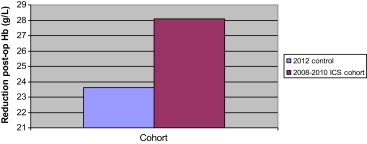
Allogenic blood is a finite resource, with associated risks. Previous studies show intraoperative cell salvage (ICS) can reduce allogenic transfusion rates in orthopaedic surgery. However, there are concerns regarding efficacy and cost-effectiveness of ICS. This study was carried out to review ICS use in revision hip arthroplasty. All patients who underwent ICS and re-infusion between 2008 and 2010 in the Southern General Hospital (SGH) were audited. The fall in haemoglobin (Hb), volume of blood re-infused and postoperative allogenic transfusion rates were recorded. This group was compared to a similar SGH cohort who underwent surgery by the same surgeons between 2006 and 2008, and a pre-2005 control group where no ICS was used. The proportion of patients receiving a postoperative allogenic transfusion fell by 55% in the 2008-2010 ICS cohort compared with the control, and by 40% compared with the previous ICS group. In both instances, there was a statistically significant (p < 0.001) reduction in mean units transfused per patient; in the 2008-2010 ICS cohort, a mean of 0.8 units was used per patient, while 1.4 were used in the 2006-2008 cohort. 3.5 units were used in the control group. There was no statistically significant difference in age or preoperative Hb between the groups, or in length of hospital stay. In this study, ICS has been shown to be effective in reducing rates and volume of postoperative allogenic transfusion in patients undergoing revision hip surgery at the SGH. However, further work is needed to establish the effect of changing anaesthetic technique on postoperative allogenic transfusion rates.
异体血是一种有限的资源,且存在相关风险。先前的研究表明,术中血液回收(ICS)可降低骨科手术中的异体输血率。然而,人们对ICS的疗效和成本效益存在担忧。本研究旨在回顾ICS在髋关节翻修术中的应用情况。对2008年至2010年在南部总医院(SGH)接受ICS及回输的所有患者进行了审核。记录血红蛋白(Hb)的下降情况、回输的血液量以及术后异体输血率。将该组患者与2006年至2008年由相同外科医生进行手术的SGH类似队列患者,以及2005年前未使用ICS的对照组进行比较。与对照组相比,2008 - 2010年ICS队列中接受术后异体输血的患者比例下降了55%,与之前的ICS组相比下降了40%。在这两种情况下,每位患者平均输注单位数均有统计学显著下降(p < 0.001);在2008 - 2010年ICS队列中,每位患者平均使用0.8个单位,而在2006 - 2008年队列中为1.4个单位。对照组使用3.5个单位。各组之间在年龄、术前Hb或住院时间方面无统计学显著差异。在本研究中,已证明ICS在降低SGH髋关节翻修手术患者术后异体输血率和输血量方面是有效的。然而,需要进一步开展工作以确定麻醉技术改变对术后异体输血率的影响。