Feng Baomin, Liu Chenglong, de Oliveira Marcos V V, Intorne Aline C, Li Bo, Babilonia Kevin, de Souza Filho Gonçalo A, Shan Libo, He Ping
Department of Biochemistry and Biophysics, and Institute for Plant Genomics & Biotechnology, Texas A&M University, College Station, Texas, United States of America.
Department of Plant Pathology and Microbiology, and Institute for Plant Genomics & Biotechnology, Texas A&M University, College Station, Texas, United States of America.
PLoS Genet. 2015 Jan 8;11(1):e1004936. doi: 10.1371/journal.pgen.1004936. eCollection 2015 Jan.
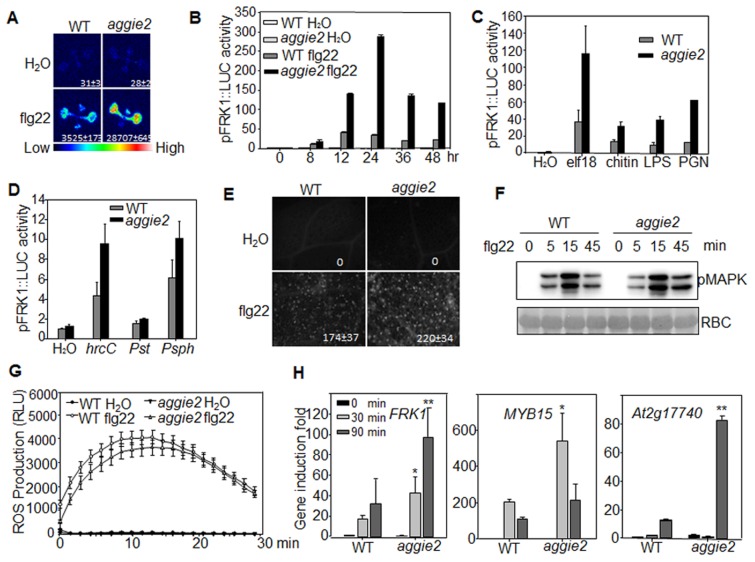
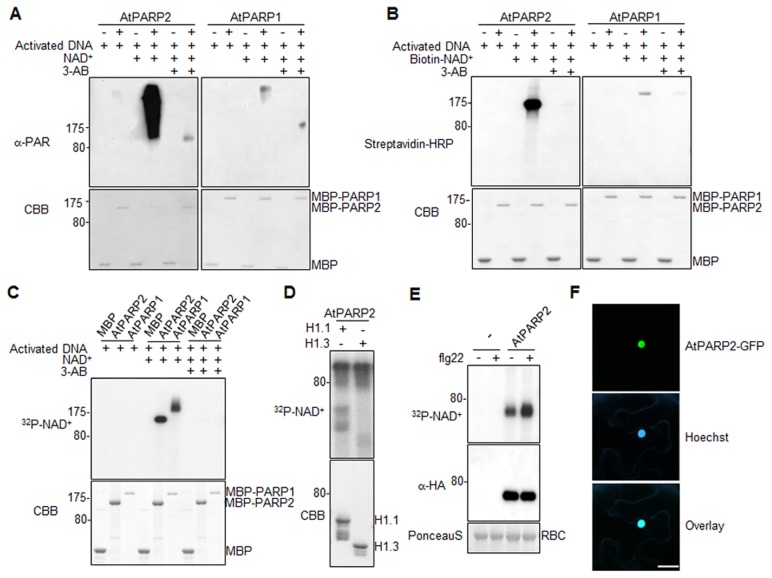
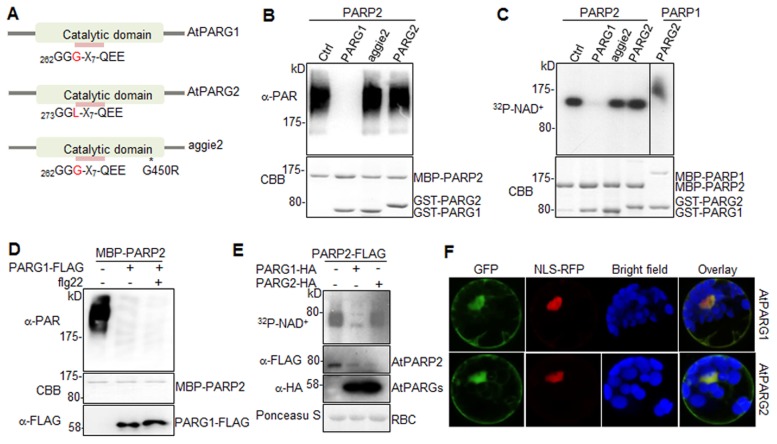
Perception of microbe-associated molecular patterns (MAMPs) elicits transcriptional reprogramming in hosts and activates defense to pathogen attacks. The molecular mechanisms underlying plant pattern-triggered immunity remain elusive. A genetic screen identified Arabidopsis poly(ADP-ribose) glycohydrolase 1 (atparg1) mutant with elevated immune gene expression upon multiple MAMP and pathogen treatments. Poly(ADP-ribose) glycohydrolase (PARG) is predicted to remove poly(ADP-ribose) polymers on acceptor proteins modified by poly(ADP-ribose) polymerases (PARPs) with three PARPs and two PARGs in Arabidopsis genome. AtPARP1 and AtPARP2 possess poly(ADP-ribose) polymerase activity, and the activity of AtPARP2 was enhanced by MAMP treatment. AtPARG1, but not AtPARG2, carries glycohydrolase activity in vivo and in vitro. Importantly, mutation (G450R) in atparg1 blocks its activity and the corresponding residue is highly conserved and essential for human HsPARG activity. Consistently, mutant atparp1atparp2 plants exhibited compromised immune gene activation and enhanced susceptibility to pathogen infections. Our study indicates that protein poly(ADP-ribosyl)ation plays critical roles in plant immune gene expression and defense to pathogen attacks.
对微生物相关分子模式(MAMPs)的感知会引发宿主的转录重编程,并激活对病原体攻击的防御反应。植物模式触发免疫的分子机制仍不清楚。一项遗传筛选鉴定出拟南芥多聚(ADP-核糖)糖水解酶1(atparg1)突变体,该突变体在多种MAMP和病原体处理后免疫基因表达升高。多聚(ADP-核糖)糖水解酶(PARG)预计会去除拟南芥基因组中由三种PARP和两种PARG修饰的受体蛋白上的多聚(ADP-核糖)聚合物。AtPARP1和AtPARP2具有多聚(ADP-核糖)聚合酶活性,MAMP处理可增强AtPARP2的活性。AtPARG1在体内和体外均具有糖水解酶活性,而AtPARG2则没有。重要的是,atparg1中的突变(G450R)会阻断其活性,且相应残基高度保守,对人类HsPARG活性至关重要。一致地,突变体atparp1atparp2植物表现出免疫基因激活受损,对病原体感染的易感性增强。我们的研究表明,蛋白质多聚(ADP-核糖基)化在植物免疫基因表达和对病原体攻击的防御中起关键作用。