Woodland Philip, Aktar Rubina, Mthunzi Engelbert, Lee Chung, Peiris Madusha, Preston Sean L, Blackshaw L Ashley, Sifrim Daniel
Barts and the London School of Medicine and Dentistry, Queen Mary University of London, London, United Kingdom.
Barts and the London School of Medicine and Dentistry, Queen Mary University of London, London, United Kingdom
Am J Physiol Gastrointest Liver Physiol. 2015 Mar 15;308(6):G525-31. doi: 10.1152/ajpgi.00175.2014. Epub 2015 Jan 8.
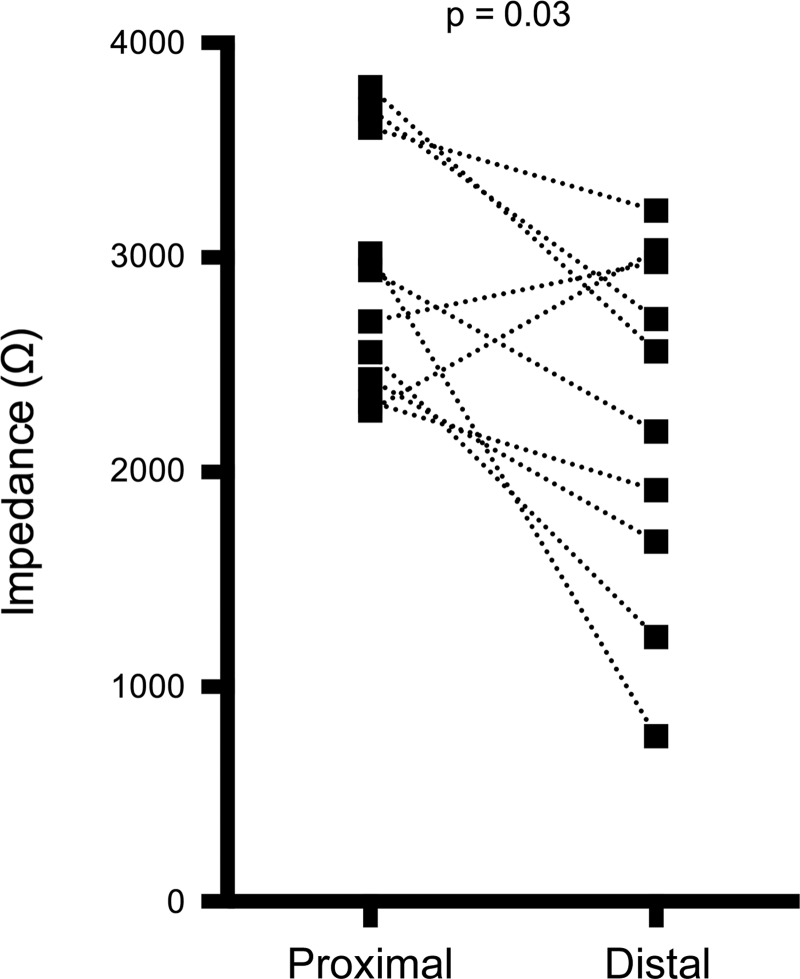
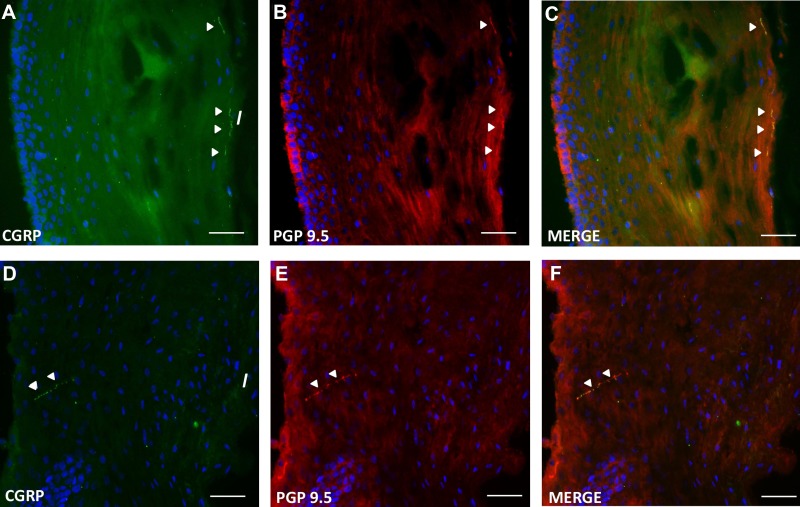
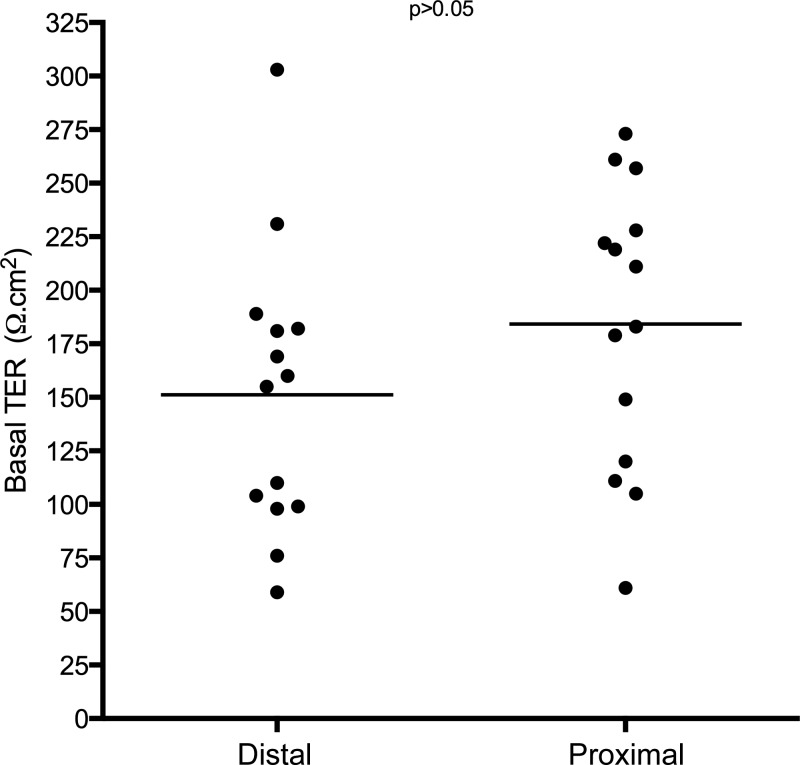
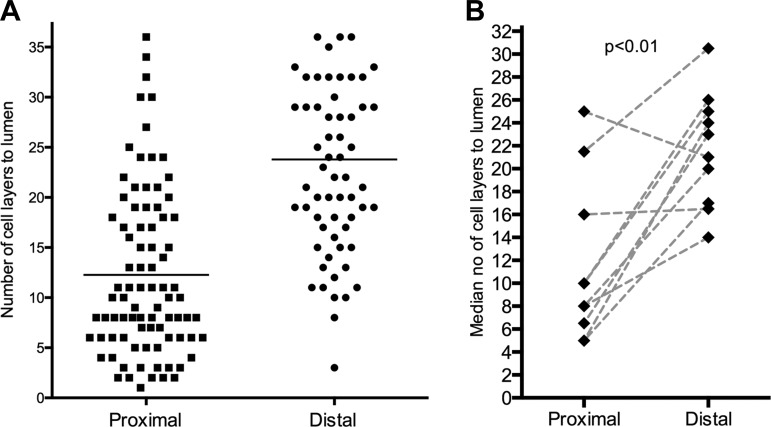
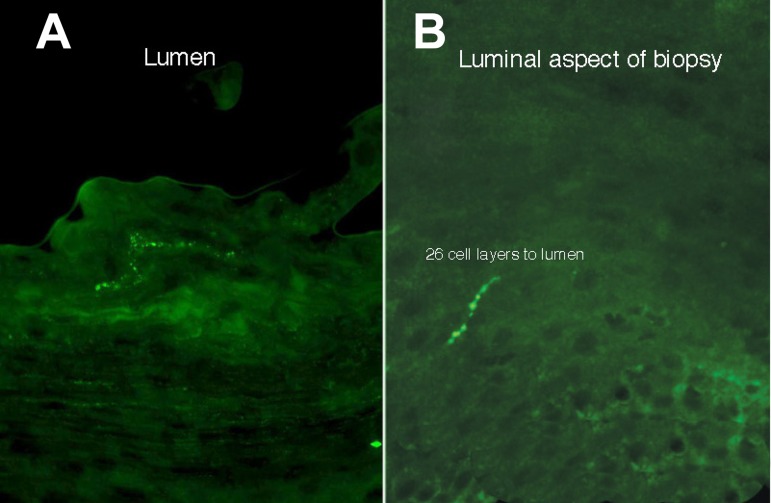
Little is known about the mucosal phenotype of the proximal human esophagus. There is evidence to suggest that the proximal esophagus is more sensitive to chemical and mechanical stimulation compared with the distal. This may have physiological relevance (e.g., in prevention of aspiration of gastroesophageal refluxate), but also pathological relevance (e.g., in reflux perception or dysphagia). Reasons for this increased sensitivity are unclear but may include impairment in mucosal barrier integrity or changes in sensory innervation. We assessed mucosal barrier integrity and afferent nerve distribution in the proximal and distal esophagus of healthy human volunteers. In 10 healthy volunteers baseline proximal and distal esophageal impedance was measured in vivo. Esophageal mucosal biopsies from the distal and proximal esophagus were taken, and baseline transepithelial electrical resistance (TER) was measured in Ussing chambers. Biopsies were examined immunohistochemically for presence and location of calcitonin gene-related peptide (CGRP)-immunoreactive nerve fibers. In a further four healthy volunteers we investigated for colocalization of CGRP and protein gene product (PGP) 9.5 immunoreactivity in nerve fibers. Baseline impedance was higher in the proximal than in the distal esophagus [2,936 Ω (SD578) vs. 2,229 Ω (SD821); P = 0.03], however, baseline TER was not significantly different between them. Mucosal CGRP-immunoreactive nerves were found in the epithelium of both proximal and distal esophagus, but were located more superficially in the proximal mucosa compared with the distal [11.5 (SD7) vs. 21.7 (SD5) cell layers from lumen, P = 0.002] 19% of proximal, and 10% of distal mucosal PGP-immunoreactive fibers colocalized with CGRP. PGP-immunoreactive fibers were also significantly closer to the luminal surface in the proximal compared with the distal esophagus (P < 0.001). We conclude that mucosal barrier integrity is similar in proximal and distal esophagus, but proximal mucosal afferent nerves are in a more superficial location. The enhanced sensitivity to reflux-evoked symptoms of the proximal esophagus most likely has an anatomical basis.
关于人类食管近端的黏膜表型,人们了解甚少。有证据表明,与食管远端相比,食管近端对化学和机械刺激更为敏感。这可能具有生理相关性(例如,在预防胃食管反流物的误吸方面),但也具有病理相关性(例如,在反流感知或吞咽困难方面)。这种敏感性增加的原因尚不清楚,但可能包括黏膜屏障完整性受损或感觉神经支配的变化。我们评估了健康人类志愿者食管近端和远端的黏膜屏障完整性及传入神经分布。对10名健康志愿者在体内测量了食管近端和远端的基线阻抗。采集了食管远端和近端的黏膜活检组织,并在尤斯灌流小室中测量了基线跨上皮电阻(TER)。对活检组织进行免疫组织化学检查,以确定降钙素基因相关肽(CGRP)免疫反应性神经纤维的存在和位置。在另外4名健康志愿者中,我们研究了神经纤维中CGRP和蛋白基因产物(PGP)9.5免疫反应性的共定位情况。食管近端的基线阻抗高于远端[2936Ω(标准差578)对2229Ω(标准差821);P = 0.03],然而,它们之间的基线TER没有显著差异。在食管近端和远端的上皮中均发现了黏膜CGRP免疫反应性神经,但与远端相比,近端黏膜中的神经位于更浅表的位置[距管腔11.5(标准差7)层对21.7(标准差5)层,P = 0.002]。近端黏膜PGP免疫反应性纤维中有19%与CGRP共定位,远端为10%。与食管远端相比,食管近端的PGP免疫反应性纤维也明显更靠近管腔表面(P < 0.001)。我们得出结论,食管近端和远端的黏膜屏障完整性相似,但近端黏膜传入神经位于更浅表的位置。食管近端对反流诱发症状的敏感性增强很可能有解剖学基础。