Mullen Leanne M, Best Serena M, Ghose Siddhartha, Wardale John, Rushton Neil, Cameron Ruth E
Department of Materials Science and Metallurgy, University of Cambridge, Pembroke Street, Cambridge, CB2 3QZ, UK,
J Mater Sci Mater Med. 2015 Jan;26(1):5325. doi: 10.1007/s10856-014-5325-y. Epub 2015 Jan 11.
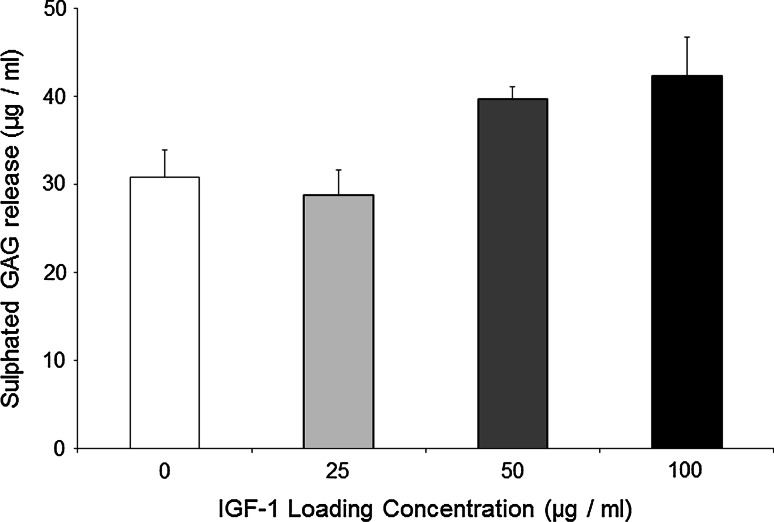
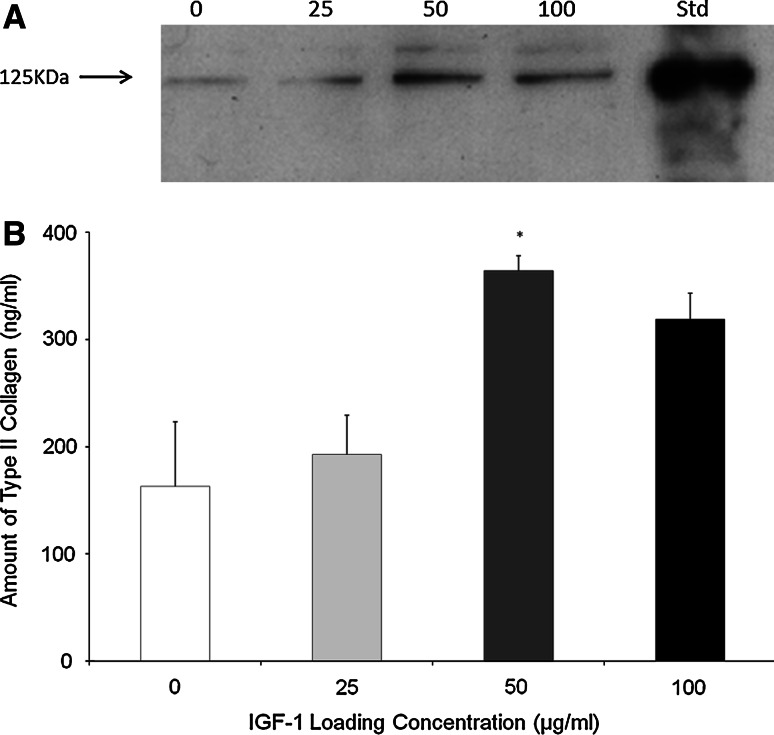
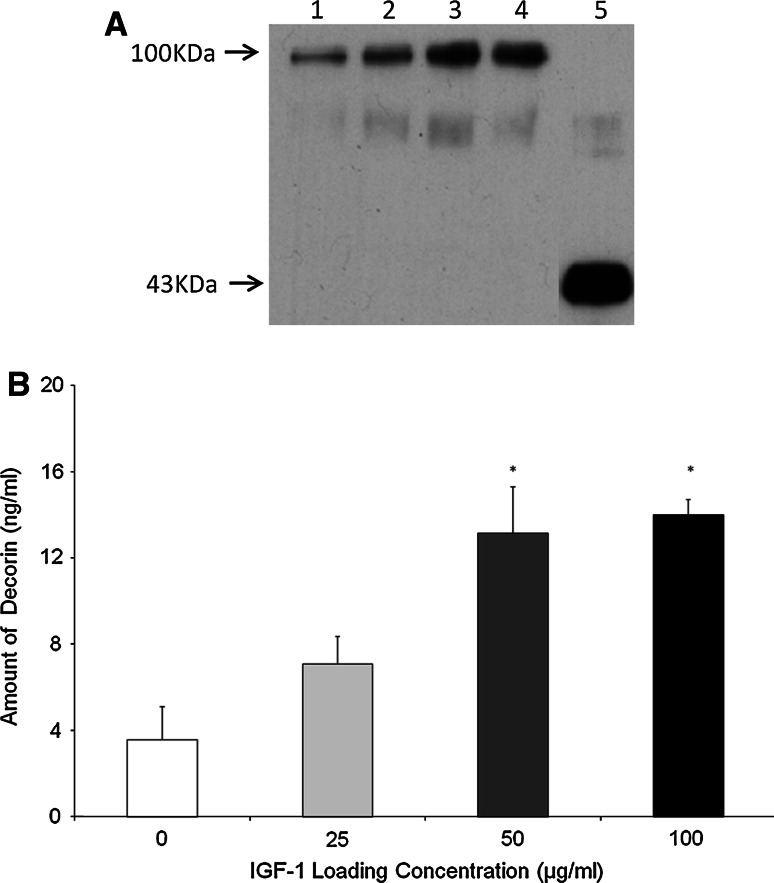
Tissue engineering is a promising technique for cartilage repair. Toward this goal, a porous collagen-glycosaminoglycan (CG) scaffold was loaded with different concentrations of insulin-like growth factor-1 (IGF-1) and evaluated as a growth factor delivery device. The biological response was assessed by monitoring the amount of type II collagen and proteoglycan synthesised by the chondrocytes seeded within the scaffolds. IGF-1 release was dependent on the IGF-1 loading concentration used to adsorb IGF-1 onto the CG scaffolds and the amount of IGF-1 released into the media was highest at day 4. This initial IGF-1 release could be modelled using linear regression analysis. Osteoarthritic (OA) chondrocytes seeded within scaffolds containing adsorbed IGF-1 deposited decorin and type II collagen in a dose dependent manner and the highest type II collagen deposition was achieved via loading the scaffold with 50 μg/ml IGF-1. Cells seeded within the IGF-1 loaded scaffolds also deposited more extracellular matrix than the no growth factor control group thus the IGF-1 released from the scaffold remained bioactive and exerted an anabolic effect on OA chondrocytes. The effectiveness of adsorbing IGF-1 onto the scaffold may be due to protection of the molecule from proteolytic digestion allowing a more sustained release of IGF-1 over time compared to adding multiple doses of exogenous growth factor. Incorporating IGF-1 into the CG scaffold provided an initial therapeutic burst release of IGF-1 which is beneficial in initiating ECM deposition and repair in this in vitro model and shows potential for developing this delivery device in vivo.
组织工程是一种很有前景的软骨修复技术。为实现这一目标,一种多孔胶原 - 糖胺聚糖(CG)支架被加载了不同浓度的胰岛素样生长因子 -1(IGF -1),并作为一种生长因子递送装置进行评估。通过监测接种在支架内的软骨细胞合成的II型胶原蛋白和蛋白聚糖的量来评估生物学反应。IGF -1的释放取决于用于将IGF -1吸附到CG支架上的IGF -1加载浓度,并且释放到培养基中的IGF -1量在第4天最高。这种初始的IGF -1释放可以使用线性回归分析进行建模。接种在含有吸附IGF -1的支架内的骨关节炎(OA)软骨细胞以剂量依赖的方式沉积了核心蛋白聚糖和II型胶原蛋白,并且通过用50μg/ml IGF -1加载支架实现了最高的II型胶原蛋白沉积。接种在加载IGF -1的支架内的细胞也比无生长因子对照组沉积了更多的细胞外基质,因此从支架释放的IGF -1保持生物活性并对OA软骨细胞发挥合成代谢作用。将IGF -1吸附到支架上的有效性可能是由于该分子受到蛋白水解消化的保护,与添加多剂量的外源性生长因子相比,随着时间的推移允许IGF -1更持续地释放。将IGF -1掺入CG支架中提供了IGF -1的初始治疗性爆发释放,这有利于在该体外模型中启动细胞外基质沉积和修复,并显示出在体内开发这种递送装置的潜力。