García-Bueno Borja, Bioque Miquel, MacDowell Karina S, Santabárbara Javier, Martínez-Cengotitabengoa Mónica, Moreno Carmen, Sáiz Pilar A, Berrocoso Esther, Gassó Patricia, Fe Barcones M, González-Pinto Ana, Parellada Mara, Bobes Julio, Micó Juan A, Bernardo Miguel, Leza Juan C
Department of Pharmacology, Faculty of Medicine, Complutense University, Instituto de Investigación Sanitaria -IIS- Hospital 12 de Octubre (i+12), Madrid, Spain (Drs García-Bueno, MacDowell, and Leza); Unitat d'Esquizofrènia Clínic, Hospital Clínic, University of Barcelona, IDIBAPS, Barcelona, Spain (Drs Bioque and Bernardo); Department of Preventive Medicine and Public Health, University of Zaragoza, Zaragoza, Spain (Dr Santabárbara); Hospital Universitario, Alava, EHU/UPV and National Distance Education University, Vitoria, Spain (Drs Martínez-Cengotitabengoa and González-Pinto); Child and Adolescent Psychiatry Department IIS Gregorio Marañón (IISGM), Hospital General Universitario Gregorio Marañón, Madrid, Spain (Drs Moreno and Parellada); Department of Psychiatry, Faculty of Medicine, University of Oviedo, Oviedo, Spain (Drs Sáiz and Bobes); Department of Pharmacology, Faculty of Medicine, University of Cádiz, Cádiz, Spain (Drs Berrocoso and Micó); Department of Pharmacology, Faculty of Medicine, University of Barcelona, Barcelona, Spain (Dr Gassó); Hospital Clínico Universitario, Zaragoza, Spain (Dr Fe Barcones).
Int J Neuropsychopharmacol. 2014 Oct 31;18(2):pyu037. doi: 10.1093/ijnp/pyu037.
Previous studies indicated a systemic deregulation of the pro-/antiinflammatory balance in subjects after 6 months of a first psychotic episode. This disruption was reexamined 12 months after diagnosis to identify potential risk/protective factors and associations with symptom severity.
Eighty-five subjects were followed during 12 months and the determination of the same pro-/antiinflammatory mediators was carried out in plasma and peripheral blood mononuclear cells. Multivariate logistic regression analyses were used to identify risk/protective factors. Multiple linear regression models were performed to detect the change of each biological marker during follow-up in relation to clinical characteristics and confounding factors.
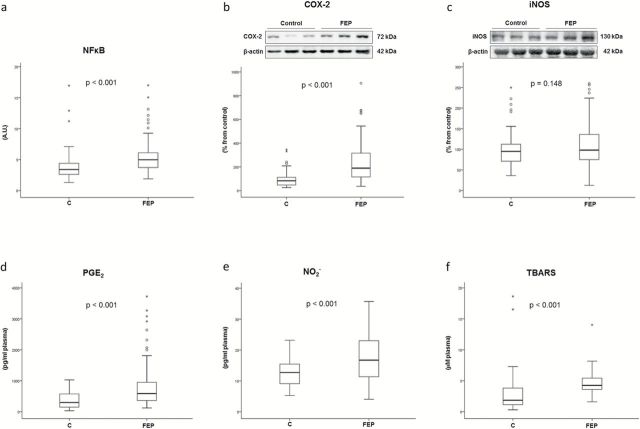
This study suggests a more severe systemic pro-/antiinflammatory deregulation than in earlier pathological stages in first psychotic episode, because not only were intracellular components of the inflammatory response increased but also the majority of soluble elements. Nitrite plasma levels and cyclooxygenase-2 expression in peripheral blood mononuclear cells are reliable potential risk factors and 15d-prostaglandin-J2 plasma levels a protection biomarker. An interesting relationship exists between antipsychotic dose and the levels of prostaglandin-E2 (inverse) and 15d-prostaglandin-J2 (direct). An inverse relationship between the Global Assessment of Functioning scale and lipid peroxidation is also present.
Summing up, pro-/antiinflammatory mediators can be used as risk/protection biomarkers. The inverse association between oxidative/nitrosative damage and the Global Assessment of Functioning scale, and the possibility that one of the targets of antipsychotics could be the restoration of the pro-/antiinflammatory balance support the use of antiinflammatory drugs as coadjuvant to antipsychotics.
先前的研究表明,首次精神病发作6个月后,受试者体内促炎/抗炎平衡出现系统性失调。在诊断12个月后对这种失调情况进行了重新检查,以确定潜在的风险/保护因素以及与症状严重程度的关联。
对85名受试者进行了为期12个月的随访,并在血浆和外周血单核细胞中测定了相同的促炎/抗炎介质。采用多变量逻辑回归分析来确定风险/保护因素。进行多元线性回归模型以检测随访期间每种生物标志物相对于临床特征和混杂因素的变化。
本研究表明,首次精神病发作时的系统性促炎/抗炎失调比早期病理阶段更为严重,这是因为不仅炎症反应的细胞内成分增加,而且大多数可溶性成分也增加。血浆亚硝酸盐水平和外周血单核细胞中环氧合酶-2的表达是可靠的潜在风险因素,而血浆15d-前列腺素-J2水平是一种保护生物标志物。抗精神病药物剂量与前列腺素-E2水平(负相关)和15d-前列腺素-J2水平(正相关)之间存在有趣的关系。功能总体评定量表与脂质过氧化之间也存在负相关关系。
总之,促炎/抗炎介质可作为风险/保护生物标志物。氧化/亚硝化损伤与功能总体评定量表之间的负相关关系,以及抗精神病药物的目标之一可能是恢复促炎/抗炎平衡,支持将抗炎药物作为抗精神病药物的辅助药物使用。