Garés-Caballer Marta, Sánchez-Ortí Joan Vicent, Correa-Ghisays Patricia, Balanzá-Martínez Vicent, Selva-Vera Gabriel, Vila-Francés Joan, Magdalena-Benedito Rafael, San-Martin Constanza, Victor Victor M, Escribano-Lopez Irene, Hernandez-Mijares Antonio, Vivas-Lalinde Juliana, Vieta Eduard, Leza Juan C, Tabarés-Seisdedos Rafael
Teaching Unit of Psychiatry and Psychological Medicine, Department of Medicine, University of Valencia, Valencia, Spain.
INCLIVA-Health Research Institute, Valencia, Spain.
Front Neurol. 2022 Jun 2;13:883927. doi: 10.3389/fneur.2022.883927. eCollection 2022.
Systemic, low-grade immune-inflammatory activity, together with social and neurocognitive performance deficits are a transdiagnostic trait of people suffering from type 2 diabetes mellitus (T2DM) and severe mental illnesses (SMIs), such as schizophrenia (SZ), major depressive disorder (MDD), and bipolar disorder (BD). We aimed to determine if immune-inflammatory mediators were significantly altered in people with SMIs or T2DM compared with healthy controls (HC) and whether these biomarkers could help predict their cognition and social functioning 1 year after assessment.
We performed a prospective, 1-year follow-up cohort study with 165 participants at baseline (TB), including 30 with SZ, 42 with BD, 35 with MDD, 30 with T2DM, and 28 HC; and 125 at 1-year follow-up (TY), and determined executive domain (ED), global social functioning score (GSFS), and peripheral blood immune-inflammatory and oxidative stress biomarkers.
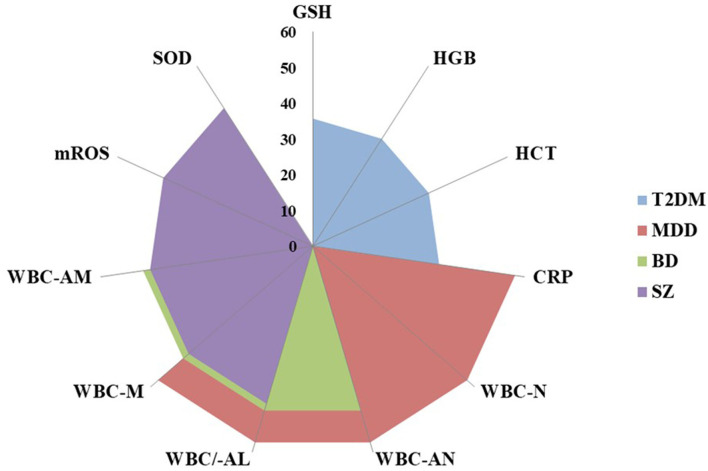
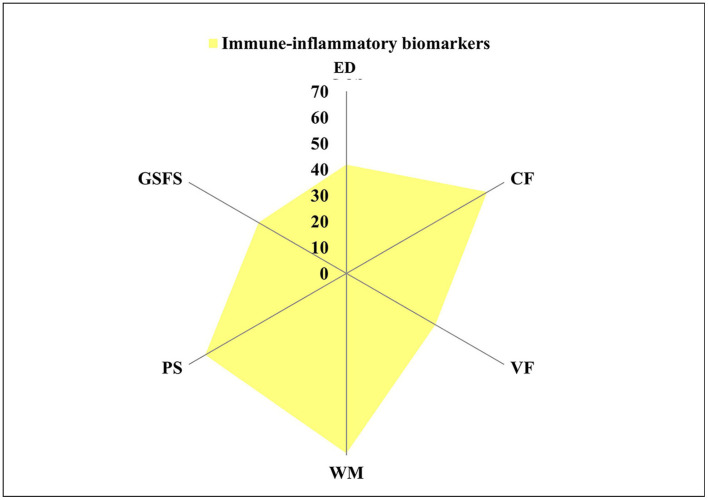
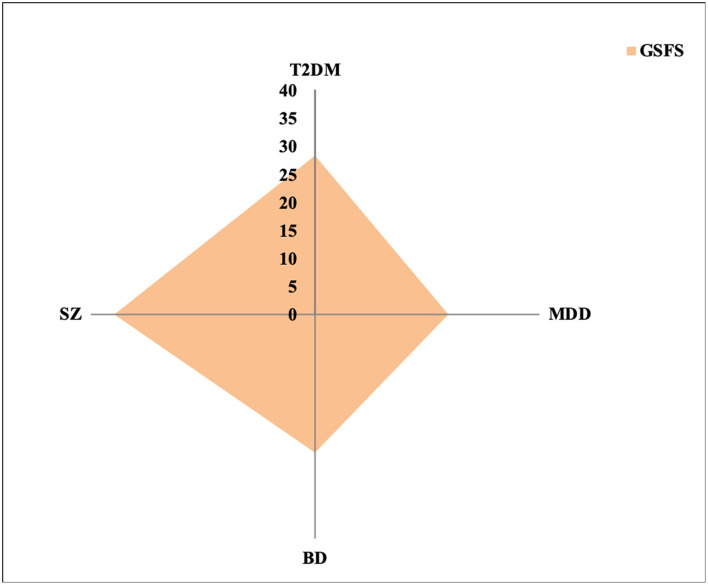
Participants with SMIs and T2DM showed increased peripheral levels of inflammatory markers, such as interleukin-10 ( < 0.01; η = 0.07) and tumor necrosis factor-α ( < 0.05; η = 0.08); and oxidative stress biomarkers, such as reactive oxygen species (ROS) ( < 0.05; η = 0.07) and mitochondrial ROS ( < 0.01; η = 0.08). The different combinations of the exposed biomarkers anticipated 46-57.3% of the total ED and 23.8-35.7% of GSFS for the participants with SMIs.
Participants' treatment, as usual, was continued without no specific interventions; thus, it was difficult to anticipate substantial changes related to the psychopharmacological pattern.
People with SMIs show significantly increased levels of peripheral immune-inflammatory biomarkers, which may contribute to the neurocognitive and social deficits observed in SMIs, T2DM, and other diseases with systemic immune-inflammatory activation of chronic development. These parameters could help identify the subset of patients who could benefit from immune-inflammatory modulator strategies to ameliorate their functional outcomes.
全身性低度免疫炎症活动,以及社会和神经认知功能缺陷是2型糖尿病(T2DM)患者和严重精神疾病(SMIs)患者(如精神分裂症(SZ)、重度抑郁症(MDD)和双相情感障碍(BD))的一种跨诊断特征。我们旨在确定与健康对照(HC)相比,SMIs或T2DM患者的免疫炎症介质是否有显著改变,以及这些生物标志物是否有助于预测评估后1年他们的认知和社会功能。
我们进行了一项前瞻性的1年随访队列研究,基线(TB)时有165名参与者,包括30名SZ患者、42名BD患者、35名MDD患者、30名T2DM患者和28名HC;1年随访(TY)时有125名参与者,并测定了执行领域(ED)、全球社会功能评分(GSFS)以及外周血免疫炎症和氧化应激生物标志物。
SMIs和T2DM患者外周炎症标志物水平升高,如白细胞介素-10(<0.01;η=0.07)和肿瘤坏死因子-α(<0.05;η=0.08);以及氧化应激生物标志物,如活性氧(ROS)(<0.05;η=0.07)和线粒体ROS(<0.01;η=0.08)。所检测生物标志物的不同组合可预测SMIs患者总ED的46%-57.3%和GSFS的23.8%-35.7%。
参与者按常规继续治疗,未进行特定干预;因此,难以预测与精神药理模式相关的实质性变化。
SMIs患者外周免疫炎症生物标志物水平显著升高,这可能导致在SMIs、T2DM以及其他具有慢性全身性免疫炎症激活的疾病中观察到的神经认知和社会功能缺陷。这些参数有助于识别可能从免疫炎症调节策略中获益以改善其功能结局的患者亚组。