Bagheri Mansooreh, Eghtedari Masoomeh, Bagheri Mandana, Geramizadeh Bita, Talebnejad Mohammadreza
Poostchi Ophthalmology Research Center, Shiraz University of Medical Sciences, Shiraz, Iran.
Ophthalmology Department, Shiraz University of Medical Sciences, Shiraz, Iran.
Dermatol Res Pract. 2014;2014:596564. doi: 10.1155/2014/596564. Epub 2014 Dec 15.
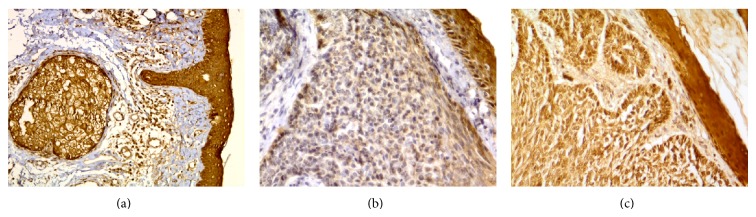
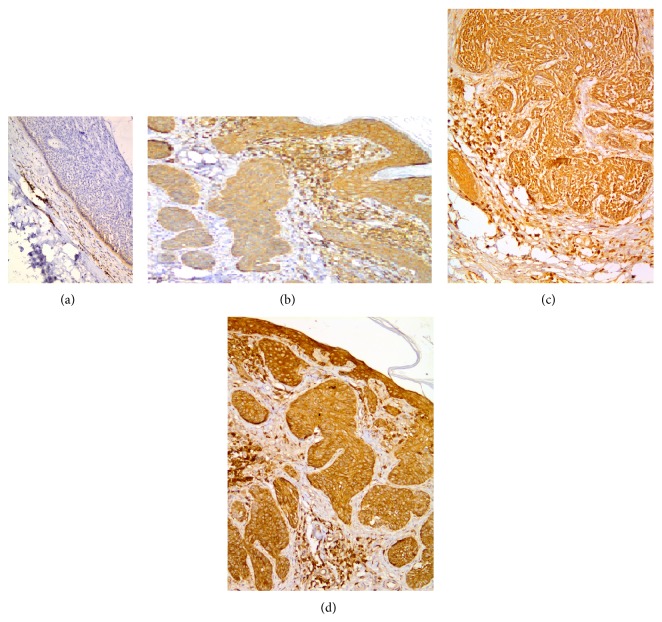
Background. The aim of this study was to investigate maspin and ezrin expression in different subtypes of periocular basal cell carcinoma (BCC). Methods. Tissue samples from 43 patients with periocular BCC. Our cases were comprised of 10 morpheaform, 25 nodular, and 8 adenoid type BCCs. Immunohistochemical staining for maspin and ezrin was performed by Envision detection system. Results. There was no difference between different subtypes of BCC in maspin expression regarding positivity, intensity, and pattern of expression. Ezrin was expressed in all subtypes of BCC but the intensity was significantly higher in morpheaform BCC compared to nodular and adenoid types (P < 0.001 and P = 0.012, resp.); ninety percent of morpheaform samples showed strong ezrin intensity, while this strong intensity was only present in 25% and 12% of adenoid and nodular subtypes, respectively. There was no correlation between age, sex, or tumor margin involvement and expression of neither maspin nor ezrin. There was no correlation between maspin and ezrin expression except in nodular type, in which an inverse correlation was found (P = 0.004). Conclusion. Ezrin is expressed intensely in morpheaform BCC of periocular region. Further studies are needed to show the significance of this finding in prognosis of morpheaform BCC.
背景。本研究旨在调查乳腺丝抑蛋白(maspin)和埃兹蛋白(ezrin)在眼周基底细胞癌(BCC)不同亚型中的表达情况。方法。收集43例眼周BCC患者的组织样本。我们的病例包括10例硬斑病样、25例结节样和8例腺样BCC。采用Envision检测系统对maspin和ezrin进行免疫组织化学染色。结果。在maspin表达的阳性率、强度和表达模式方面,BCC不同亚型之间没有差异。埃兹蛋白在所有BCC亚型中均有表达,但硬斑病样BCC中的表达强度显著高于结节样和腺样亚型(分别为P < 0.001和P = 0.012);90%的硬斑病样样本显示埃兹蛋白强表达,而腺样和结节样亚型中分别只有25%和12%有这种强表达。年龄、性别或肿瘤边缘受累情况与maspin和埃兹蛋白的表达均无相关性。除结节样类型外,maspin和埃兹蛋白表达之间没有相关性,在结节样类型中发现二者呈负相关(P = 0.004)。结论。埃兹蛋白在眼周区域的硬斑病样BCC中高表达。需要进一步研究以阐明这一发现对硬斑病样BCC预后的意义。