Mukhopadhyay A, Tai B C, See K C, Ng W Y, Lim T K, Onsiong S, Ee S, Chua M J, Lee P R, Loh M L, Phua J
Division of Respiratory and Critical Care Medicine, University Medicine Cluster, National University Health System, Singapore ; Department of Medicine, Yong Loo Lin School of Medicine, National University of Singapore, Singapore.
Saw Swee Hock School of Public Health, National University of Singapore and National University Health System, Singapore.
Biomed Res Int. 2014;2014:960575. doi: 10.1155/2014/960575. Epub 2014 Dec 16.
Data on long-term outcomes of elderly (≥65 years) patients in ICU are sparse.
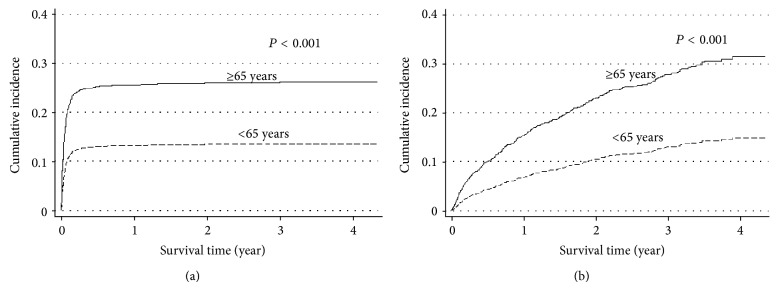
Adult patients (n = 1563, 45.4% elderly) admitted over 28 months were analyzed by competing risks regression model to determine independent factors related to in-hospital and long-term mortality.
414 (26.5%) and 337 (21.6%) patients died in-hospital and during the 52 months following discharge, respectively; the elderly group had higher mortality during both periods. After discharge, elderly patients had 2.3 times higher mortality compared to the general population of the same age-group. In-hospital mortality was independently associated with mechanical ventilation (subdistribution hazard ratio (SHR) 2.74), vasopressors (SHR 2.56), neurological disease (SHR 1.77), and Mortality Prediction Model II score (SHR 1.01) regardless of age and with malignancy (SHR, hematological 3.65, nonhematological 3.4) and prior renal replacement therapy (RRT, SHR 2.21) only in the elderly. Long-term mortality was associated with low hemoglobin concentration (SHR 0.94), airway disease (SHR 2.23), and malignancy (SHR hematological 1.11, nonhematological 2.31) regardless of age and with comorbidities especially among the nonelderly.
Following discharge, elderly ICU patients have higher mortality compared to the nonelderly and general population. In the elderly group, prior RRT and malignancy contribute additionally to in-hospital mortality risk. In the long-term, comorbidities (age-related), anemia, airway disease, and malignancy were significantly associated with mortality.
关于重症监护病房(ICU)中老年(≥65岁)患者长期预后的数据较为稀少。
对28个月内收治的成年患者(n = 1563,45.4%为老年人)采用竞争风险回归模型进行分析,以确定与院内及长期死亡率相关的独立因素。
分别有414例(26.5%)和337例(21.6%)患者在院内及出院后的52个月内死亡;老年组在这两个时期的死亡率均较高。出院后,老年患者的死亡率比同年龄组的普通人群高2.3倍。无论年龄大小,院内死亡率均与机械通气(亚分布风险比(SHR)2.74)、血管升压药(SHR 2.56)、神经系统疾病(SHR 1.77)和死亡率预测模型II评分(SHR 1.01)独立相关,而在老年人中仅与恶性肿瘤(SHR,血液系统疾病3.65,非血液系统疾病3.4)和既往肾脏替代治疗(RRT,SHR 2.21)相关。长期死亡率与血红蛋白浓度低(SHR 0.94)、气道疾病(SHR 2.23)和恶性肿瘤(SHR,血液系统疾病1.11,非血液系统疾病2.31)独立相关,无论年龄大小,尤其是在非老年人中与合并症相关。
出院后,老年ICU患者的死亡率高于非老年患者和普通人群。在老年组中,既往RRT和恶性肿瘤会额外增加院内死亡风险。从长期来看,合并症(与年龄相关)、贫血、气道疾病和恶性肿瘤与死亡率显著相关。