Desurmont Thibault, Skrypek Nicolas, Duhamel Alain, Jonckheere Nicolas, Millet Guillaume, Leteurtre Emmanuelle, Gosset Pierre, Duchene Belinda, Ramdane Nassima, Hebbar Mohamed, Van Seuningen Isabelle, Pruvot François-René, Huet Guillemette, Truant Stéphanie
Inserm, U837, Team-5 (Mucins, Epithelial Differentiation, and Carcinogenesis), Jean-Pierre Aubert Research Centre, Université Lille, France; Department of Digestive and Visceral Surgery, GHICL, Saint-Vincent de Paul Hospital, Lille, France.
Cancer Sci. 2015 Mar;106(3):262-9. doi: 10.1111/cas.12603. Epub 2015 Mar 5.
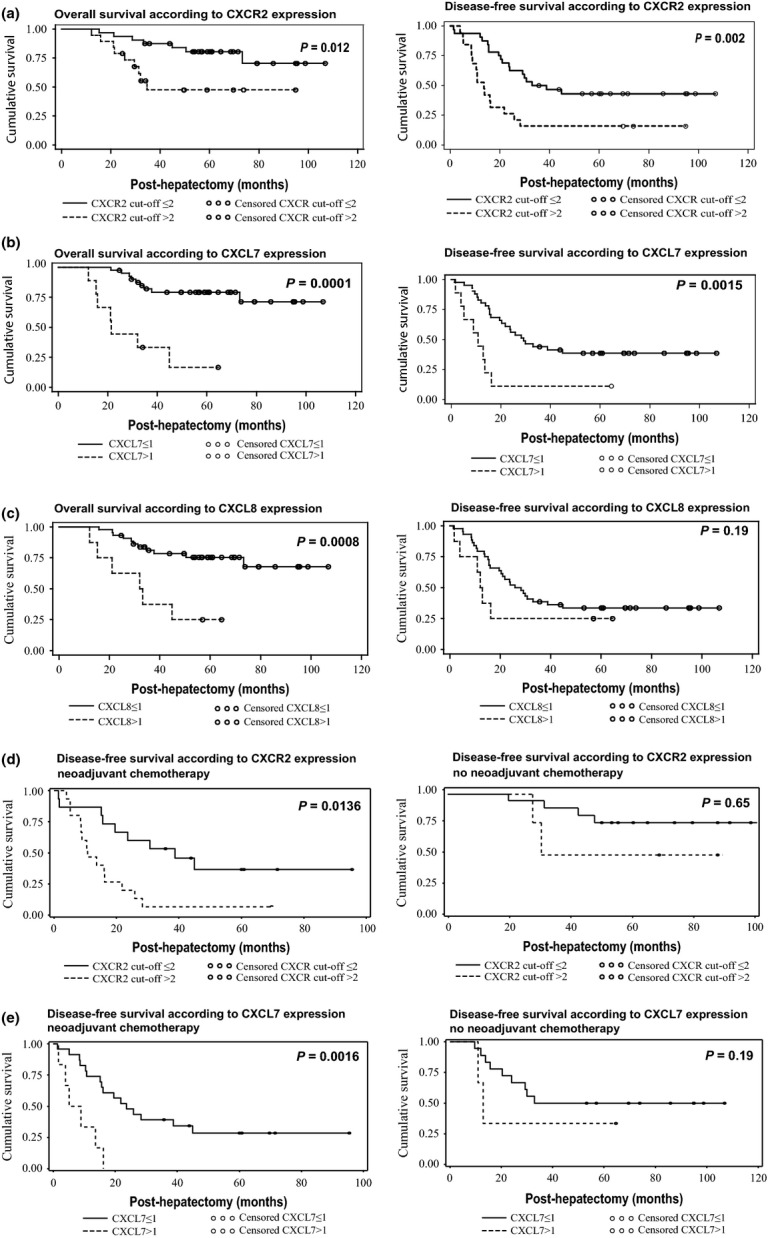
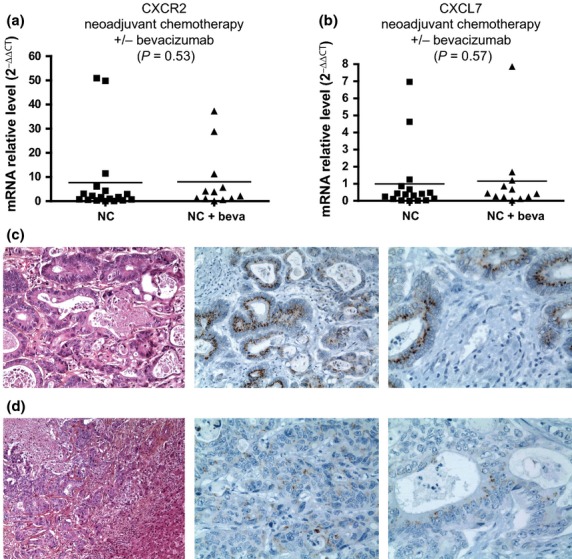
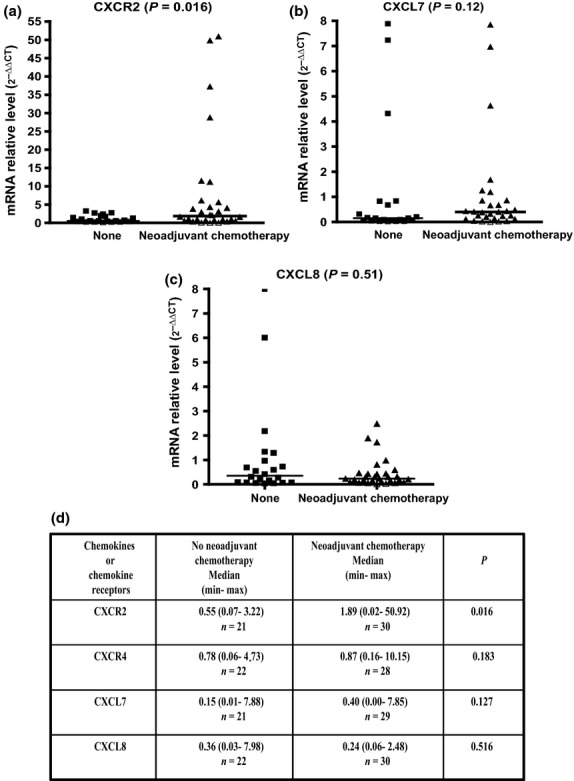
Our aim was to analyze the potential role of chemokine receptors CXCR2 and CXCR4 signalling pathways in liver metastatic colorectal cancer (CRC) relapse. CXCR2, CXCR4, and their chemokine ligands were evaluated in liver metastases of colorectal cancer in order to study their correlation with overall and disease-free survival of patients having received, or not received, a neoadjuvant chemotherapy regimen. Quantitative RT-PCR and CXCR2 immunohistochemical staining were carried out using CRC liver metastasis samples. Expression levels of CXCR2, CXCR4, and their ligands were statistically analyzed according to treatment with neoadjuvant chemotherapy and patients' outcome. CXCR2 and CXCL7 overexpression are correlated to shorter overall and disease-free survival. By multivariate analysis, CXCR2 and CXCL7 expressions are independent factors of overall and disease-free survival. Neoadjuvant chemotherapy increases significantly the expression of CXCR2: treated group 1.89 (0.02-50.92) vs 0.55 (0.07-3.22), P = 0.016. CXCL7 was overexpressed close to significance, 0.40 (0.00-7.85) vs 0.15 (0.01-7.88), P = 0.12. We show the involvement of CXCL7/CXCR2 signalling pathways as a predictive factor of poor outcome in metastatic CRC. 5-Fluorouracil-based chemotherapy regimens increase the expression of these genes in liver metastasis, providing one explanation for aggressiveness of relapsed drug-resistant tumors. Selective blockage of CXCR2/CXCL7 signalling pathways could provide new potential therapeutic opportunities.
我们的目的是分析趋化因子受体CXCR2和CXCR4信号通路在肝转移性结直肠癌(CRC)复发中的潜在作用。对结直肠癌肝转移灶中的CXCR2、CXCR4及其趋化因子配体进行评估,以研究它们与接受或未接受新辅助化疗方案患者的总生存期和无病生存期的相关性。使用结直肠癌肝转移样本进行定量逆转录聚合酶链反应(RT-PCR)和CXCR2免疫组织化学染色。根据新辅助化疗治疗情况和患者预后,对CXCR2、CXCR4及其配体的表达水平进行统计学分析。CXCR2和CXCL7的过表达与较短的总生存期和无病生存期相关。多因素分析显示,CXCR2和CXCL7的表达是总生存期和无病生存期的独立影响因素。新辅助化疗显著增加了CXCR2的表达:治疗组为1.89(0.02 - 50.92),而未治疗组为0.55(0.07 - 3.22),P = 0.016。CXCL7的过表达接近显著水平,分别为0.40(0.00 - 7.85)和0.15(0.01 - 7.88),P = 0.12。我们证明CXCL7/CXCR2信号通路参与其中,是转移性结直肠癌预后不良的预测因素。基于5-氟尿嘧啶的化疗方案会增加这些基因在肝转移灶中的表达,这为复发的耐药肿瘤的侵袭性提供了一种解释。选择性阻断CXCR2/CXCL7信号通路可能提供新的潜在治疗机会。