John C. Lincoln North Mountain Hospital, Phoenix, USA.
John C. Lincoln North Mountain Hospital, Phoenix, USA ; North Mountain Radiology Group Hospital, Phoenix, USA.
World J Emerg Surg. 2014 Dec 13;9(1):59. doi: 10.1186/1749-7922-9-59. eCollection 2014.
Annually in the US, there are over 300,000 hospital admissions due to hip fractures in geriatric patients. Consequently, there have been several large observational studies, which continue to provide new insights into differences in outcomes among hip fracture patients. However, few hip fracture studies have specifically examined the relationship between hip fracture patterns, sex, and short-term outcomes including hospital length of stay and discharge disposition in geriatric trauma patients.
We performed a retrospective study of hip fractures in geriatric trauma patients. Hip fracture patterns were based on ICD -9 CM diagnostic codes for hip fractures (820.00-820.9). Patient variables were patient demographics, mechanism of injury, injury severity score, hospital and ICU length of stay, co-morbidities, injury location, discharge disposition, and in-patient mortality.
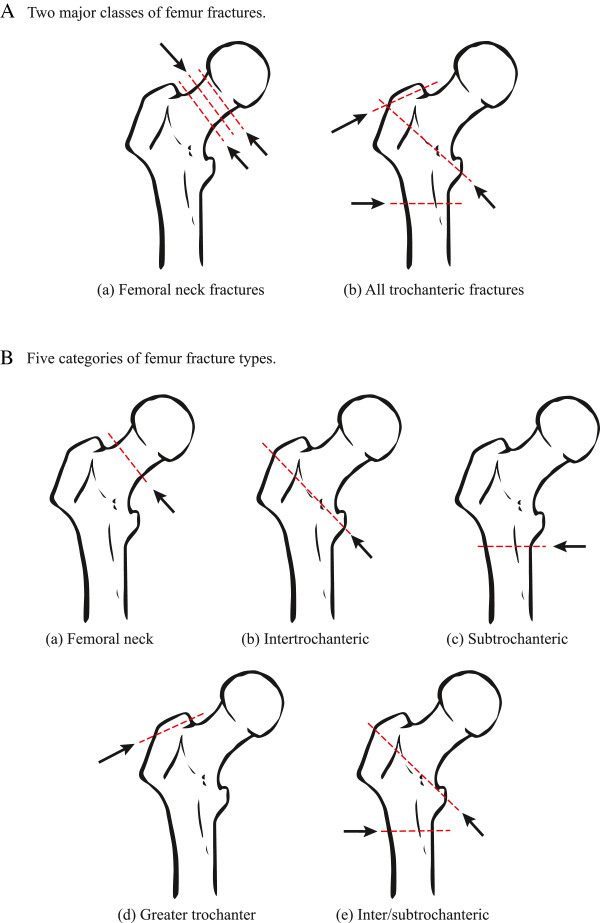
A total of 325 patient records met the inclusion criteria. The mean age of the patients was 82.2 years, and the majority of the patients were white (94%) and female (70%). Hip fractures patterns were categorized as two fracture classes and three fracture types. We observed a difference in the proportion of males to females within each fracture class (Femoral neck fractures Z-score = -8.86, p < 0.001, trochanteric fractures Z-score = -5.63, p < 0.001). Hip fractures were fixed based on fracture pattern and patient characteristics. Hip fracture class or fracture type did not predict short-term outcomes such as in-hospital or ICU length of stay, death, or patient discharge disposition. The majority of patients (73%) were injured at home. However, 84% of the patients were discharged to skilled nursing facility, rehabilitation, or long-term care while only 16% were discharged home. There was no evidence of significant association between fracture pattern, injury severity score, diabetes mellitus, hypertension or dementia.
Hip fracture patterns differ between geriatric male and female trauma patients. However, there was no significant association between fracture patterns and short-term patient outcomes. Further studies are planned to investigate the effect of fracture pattern and long-term outcomes including 90-day mortality, return to previous levels of activity, and other quality of life measures.
在美国,每年有超过 30 万的老年患者因髋部骨折住院治疗。因此,已经有几项大型观察性研究继续提供有关髋部骨折患者结局差异的新见解。然而,很少有髋部骨折研究专门研究髋部骨折类型、性别与短期结局之间的关系,包括老年创伤患者的住院时间和出院去向。
我们对老年创伤患者的髋部骨折进行了回顾性研究。髋部骨折类型基于 ICD-9-CM 诊断代码(820.00-820.9)。患者变量包括患者人口统计学特征、损伤机制、损伤严重程度评分、住院和 ICU 住院时间、合并症、损伤部位、出院去向和住院死亡率。
共有 325 份患者记录符合纳入标准。患者的平均年龄为 82.2 岁,大多数患者为白人(94%)和女性(70%)。髋部骨折类型分为两类和三种类型。我们观察到每个骨折类别的男性与女性比例存在差异(股骨颈骨折 Z 分数=-8.86,p<0.001,转子间骨折 Z 分数=-5.63,p<0.001)。根据骨折类型和患者特征对髋部骨折进行固定。髋部骨折类型或骨折类型与住院或 ICU 住院时间、死亡或患者出院去向等短期结局无关。大多数患者(73%)在家中受伤。然而,84%的患者出院到康复、长期护理或护理院,而只有 16%的患者出院回家。在骨折类型、损伤严重程度评分、糖尿病、高血压或痴呆之间没有明显的关联。
老年男性和女性创伤患者的髋部骨折类型不同。然而,骨折类型与短期患者结局之间没有显著关联。计划进一步研究以调查骨折类型和包括 90 天死亡率、恢复到先前活动水平和其他生活质量指标在内的长期结局之间的关系。