Fu Xiuping, Liang Weili, Du Pengcheng, Yan Meiying, Kan Biao
State Key Laboratory for Infectious Disease Prevention and Control, National Institute for Communicable Disease Control and Prevention, Chinese Center for Disease Control and Prevention, 155, Changbai Road, Changping, Beijing 102206 China ; Collaborative Innovation Center for Diagnosis and Treatment of Infectious Diseases, Hangzhou, 310006 China.
Gut Pathog. 2014 Dec 30;6(1):47. doi: 10.1186/s13099-014-0047-8. eCollection 2014.
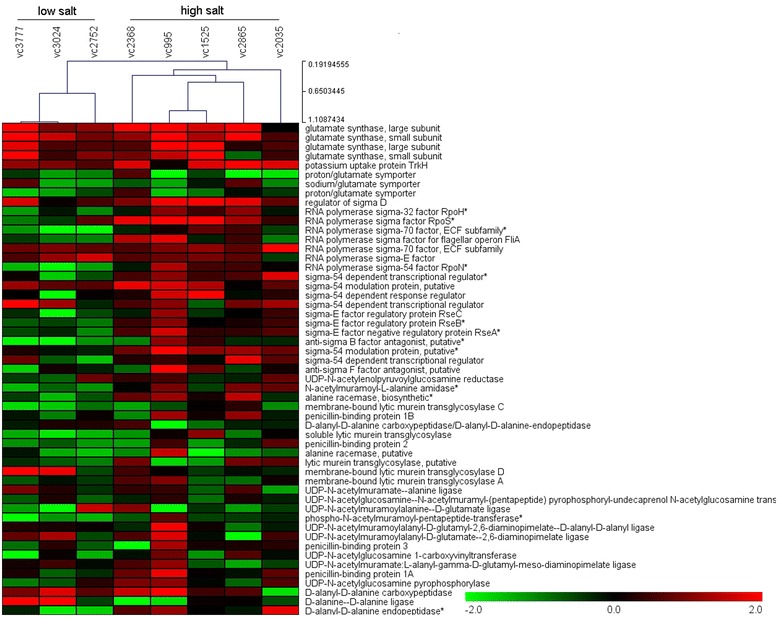
Vibrio cholerae, which is a serious human intestinal pathogen, often resides and thrives in estuaries but requires major self-regulation to overcome intestinal hyperosmotic stress or high salt stress in water and food. In the present study, we selected multiple O1 and O139 group V. cholerae strains that were isolated from different regions and during different years to study their salt tolerance. Based on the mechanisms that other bacteria use to respond to high salt stress, we selected salt stress-response related genes to study the mechanisms which V. cholerae responds to high salt stress. V. cholerae strains showed salt-resistance characteristics that varied in salt concentrations from 4% to 6%. However, group O1 and group O139 showed no significant difference in the degree of salt tolerance. The primary responses of bacteria to salt stress, including Na(+) exclusion, K(+) uptake and glutamate biosynthesis, were observed in V. cholerae strains. In addition, some sigma factors were up-regulated in V. cholerae strains, suggesting that V. cholerae may recruit common sigma factors to achieve an active salt stress response. However, some changes in gene transcript levels in response to salt stress in V. cholerae were strain-specific. In particular, hierarchical clustering of differentially expressed genes indicated that transcript levels of these genes were correlated with the degree of salt tolerance. Therefore, elevated transcript levels of some genes, including sigma factors and genes involved in peptidoglycan biosynthesis, may be due to the salt tolerance of strains. In addition, high salt-tolerant strains may recruit common as well as additional sigma factors to activate the salt stress response.
霍乱弧菌是一种严重的人类肠道病原体,通常栖息于河口并在其中大量繁殖,但需要进行主要的自我调节以克服肠道高渗应激或水和食物中的高盐应激。在本研究中,我们选取了多个从不同地区和不同年份分离得到的O1群和O139群霍乱弧菌菌株,以研究它们的耐盐性。基于其他细菌应对高盐应激的机制,我们选择了与盐应激反应相关的基因,以研究霍乱弧菌应对高盐应激的机制。霍乱弧菌菌株在盐浓度为4%至6%时表现出不同的耐盐特性。然而,O1群和O139群在耐盐程度上没有显著差异。在霍乱弧菌菌株中观察到了细菌对盐应激的主要反应,包括Na(+) 排出、K(+) 摄取和谷氨酸生物合成。此外,一些σ因子在霍乱弧菌菌株中上调,表明霍乱弧菌可能招募常见的σ因子来实现活跃的盐应激反应。然而,霍乱弧菌中响应盐应激的基因转录水平的一些变化具有菌株特异性。特别是,差异表达基因的层次聚类表明这些基因的转录水平与耐盐程度相关。因此,一些基因(包括σ因子和参与肽聚糖生物合成的基因)转录水平的升高可能归因于菌株的耐盐性。此外,高耐盐菌株可能招募常见的以及额外的σ因子来激活盐应激反应。