Gan Ryan W, Trouw Leendert A, Shi Jing, Toes René E M, Huizinga Tom W J, Demoruelle M Kristen, Kolfenbach Jason R, Zerbe Gary O, Deane Kevin D, Edison Jess D, Gilliland William R, Norris Jill M, Holers V Michael
From the Colorado School of Public Health; Division of Rheumatology, University of Colorado Aurora, Colorado; Walter Reed National Military Medical Center, Bethesda, Maryland, USA; and the Department of Rheumatology, Leiden University Medical Center, Leiden, the Netherlands.R.W. Gan, MPH; G.O. Zerbe, PhD; J.M. Norris, PhD, Colorado School of Public Health; L.A. Trouw, PhD; J. Shi; R.E.M. Toes, PhD; T.W.J. Huizinga, MD; Department of Rheumatology, Leiden University Medical Center; M.K. Demoruelle, MD; J.R. Kolfenbach, MD; K.D. Deane, MD; V.M. Holers, MD, Division of Rheumatology, University of Colorado; J.D. Edison, MD; W.R. Gilliland, MD, Walter Reed National Military Medical Center.
J Rheumatol. 2015 Apr;42(4):572-9. doi: 10.3899/jrheum.140767. Epub 2015 Jan 15.
Anti-carbamylated protein (anti-CarP) antibodies could further elucidate early rheumatoid arthritis (RA) pathogenesis and predict clinical disease. We compared the diagnostic accuracy of anti-CarP antibodies for future RA to other RA-related antibodies in military personnel.
Stored pre-RA diagnosis serum samples from 76 RA cases were tested for anti-CarP fetal calf serum (FCS), anti-CarP fibrinogen (Fib), anticyclic citrullinated peptide antibodies version 2 (anti-CCP2), rheumatoid factor-nephelometry (RF-Neph), and RF isotypes [immunoglobulin M (IgM), IgG, and IgA]. Positivity for all antibodies was determined as ≥ 2 SD of log-transformed means from controls. Relationships between autoantibodies and future RA were assessed in prediagnosis serum for all RA cases compared to controls using sensitivity, specificity, and logistic regression. Differences in diagnostic accuracy between antibody combinations were assessed using comparisons of area under the curves (AUC).
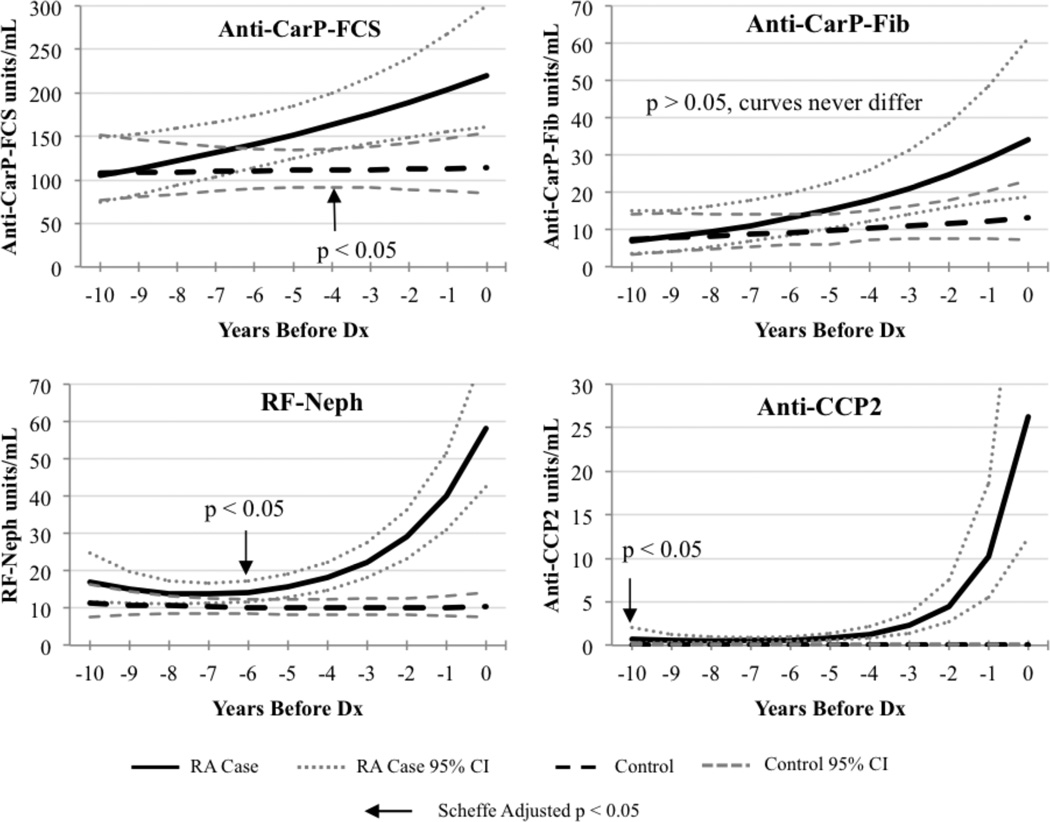
Anti-CarP-FCS was 26% sensitive and 95% specific for future RA, whereas anti-CarP-Fib was 16% sensitive and 95% specific for future RA. Anti-CarP-FCS positivity was associated with future RA, while anti-CarP-Fib trended toward association. The antibody combination of anti-CCP2 and/or ≥ 2 RF (RF-Neph and/or RF-isotypes) resulted in an AUC of 0.72 for future RA, where the AUC was 0.71 with the addition of anti-CarP-FCS to this prior combination.
Adding anti-CarP-FCS to antibody combinations did not improve AUC. However, anti-CarP-FCS was associated with future onset of RA, and was present in prediagnosis serum in ∼10% of RA cases negative for anti-CCP2 but positive for RF.
抗氨甲酰化蛋白(anti-CarP)抗体可进一步阐明早期类风湿关节炎(RA)的发病机制并预测临床疾病。我们比较了军事人员中抗CarP抗体对未来RA的诊断准确性与其他RA相关抗体。
对76例RA病例的RA诊断前储存血清样本进行抗CarP胎牛血清(FCS)、抗CarP纤维蛋白原(Fib)、抗环瓜氨酸肽抗体2型(anti-CCP2)、类风湿因子比浊法(RF-Neph)以及RF同种型[免疫球蛋白M(IgM)、IgG和IgA]检测。所有抗体的阳性判定为≥对照组对数转换均值的2个标准差。使用敏感性、特异性和逻辑回归评估所有RA病例诊断前血清中自身抗体与未来RA之间的关系。使用曲线下面积(AUC)比较评估抗体组合之间诊断准确性的差异。
抗CarP-FCS对未来RA的敏感性为26%,特异性为95%,而抗CarP-Fib对未来RA的敏感性为16%,特异性为95%。抗CarP-FCS阳性与未来RA相关,而抗CarP-Fib有相关趋势。抗CCP2和/或≥2种RF(RF-Neph和/或RF同种型)的抗体组合对未来RA的AUC为0.72,在此先前组合中加入抗CarP-FCS后AUC为0.71。
在抗体组合中加入抗CarP-FCS并未提高AUC。然而,抗CarP-FCS与未来RA发病相关,且在约10%抗CCP2阴性但RF阳性的RA病例诊断前血清中存在。