Korea Institute of Ceramic Engineering and Technology, Seoul 153-801, South Korea.
Nanoscale Res Lett. 2014 Dec 10;9(1):664. doi: 10.1186/1556-276X-9-664. eCollection 2014.
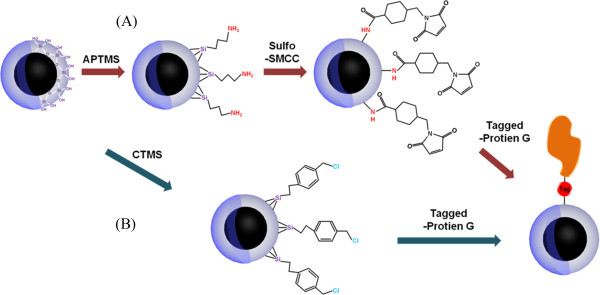
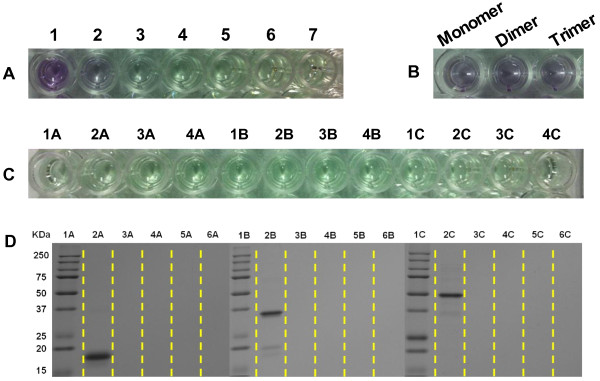
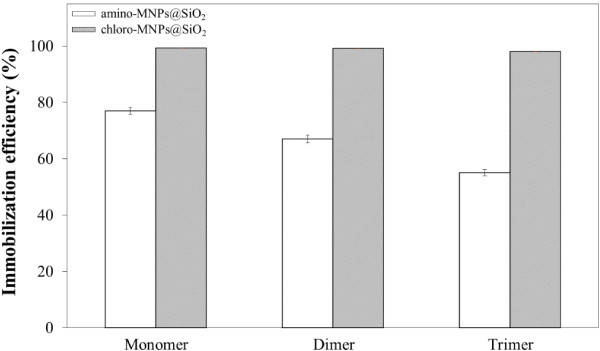
This work reports the high-efficient and one-step immobilization of multimeric protein G on magnetic nanoparticles. The histidine-tagged (His-tag) recombinant multimeric protein G was overexpressed in Escherichia coli BL21 by the repeated linking of protein G monomers with a flexible linker. High-efficient immobilization on magnetic nanoparticles was demonstrated by two different preparation methods through the amino-silane and chloro-silane functionalization on silica-coated magnetic nanoparticles. Three kinds of multimeric protein G such as His-tag monomer, dimer, and trimer were tested for immobilization efficiency. For these tests, bicinchoninic acid (BCA) assay was employed to determine the amount of immobilized His-tag multimeric protein G. The result showed that the immobilization efficiency of the His-tag multimeric protein G of the monomer, dimer, and trimer was increased with the use of chloro-silane-functionalized magnetic nanoparticles in the range of 98% to 99%, rather than the use of amino-silane-functionalized magnetic nanoparticles in the range of 55% to 77%, respectively.
这项工作报道了将多聚体蛋白 G 高效且一步固定在磁性纳米粒子上的方法。通过将蛋白 G 单体与柔性接头重复连接,在大肠杆菌 BL21 中过表达了带有组氨酸标签(His-tag)的重组多聚体蛋白 G。通过氨基硅烷和氯硅烷在二氧化硅包覆的磁性纳米粒子上的功能化,两种不同的制备方法证明了其在磁性纳米粒子上的高效固定化。对单体、二聚体和三聚体三种不同的多聚体蛋白 G 进行了固定化效率的测试。对于这些测试,采用二喹啉甲酸(BCA)法来确定固定化的 His-tag 多聚体蛋白 G 的量。结果表明,在使用氯硅烷功能化的磁性纳米粒子时,单体、二聚体和三聚体的 His-tag 多聚体蛋白 G 的固定化效率分别在 98%至 99%的范围内增加,而在使用氨基硅烷功能化的磁性纳米粒子时,固定化效率分别在 55%至 77%的范围内增加。