Mahajan Shivani, Bachtrog Doris
Department of Integrative Biology, University of California Berkeley.
Department of Integrative Biology, University of California Berkeley
Genome Biol Evol. 2015 Jan 18;7(2):591-600. doi: 10.1093/gbe/evv008.
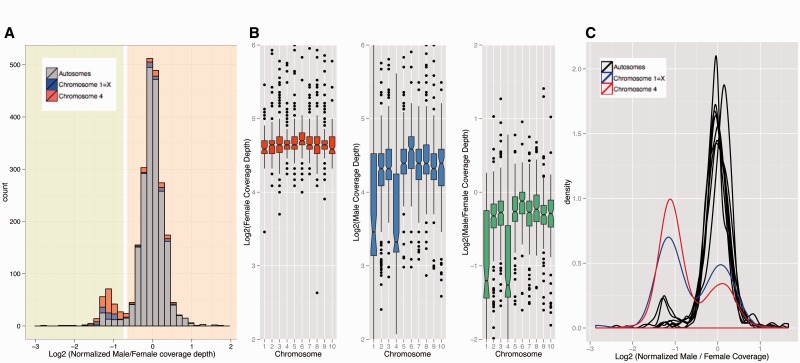
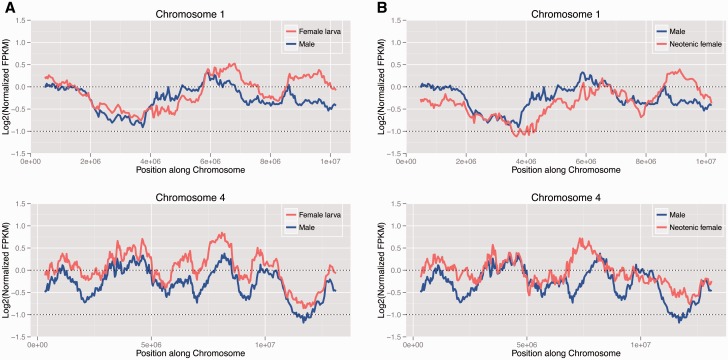
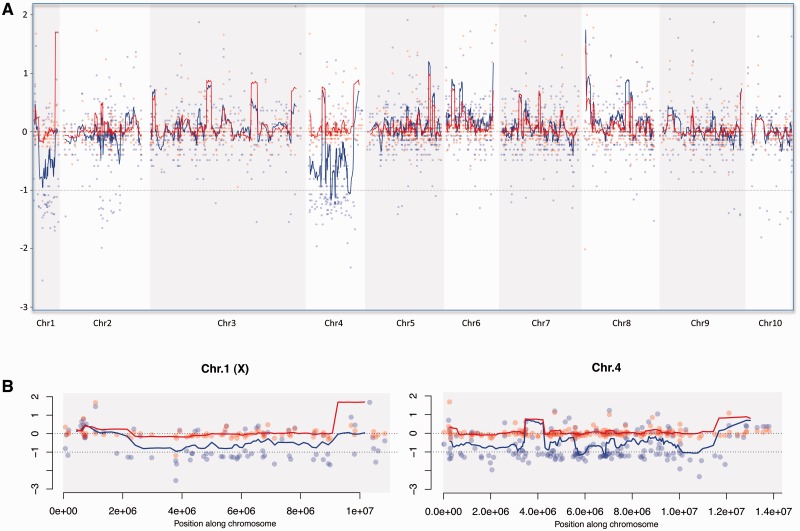
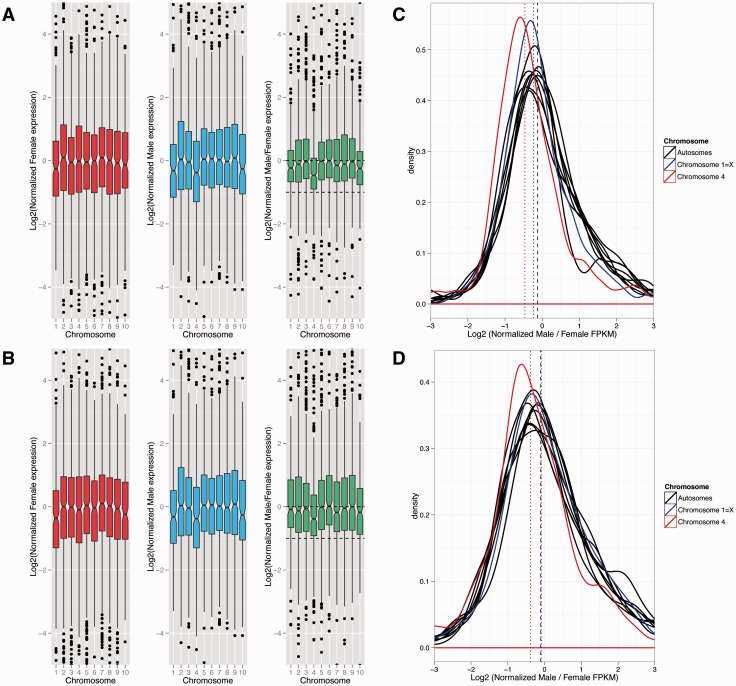
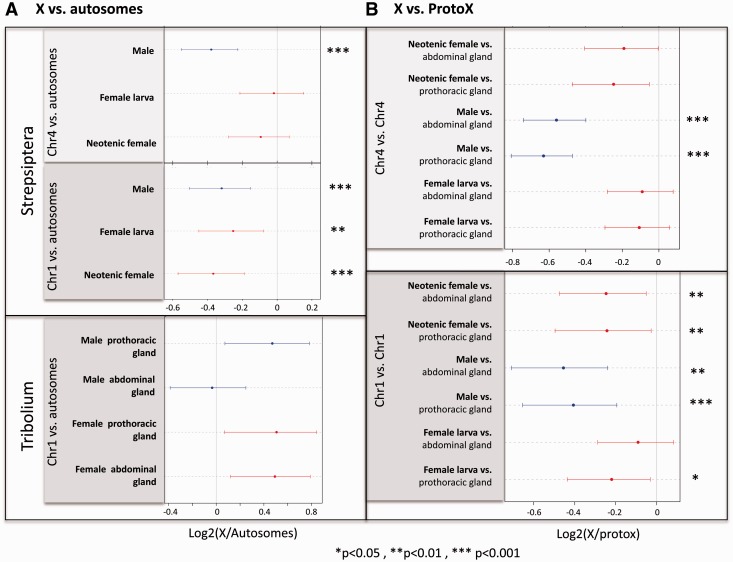
Sex chromosomes have evolved independently in many different taxa, and so have mechanisms to compensate for expression differences on sex chromosomes in males and females. Different clades have evolved vastly different ways to achieve dosage compensation, including hypertranscription of the single X in male Drosophila, downregulation of both X's in XX Caenorhabditis, or inactivation of one X in female mammals. In the flour beetle Tribolium, the X appears hyperexpressed in both sexes, which might represent the first of two steps to evolve dosage compensation along the paths mammals may have taken (i.e., upregulation of X in both sexes, followed by inactivation of one X in females). Here we test for dosage compensation in Strepsiptera, a sister taxon to beetles. We identify sex-linked chromosomes in Xenos vesparum based on genomic analysis of males and females, and show that its sex chromosome consists of two chromosomal arms in Tribolium: The X chromosome that is shared between Tribolium and Strepsiptera, and another chromosome that is autosomal in Tribolium and another distantly related Strepsiptera species, but sex-linked in X. vesparum. We use RNA-seq (RNA sequencing) to show that dosage compensation along the X of X. vesparum is partial and heterogeneous. In particular, genes that are X-linked in both beetles and Strepsiptera appear fully dosage compensated probably through downregulation in both sexes, whereas genes on the more recently added X segment have evolved only partial dosage compensation. In addition, reanalysis of published RNA-seq data suggests that Tribolium has evolved dosage compensation, without hypertranscribing the X in females. Our results demonstrate that patterns of dosage compensation are highly variable across sex-determination systems and even within species.
性染色体在许多不同的分类群中独立进化,用于补偿雄性和雌性性染色体上表达差异的机制也是如此。不同的进化枝已经进化出了截然不同的实现剂量补偿的方式,包括雄性果蝇中单个X染色体的超转录、秀丽隐杆线虫中两条X染色体的下调,或雌性哺乳动物中一条X染色体的失活。在面粉甲虫赤拟谷盗中,X染色体在两性中似乎都过度表达,这可能代表了沿着哺乳动物可能走过的路径进化剂量补偿的两个步骤中的第一步(即两性中X染色体的上调,随后是雌性中一条X染色体的失活)。在这里,我们测试捻翅目昆虫(甲虫的姐妹分类群)中的剂量补偿情况。我们通过对雄性和雌性黄足 Xenops vesparum 的基因组分析确定了其性连锁染色体,并表明其性染色体由赤拟谷盗中的两条染色体臂组成:一条是赤拟谷盗和捻翅目昆虫共有的X染色体,另一条染色体在赤拟谷盗和另一种亲缘关系较远的捻翅目昆虫中是常染色体,但在黄足 Xenops vesparum 中是性连锁的。我们使用RNA测序(RNA-seq)表明,黄足 Xenops vesparum X染色体上的剂量补偿是部分的且不均匀的。特别是,在甲虫和捻翅目昆虫中都是X连锁的基因似乎通过两性下调实现了完全剂量补偿,而在最近添加的X片段上的基因只进化出了部分剂量补偿。此外,对已发表的RNA-seq数据的重新分析表明,赤拟谷盗已经进化出了剂量补偿,而雌性中X染色体并没有超转录。我们的结果表明,剂量补偿模式在性别决定系统之间甚至在物种内部都高度可变。